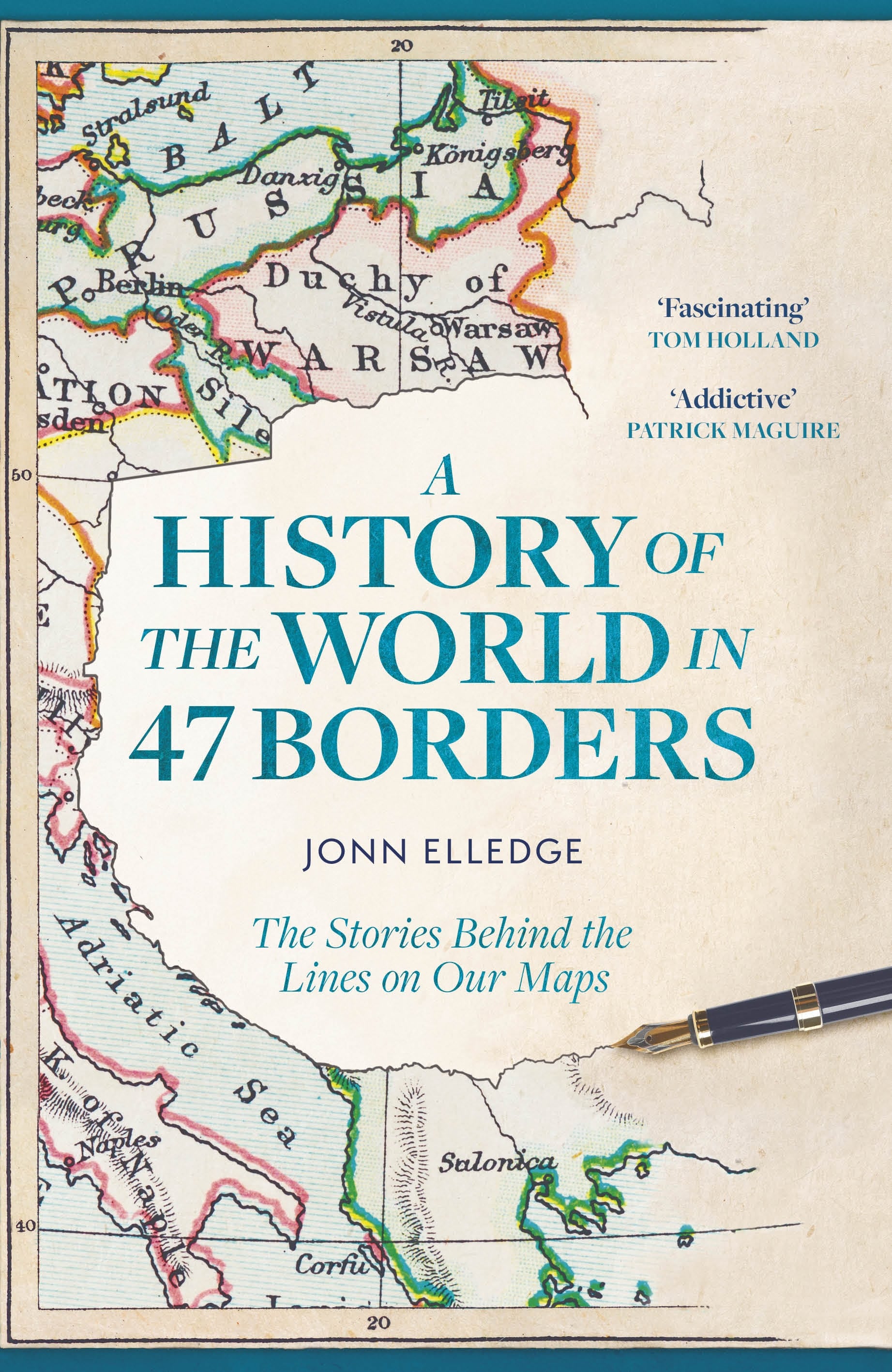
In A History of the World in 47 Borders, Jonn Elledge takes an ostensibly dry subject – how maps and boundaries have shaped our world – and makes from it a diverting and informative read. It is light and conversational in tone, covering topics that range from the clearly important to the niche, showing Elledge’s eye for an entertaining story and an ability to pick up political hot potatoes without burning his fingers.
The 47 chapters are each about five pages long (none outstay their welcome) divided into three tranches: “Histories” (how the map of the world changed over time from the earliest records), “Legacies” (unusual and esoteric border issues of today, as bequeathed by previous generations) and “Externalities” (broadening things out to look at issues like the International Date Line, why the Prime Meridian is where it is, who owns Antarctica.) Why 47? I don’t know, apart from the fact of avoiding a round number is of a piece with its quirky outlook. I wouldn’t have complained about there being a few less, but there are no particularly obvious stories to be cut (although the editor could have been a bit tougher on the matter of footnotes, where Elledge is a bit self-indulgent.)
 The opening section has some tricky stretches: Elledge’s accounts of the development of medieval China, the Mongol empire, or the ebbs and flows of the Holy Roman Empire are fluent and not unclear, but the stories are so inescapably complex that it is a struggle to follow them. I took away things I didn’t know, or hadn’t previously thought about: why Europe is essentially a made-up continent, what “margraves” originally were and why they mattered, and how improved map-making technology of the 17th century made possible the colonial carving up of other lands by the stroke of a pen in a European capital. Above all, I was made aware of how much of the history of my own nation I don’t really know about (often things that don’t reflect well on our forefathers) let alone that of other parts of the world. In this way the book is a nudge to go out and read more widely: many of the chapters feel like they deserve their own book.
The middle section is the most entertaining: vignettes of odd or even silly situations that persist in the modern world for really no good reason. The village that is half in the Netherlands and half in Belgium, the bit of desert that neither Sudan nor Egypt want to claim (as it would prejudice other claims elsewhere), or the reason Washington DC is the peculiar square-with-a-bite-taken-out shape that it is. Elledge looks at some wider questions of what borders are, and how “given a distant enough perspective by time or geography, almost any boundary can become baffling to the point of meaninglessness.” What started out, in deep history, as attempts to mark the very edges of where a tribal leader’s writ ran, have become flashpoints – Kashmir, the Korean DMZ – that could, even today, set off a military conflict.
But the moments of seriousness are diluted by the jovial tone of most of the book and Elledge’s almost puppyish enthusiasm for his subject matter. His delight in sharing the things he has discovered shines through; it is like spending an evening in the pub with an entertaining pal. Elledge treads carefully when tackling sensitive issues such as Israel and Palestine (“I’m going to confess something at this point: I’ve been dreading this bit.”) or the partition of India, where he is scornful of Mountbatten’s failings, but clearly more comfortable when discussing things like the “ghost stations” of the divided Berlin’s U-Bahn. Borders, he concludes, are a necessary evil. “The division between people like us and people like them, have been with us for the entirety of human history.” And that’s not likely to change.
- A History of the World in 47 Borders by Jonn Elledge (Wildfire, £25)
- More book reviews on theartsdesk