Nathalie Léger’s The White Dress brings personal and public tragedy together in a narrative as absorbingly melancholic as its subject is shocking. The story described by Léger’s narrator – a scarcely fictional version of herself – is of the performance artist Pippa Bacca who, in 2008, set out on a symbolic journey from Milan to Jerusalem clad in a white wedding dress, hitchhiking her way through cities and countryside. Bacca was never to reach her destination. The narrator’s research of this woman’s failed journey runs alongside and increasingly intertwines with her own story, that of her tortured relationship with her mother, never recovered from a cold husband’s abandonment. Natasha Lehrer’s translation skilfully captures the fiendishly digressive style of Léger, whose sentences in their lyricism and volume often seek to dispense with the inhibitive punctuation of full-stops.
Readers of the previous two novels by Léger – Exposition and Suite for Barbara Loden – in what is now considered a trilogy completed by The White Dress, will be familiar with her introspective style. This trio of texts in which plot takes a back seat does to a certain extent revisit the same themes. However, The White Dress shows Léger doing something new. Her melodious intertwining of another’s story with her own recalls her other works, but this is an altogether darker, altogether more unashamedly melancholic exploration of narrative. Where Exposition constantly teeters on the verge between biography and autobiography, the narrator of The White Dress is no longer so tentative. For Léger’s message seems to be that to immerse oneself in other people’s stories, whether out of pity or simple escapism, is only to find a projection of one’s own life. Everything, for this author, is inherently autobiographical.
 To reach such a conclusion might lead one naturally to consider that life is endlessly repetitive. If the other is a projection of the self; if, as the narrator writes when describing a range of acts by different performance artists, ‘it seems to me that it was me doing it’, then the implication is that all our thoughts, our actions, are only ever repetitions of others’ thoughts, actions. The White Dress shows us, however, that this is no bad thing. Léger brings out the fascination of memory, of identity, of melancholy, and shows that if life is endlessly repetitive then it is by nature endlessly literary. After all, as her narrator writes toward the end of the novel, ‘we are made of paper’.
That is not to say that this is simply a book about books, a Flaubertian mockery of originality. Amongst all the self-reflexivity is a series of important, even political tensions. This is a story about family, for instance: how a relationship between mother and daughter can, through no fault of either party, border on the toxic. It is a story about femininity: a female narrator, describing the life of a female performance artist and unable to escape the life of her own female progenitor. It is undoubtedly a story about the sinister, damaging masculinity of certain men. No tensions are truly solved – in fact, the abiding frustration of the narrator is that ‘I still don’t understand’ – but throughout the narrative there is a sense that significance can still be gleaned even through a lack of comprehension. If it is a novel of failure, it is a novel showing that failure is just as worthy of representation as success.
Finally, though, The White Dress is a novel of fundamental human experience. The vagaries of the mind are ever present on the page; the reader witnesses the very enactment of consciousness. Indeed, if there are weak points in this book, these are when the narrator feels obliged to proffer biography, to recount facts about Pippa Bacca’s heritage, for instance. Léger is at her strongest in showing that really the biographical does not exist, that consciousness can never truly separate the self and the other. The ultimate question is perhaps whether this is a novel at all. What is a novel, though, if not a study of its writer?
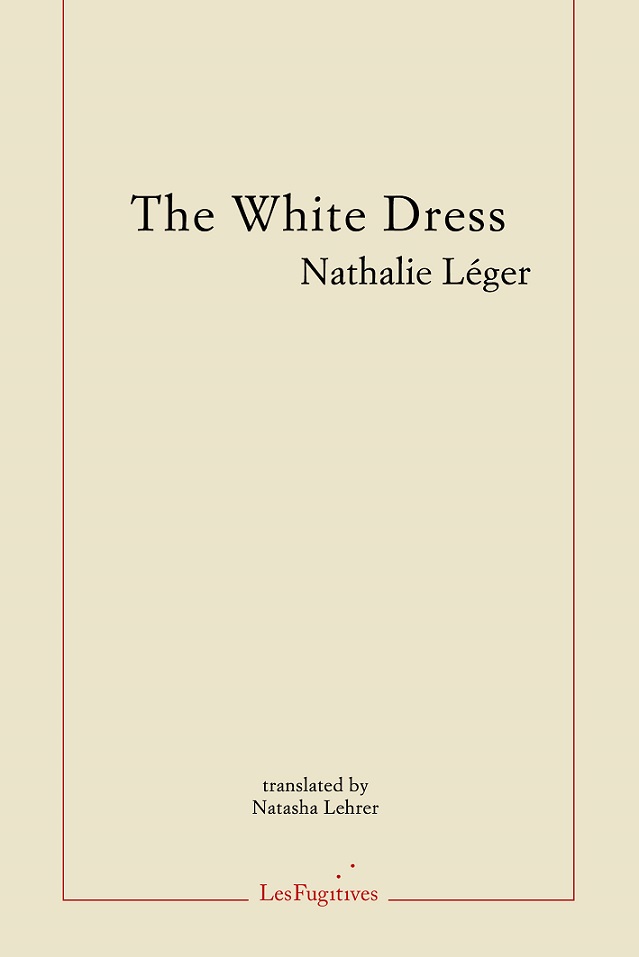
- The White Dress by Nathalie Léger trans. Natasha Lehrer (Les Fugitives, £12)
- Read more book reviews on theartsdesk