

Amid madness, fear and death, there is still an oasis in the music of Bach - and Bach played by András Schiff in the Wigmore Hall is a special type of haven. Normally one can’t get in to those concerts because they are instantly sold out, even though he usually does each one twice. Instead, this performance was beamed live into our own computers wherever we may be, and after the past few days, my goodness, we needed it.
Playing into the empty cavern of the Wigmore’s auditorium - the hall that is usually his home from home - Schiff spoke to his invisible audience through the cameras, providing a guide to the pieces and a few quips besides. He chose an hour and half of Bach’s most pan-European pieces from the Clavierübung, including the Italian Concerto and the French Overture.
Schiff has always excelled in gargantuan programmes and series; he appears to have the mental constitution of a marathon runner plus a memory worthy of an elephant. Sitting low at the keyboard, he lets the music fly up from the piano, as if setting it free.
Bach on the piano? “I am playing the wrong instrument,” he commented. “I apologise…” This wry semi-smile is a bit like his playing: concise, clear, cool and somewhat anti-gravitational. “Don’t hit the piano,” he advises. “It hits back.” His personal sound is one of the most striking things about his pianism: there is a special singing clarity to the tone and airiness to the contrapuntal textures that is wholly individual (the closest other, to my ear, being Bartók himself in his too-rare piano recordings). You can hear every strand, every voice, every direction, without even realising it, because it simply flows as if it’s the easiest thing in the world. 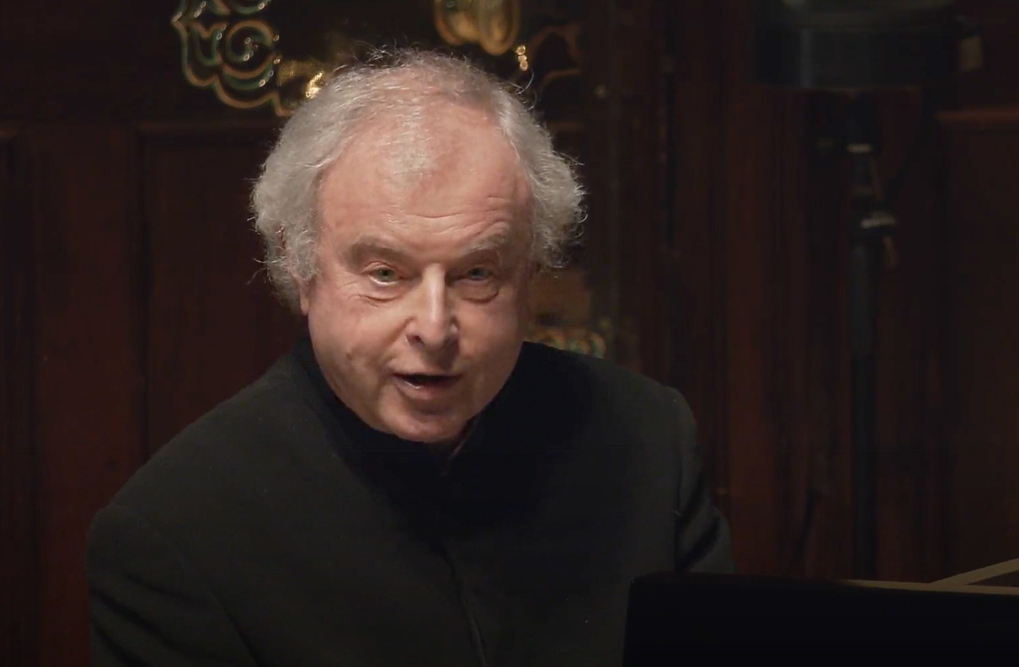 The Capriccio on the Departure of his Most Beloved Brother is Bach’s one piece of instrumental “programme music”, a charming early work in which the post horn sounds out as the teenage Johann Sebastian sees his big brother off onto a long journey by coach, and Schiff let the story unfold with innocent grace and gently hinted wit. The Chromatic Fantasy and Fugue achieved the ideal balance of articulation, brilliance and structural cohesion; the Sinfonias, chosen for their charm and originality, emerged poised and tender.
The effect of a two-manual harpsichord was not mimicked but, if anything, bettered by the subtle adjustment of tone and sound levels in Schiff’s touch, while each different voice in the texture seemed to sing with a quality of its own, while creating the illusion of being entirely natural. The Andante of the Italian Concerto was a case in point, an orchestra in two hands; or try the subtle shadings of atmosphere in the French Overture, a dusky sotto-voce for the Courante, or the shifts of “register” evoked in the closing “Echo”. Finally, as encore, the Aria from the Goldberg Variations, perhaps still the piece most associated with Schiff, left us hoping for better times with a foundation as solid as that of its ever-resilient bass line.
Please, please make a donation upon watching this streaming. Wigmore Hall concerts do not grow on trees.











