

Once upon a time, Gyorgy Ligeti heard a rehearsal performance of a piece of music he wrote soon after graduating from the Franz Liszt Academy of Music in Budapest. Just once. Then it was banned by the Hungarian apparatchiks responsible for the arts and he had to wait another 20 years to hear it played in public. It was the Concert Romanesc (Romanian Concerto), written in 1951 and drawing from his memories of, and research into, the folk music of the Romanian Transylvania of his boyhood.
It’s a jolly piece altogether, capturing the attractiveness of dances and village bands and incorporating interesting instrumental combinations, like the opening bars from cellos and clarinets. He uses intermittent solos from fiddle and horn, clarinet and cor anglais, and he brings in haunting, slightly off-key-sounding harmonies, nostalgically reflecting boyhood memories.
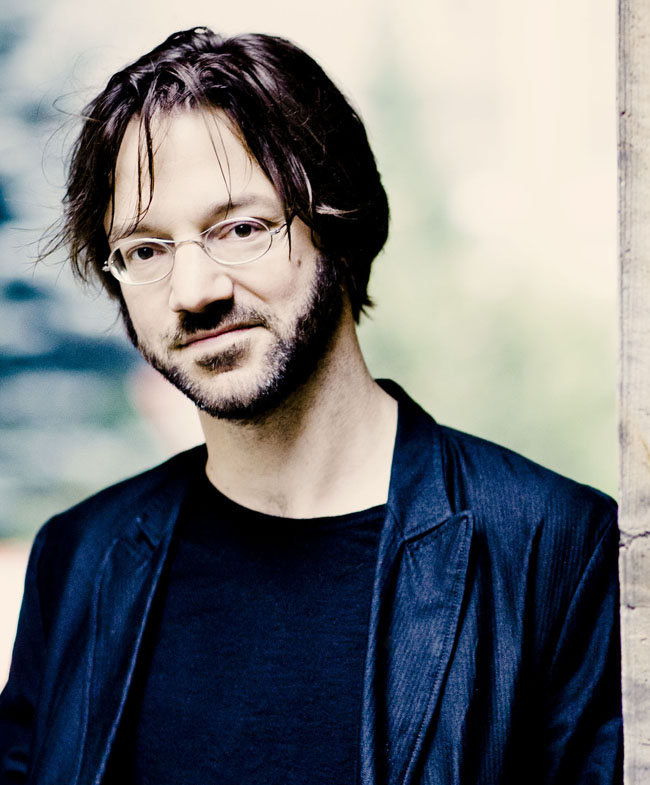 It was an inspired choice by conductor André de Ridder (pictured right) as curtain-raiser to the big guns of Beethoven and Brahms, intelligently linking to the latter’s interest in Hungarian music. Paired for the first time with the Israeli pianist Saleem Abboud Ashkar, de Ridder essayed Beethoven’s Third Piano Concerto.
Ashkar, protégé of Mehta and Barenboim, gave an interpretation that had much to commend it. His playing from the start had crispness and clarity, and I found his cadenza spellbinding, with a plangent tone and flowing glissandi. Ashkar has remarkable dexterity and attention to detail.
As a first outing, the Ashkar/ de Ridder combination didn’t quite hit the heights, but showed enough to indicate that, given more time together, they could make a real impact. The orchestral playing began and ended strongly, bringing out the melancholic and nostalgic, especially in the Largo, before reaching the Rondo Allegro and its exuberant climax. Yet somehow, there was an unevenness overall.
However, de Ridder really came into his own in Brahms’s swansong symphony, the Fourth. He is an unfussy conductor, measured yet expressive, and showed a real grasp and feel for the scale of the work across the four movements. The orchestra responded splendidly, with notable solo contributions, especially from the horns.
The way in which he managed the changes of emphasis in the final movement, with its Bach-inspired variations in the form of a passacaglia with its Baroque structure, showed real mastery.
He is an interesting and innovative young conductor and no newcomer to the Halle, where he spent a year in 2005-6 as Assistant Conductor to Sir Mark Elder. I last saw him a couple of years ago at the Manchester International Festival, when he conducted and orchestrated Damon Albarn’s controversial music theatre piece Monkey: Journey to the West. The versatile de Ridder is one to watch.











