What Manchester has today, Vienna will have tomorrow. The BBC Phil’s composer/conductor HK “Nali” Gruber is taking his musicians and singers back home to the Wiener Konzerthaus to reprise this concert next week. You can’t fault it for variety – Stravinsky, Britten and MacMillan, Gruber’s predecessor as composer/conductor here. But the main thrust is celebrating Stravinsky. It is the centenary of The Rite of Spring. In the BBC Phil’s series of celebratory concerts, we here came to his opera-oratorio Oedipus Rex, also premiered in Paris, in 1927. It hasn’t been heard in Manchester for nearly 20 years (and nearly 30 years before that), when it was performed by the Hallé.
Since Latin is, we understand, undergoing something of a revival for a “dead” language, the performance of the oratorio in that tongue, translated from Jean Cocteau’s original French libretto, seems all the more pertinent. There was a narrator telling the tale in English between scenes. As Gruber put it, this is “imaginary theatre in your head”. There were no stage effects. Stravinsky had asked that the soloists wore masks and be illuminated individually as they sang, and that there were no entrances and exits. Gruber didn’t get involved in any of that. The soloists, apart from Oedipus, trooped on and off unceremoniously, as required.
 In many ways the work is dated, but has lost none of its power - and, it could be argued, has contemporary relevance with regime change in vogue and one-time heroes exposed as murderous villains. Here we’re concerned with the King of Thebes, who solves the riddle of the Sphinx and is called upon to save the city from the plague, but discovers that he has unwittingly killed his father and married his mother. Yet, even at the end, having picked out his eyes with a golden pin, he is given a fond farewell, with repeated trumpet fanfares, by the citizens. “Vale Oedipus, te amabam, te miseror [Farewell, Oedipus, I love you, I pity you]," sings the Chorus, a splendid body of 56 men drawn from the Hallé and the London Symphony Chorus.
Gruber brought out the power of the piece from the start. So much so that the orchestra drowned out the chorus initially and most of King Creon’s fearful report from Delphi in Act One. But the tragedy built beautifully. In the title role, Ian Bostridge sang with clarity, brightness and dramatic effect. However, the arrival of his wife/mother Jocasta in Act Two, in the form of the Austrian mezzo Angelika Kirchschlager (pictured above by Nikolaus Karlinsky) in a sparkling gold gown, raised the stakes. She brought heightened drama with her singing, body language and stage presence. And her aria denouncing the oracles – “They always lie” – has the musical advantage of Stravinsky’s magical ornamentation.
Gruber began with James MacMillan’s concert suite made up of the three interludes which link the scenes of his Welsh tribal warfare opera The Sacrifice, written in 2005-6. Based on one of the Mabinogion, it concerns a tragic love story that ends in murder. So, to some extent, if fits the mood of the Oedipus piece. Lasting 15 minutes, the score has vivid filmic qualities, starting with insistent and threatening percussion and working its way to a shattering climax, befitting a murderous action.
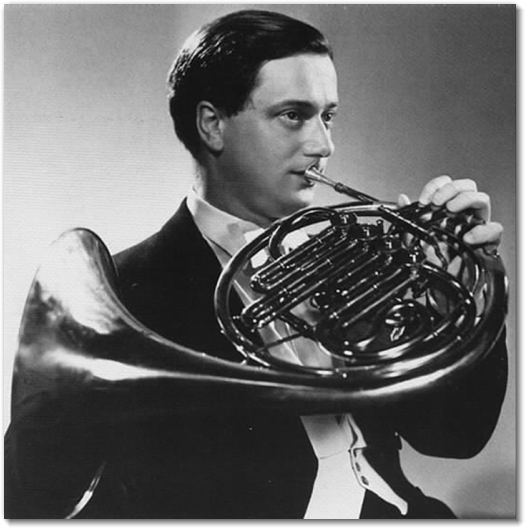 Then came Britten’s Serenade for tenor, horn and strings, Op.31, reflecting another centenary. Originally a set of nocturnes, it was premiered at the Wigmore Hall in 1943, featuring Peter Pears and Dennis Brain (pictured left). On this occasion, we heard Timothy Robinson and Richard Watkins. Britten uses his soloists in isolation and in tandem to good effect. He works his music effectively around six poems, making particular demands on the tenor. Robinson met the challenges of the high voice range, notably in the funereal Dirge impressively.
From the solo horn Prologue to the off-stage Epilogue, Watkins played with stunning effect. And they combined beautifully in Ben Jonson’s hunting-theme Hymn. But the highlight was the final "Sonnet to Sleep" by Keats, with shimmering strings ushering the soloist to lasting peace.