

I’ve been missing the sound of applause. That realisation dawned on me on the couple of occasions when it broke out spontaneously in last night’s Prom. There was no audience at Hoddinott Hall in Cardiff Bay, so these particular bouts of hand-clapping were coming from the orchestral musicians of the BBC National Orchestra of Wales. And it definitely wasn’t that slightly precious, tapping-on-the-music-stands thing (where did that ever come from?) It was sincere, real, loud and strong – and truly touching.
One occasion that it happened was when the musicians showed their appreciation for composer Gavin Higgins. His new piece Rough Voices was placed as the centrepiece of the Prom programme, and through its sheer quality it had definitely earned that prominent exposure. It was commissioned to be "relevant", to be a response to the pandemic and, yes, there is strong messaging in it: Higgins has stated that he wants Rough Voices to be “a rallying call for the underclasses”. That may be, but the result is that his craft and his passion have combined here and produced a very persuasive piece. It starts by alternating suspended, even eerie tranquillity with fierce anger, and then moves into a long intensity build. As the mood becomes more urgent, as the precise yet forceful percussion became more dominant, it carries you with it and holds the attention, before the final return to contemplation.
The new principal conductor of BBCNOW, 31 year old Los Angeles-born Ryan Bancroft shaped the eight-minute piece well and appeared to be completely in sync with its idiom. After one hearing, I definitely want to go back and hear it again, and hope and expect that in the fullness of time it will get a lot more performances. Gavin Higgins has just been appointed Composer in Association with the orchestra. Random thought: time will tell if he can match the record of Glamorgan batsman Steve James, also from the Forest of Dean, who was made welcome in Cardiff for 17 seasons, let’s hope so. 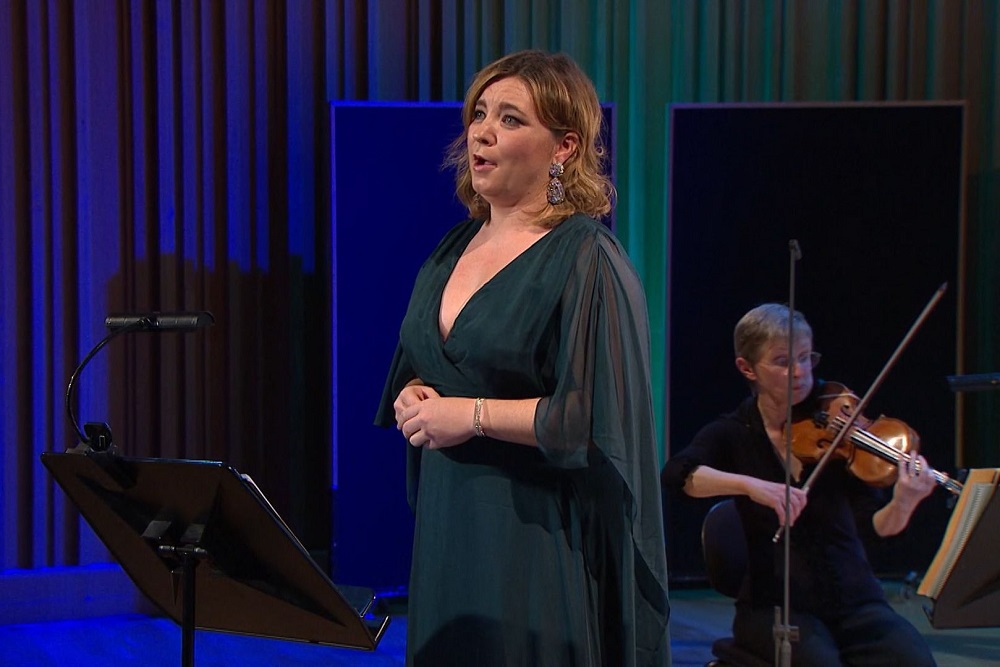 There was another bout of well-earned orchestral applause for soprano Natalya Romaniw (pictured above), soloist in Samuel Barber’s Knoxville: Summer of 1915. This was the chamber version, receiving its first performance at the Proms. Romaniw appeared tentative at the start, took time to settle, but seemed to turn a corner with the words “They are not talking much, and the talk is quiet, of nothing in particular, of nothing at all,” where she found the wistful simplicity and lightness of voice that the piece needs, particularly with the slimmed-down orchestral forces. Bancroft paced it well, and harpist Valerie Aldrich-Smith created something very special with the return of the lilting triple time that ushers in the closing section.
Another highlight was the 13-instrument original version of Copland’s suite from Appalachian Spring. It is indeed “sparse and transparent,” as Ryan Bancroft described it in his opening remarks. The lightness of the orchestration (just nine strings, three winds and a piano) requires every player to keep the long phrases very much alive, and the conductor to pace it. The piano part requires subtlety to create balance - Catherine Roe Williams was highly effective, and flautist Matthew Featherstone brought a beautiful evenness to the close of the piece.  The programme was determined by distancing requirements that put a maximum number on the players able to perform, and also included a cautious reading of Bohuslav Martinů’s Jazz Suite and a fleet and idiomatic performance of John Adams’ Chamber Symphony.
The concert was well presented. Whereas some of the television presenters and guests at the Royal Albert Hall have gushed to cringe-making excess, Radio 3’s seasoned Welsh anchorwoman Nicola Heywood Thomas (pictured above) brought poise and professionalism to her task of introducing the concert, described in the press release as "the first Prom from Wales."
Socially distanced "hwyl" with no audience... it's such a strange experience...it's going to take some getting used to.











