

Sunday night’s Prom by the London Symphony Orchestra was Simon Rattle’s 75th and surely his strangest. But, in his best style, it was eclectically programmed, balancing novelty with tradition, responded imaginatively to the restrictions in place, and was very well played in the circumstances. These circumstances allowed for more inventive programming than would normally be entertained, but the biggest irony was that the spatial effects that would have sounded so amazing in the hall were only possible because the hall was empty.
The required distancing between players became the basis of the programming, from Gabrieli brass ensemble music with the players scattered around the RAH’s boxes, to György Kurtág’s …quasi una fantasia… that, although written in 1988, has social distancing built into it. Only at the end, for Vaughan Williams’s Fifth Symphony, did all the players come together in relatively conventional formation, for what was the highlight of the evening. The physical separation of the players even in this piece clearly made ensemble playing more difficult – especially with perspex barriers also in place – but for the most part the ensemble was very good.
Watching BBC Four’s coverage was enjoyable for lots of reasons – the camera-work was resourceful, the editing less twitchy and fussy than usual – but of course the spatial effects don’t really come over aurally. The segueing between pieces made a virtue of the lack of audience applause, and the cameras had freer rein to move around without worrying about disturbing – or knocking over – Prommers. 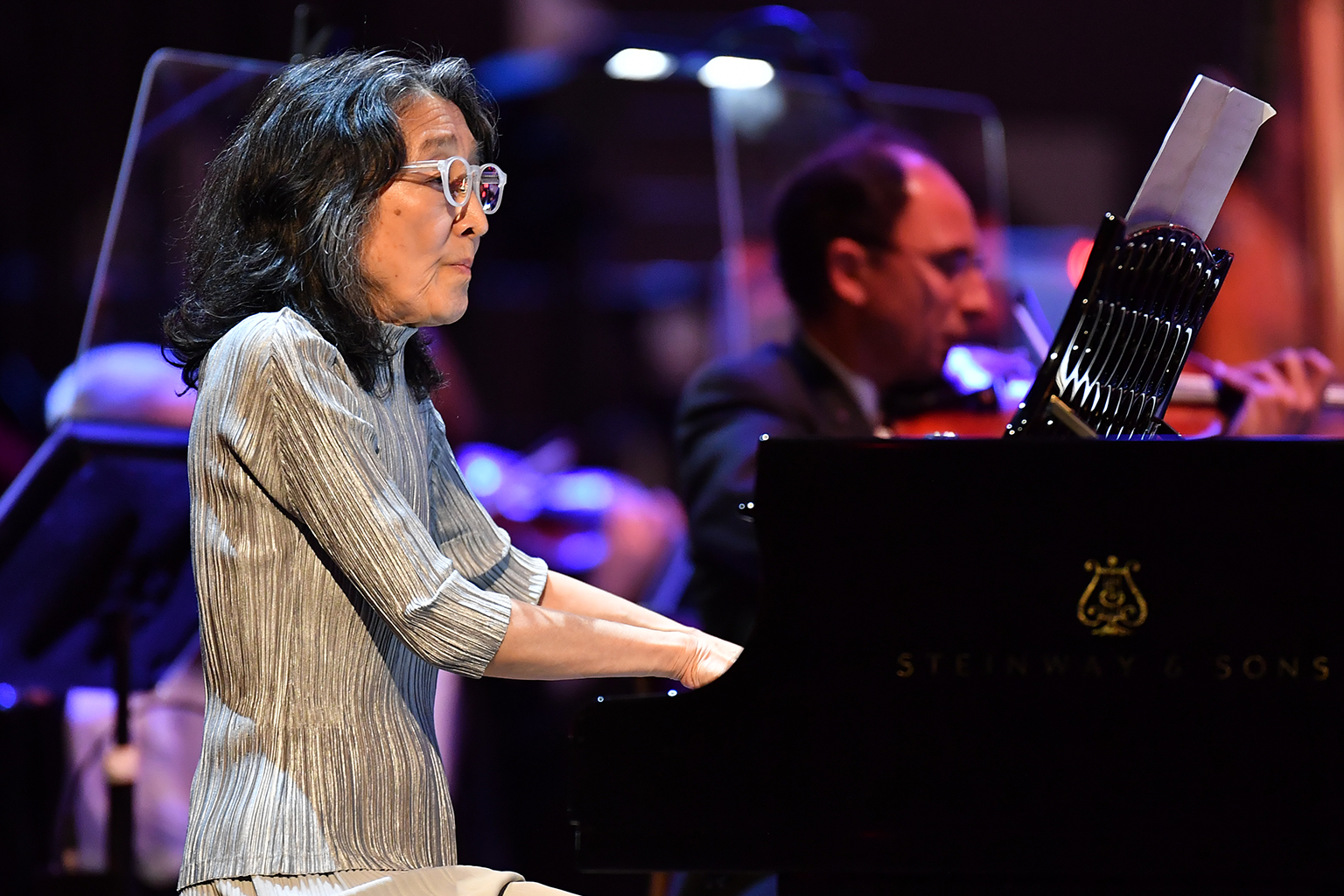 This was most noticeable in Mitsuko Uchida’s performance of the first movement of Beethoven’s “Moonlight” Sonata (the pianist pictured above), which she played intimately and with customary care. This was relayed via a long tracking shot, gradually closing in on the pianist, then flying above her to look down on the keyboard, and then zooming out to a long shot, following the shape of the music. It was beautiful television.
The Kurtág that followed was a terrific juxtaposition, starting with the piano alone before the strange line-up of percussion entered. Sadly the strangeness of the percussive effects were flattened out by TV, the fragility of the sound lost in the warmth and compression of the broadcast sound.
After more crisp Gabrieli we had a world premiere, Thomas Adès’s Dawn, an obvious choice of composer for his long-time champion, Rattle. The piece is a chaconne, built over a repeating phrase, which was only one clue to the fact the piece was written in a hurry (presumably during lockdown).
Featuring Uchida as orchestral pianist, the music started with smudgy arpeggios (perhaps a reference to the Beethoven sonata?) on harp, cimbalom, gongs and vibraphone that persisted through the whole piece. There were solos thrown over the top and the almost entirely diatonic music built to a gleaming C major ending. Pleasingly scored – the timbres coming over better than in the Kurtág – it was compositionally underbaked. Acclaiming it an “instant classic” as Suzy Klein did was, apart from being an example of some broadcasters’ need to tell us how to react, clearly an overstatement that would surely embarrass rather than delight the composer (pictured below).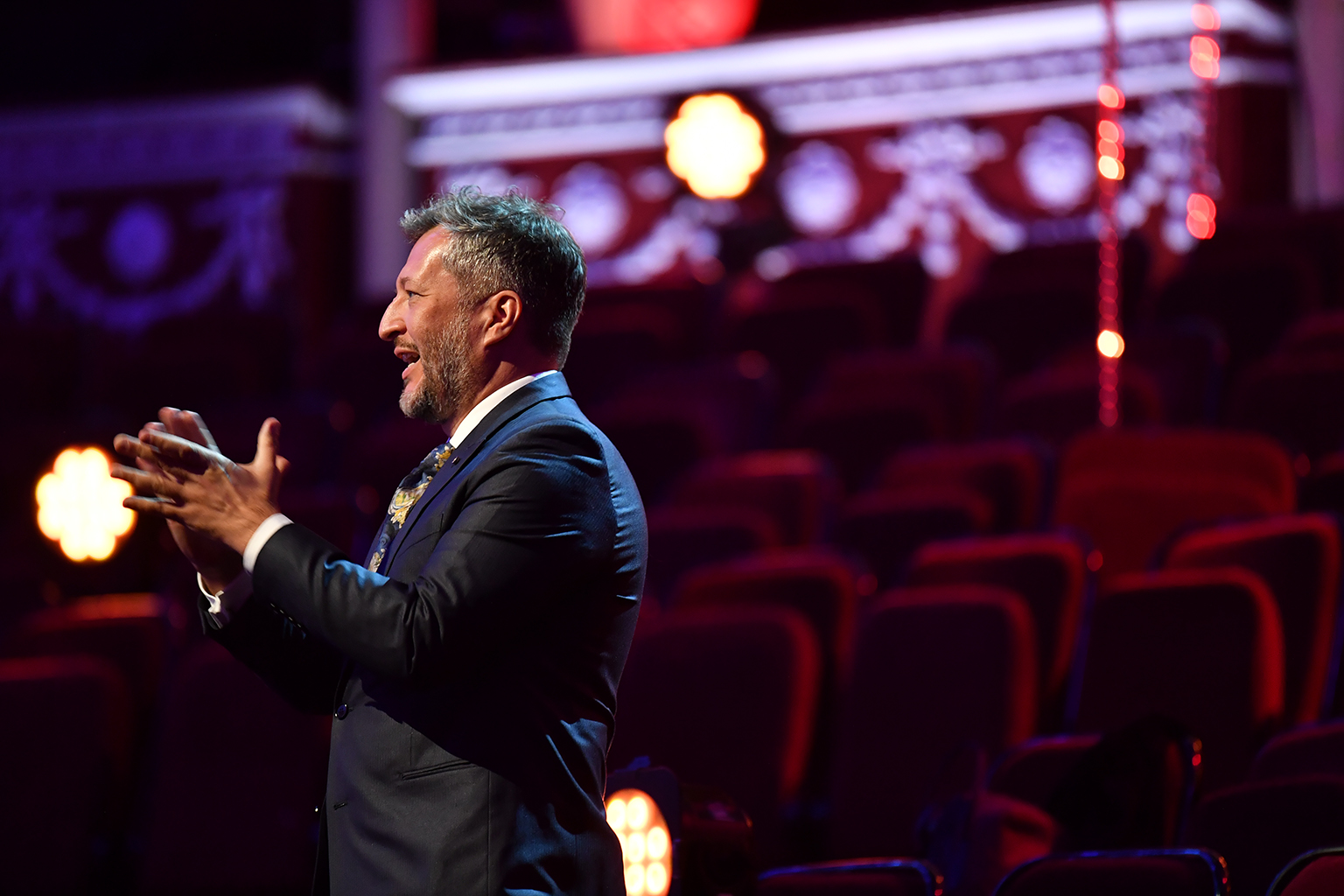 The Vaughan Williams symphony – premiered at the Proms in 1943 – was the most conventional part of the evening. It was a delight right from the purposeful start, Rattle conducting from memory with economy of means but great intensity. The scherzo perhaps lacked a bit of edge, but the rapt slow movement, starting from hushed opening chords which hark back to the Tallis Fantasia of more than 30 years earlier, was exquisite, Rosie Jenkins negotiating the cor anglais solo beautifully.
The last movement is, like the Adés, a passacaglia, but a fully conceived one. The passing around of the theme is masterly and the counterpoint worthy of the old masters RVW revered. But it is clothed in an essentially English modality that, while perhaps sounding old-fashioned in 1943, has a certain contemporary edge today. The final chords saw Rattle almost brought to tears by the music, his heartfelt whispered “bravo” to the players a more fitting end than any amount of applause.
- Watch this concert on BBC Four and/or listen on BBC Radio 3 for the next month
- Full programme of livestreamed BBC Proms here
- Read more classical reviews on theartsdesk











