

For Delius – then a young man, visiting Norway in the late 1880s to walk in its mountains – his first encounter with Nietzsche’s Thus Spake Zarathustra was nothing less than an epiphany. Already high on the grandeur of nature in a country defined by its shimmering fjords and austere mountains, he found the text to be an intoxicating affirmation of the glories of the world in a humanistic universe.
It took him several years to complete A Mass of Life, the choral work defined by many as his masterpiece, which was eventually brought to the public attention in 1909 at a London performance conducted by Thomas Beecham. Last night’s Prom – bewitching and challenging in equal measure – marked the first time it had been performed at the Royal Albert Hall for almost four decades.
Conductor Mark Elder has been the work’s great advocate in recent years. In 2022, he took it back to the fjords and mountains that inspired it, conducting the Bergen Philharmonic Orchestra and Choir for a Norwegian premiere that featured the mezzo-soprano Claudia Huckle and Roderick Williams as Zarathustra. For this year’s Prom, while Huckle was once more the mezzo-soprano soloist and Williams brought his richly resonant baritone to the lead, it was the BBC Symphony Orchestra who performed, along with the BBC Symphony Chorus and London Philharmonic Choir. Right from the impassioned Wagnerian opening, dominated by great blasts of colour from the sopranos, it was clear that this was going to be a musical journey that was as idiosyncratic as it was exhilarating.
Both the title and the origin of the piece are misleading. For the staunchly atheist Delius, this was no mass in the traditional sense, while his love of Nietzsche ignored his more contentious philosophies to reframe the philosopher as the ultimate Romantic. His editing of the text of Thus Spoke Zarathustra, therefore – in collaboration with the German conductor Fritz Cassirer – read like Keats on steroids, as the chorus sang of human will as “A star, ripe at noon, [that] glows with bliss before the sun’s arrows”. Later, in the Song of Life – in which the soloists, who represent different aspects of Zarathustra’s thoughts, address life as a lover – the heady, sensual imagery conjures existence up as “a boat glittering on nocturnal waters”.
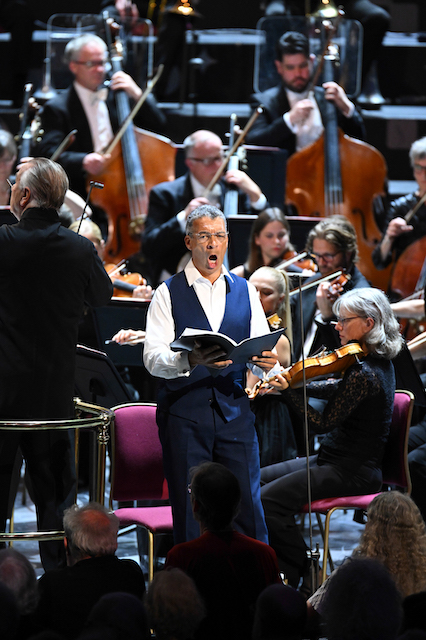 Shimmering, quivering, ripening, soaring – with the lyrics (sung here in German) in overdrive, it would be all too easy for the music to do the same. So it’s striking that Elder’s interpretation very deliberately held back from blasting the audience with sound, choosing instead to map the ebb and flow of emotion through the gossamer-subtle harmonies. In the tricky acoustic of the Royal Albert Hall, sometimes this meant that the music didn’t feel quite as transcendent or awe-inspiring as it does in his Bergen recording. Delius’s rhapsodic vision was realised with absolute clarity, but there was occasionally a slightly muted aspect to the performance that made it seem that we were lurking in foothills as much as chasing after eagles on mountain peaks.
Even so, this adventurous programming is precisely what the Proms were designed for, and it was a pleasure to watch Roderick Williams’ energised, highly articulate performance as he mapped the course of Zarathustra’s emotions (pictured above). In The Song of Laughter, in which Zarathustra urges humanity to venerate the holiness of laughter, his whole body moved with each exhortation. Later, in The Song of the Lyre, his voice took on a subtle gold-hued richness as he sang about the “fragrance of eternity”. He was a man possessed by his vision, and through him we experienced all of Zarathustra’s hopes and doubts.
Tenor David Butt Philip delivered his solos with resinous lyricism, while Buckle’s voice soared as freely and powerfully as a bird of prey. Soprano Jennifer Davis brought both rage and transcendence to Zarathustra’s gnomic vision. Throughout, the BBC Symphony Orchestra evoked a glimmering picture of Delius’s sublime landscape, never more so than when horns sounding around the hall created a sense of scale that made it almost possible to see the mist rising up from the mountain valleys. Whether or not you were a convert by the end, this was an event to clear your mind and – according to your temperament – inspire you either to seek out a volume of Nietzsche or high tail it up a Norwegian mountain.











