

It started like Sunday afternoon band concert on a seaside promenade, a massive ensemble playing it light. But while there were several too many Shostakovich pops, the Ravel concerto and Walton symphony ahead sailed for deeper waters, And the Bournemouth Symphony Orchestra is on top form, lucky to have one of the world’s best conductors, Mark Wigglesworth, in charge.
Having proved his credentials in dance music with a Portsmouth performance of Tchaikovsky’s The Nutcracker Act 2 last December, Wigglesworth struck a similarly spacious mix of control and relaxation in the Shostakovich Suite for Variety Orchestra. It’s as much the work of Levon Atovmyan in its colouration, which gave the four saxophones (led by Simon Haram, no less) and accordion (Ryan Corbett) a chance to shine, while BSO brass played it suave. Listeners might have recognised a darker-timbred version of the Italian holiday music from the film The Gadfly and the sax-led waltz familiar from the so-called Jazz Suite No. 2, through which my six-year-old godson came to love the composer he called “curly sausage”. Four rather than eight numbers would have been enough, though. 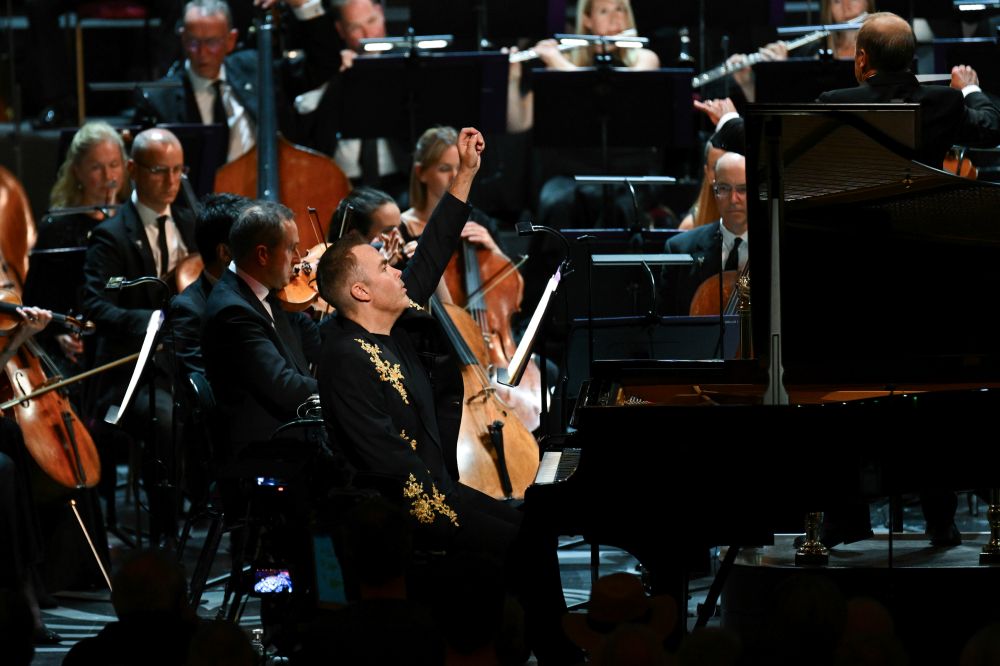 Many had come to hear Nicholas McCarthy (pictured above with players and Wigglesworth) as soloist in Ravel’s last great masterpiece, the Piano Concerto for the Left Hand. McCarthy subsequently told us that he was the second one-handed pianist to play the work in the Royal Albert Hall; the first was the commissioner, Paul Wittgenstein, who lost his right arm in the First World War and has left McCarthy a legacy of other such pieces. None is as well-proportioned or as well distributed between piano and orchestra as Ravel’s. The contrabassoon giving out one of the two main themes at the beginning resonated around the Albert Hall in the hands of Kim Murphy; the silky blues bassoon in the potted-Bolero sequence, Tammy Thorn, was followed by full jazz licence from trombonist Kevin Morgan.
McCarthy thundered in the depths, but needed more brilliance in the middle register, and the synchronicity wasn’t always perfect. He shone most in taking his time over the lyrical moments, which made the predicted encore perfect, too: one of the two pieces the 18-year-old Scriabin composed for the left hand when suffering from tendonitis in the right, the lovely, candid, post-Chopinesque Nocturne. 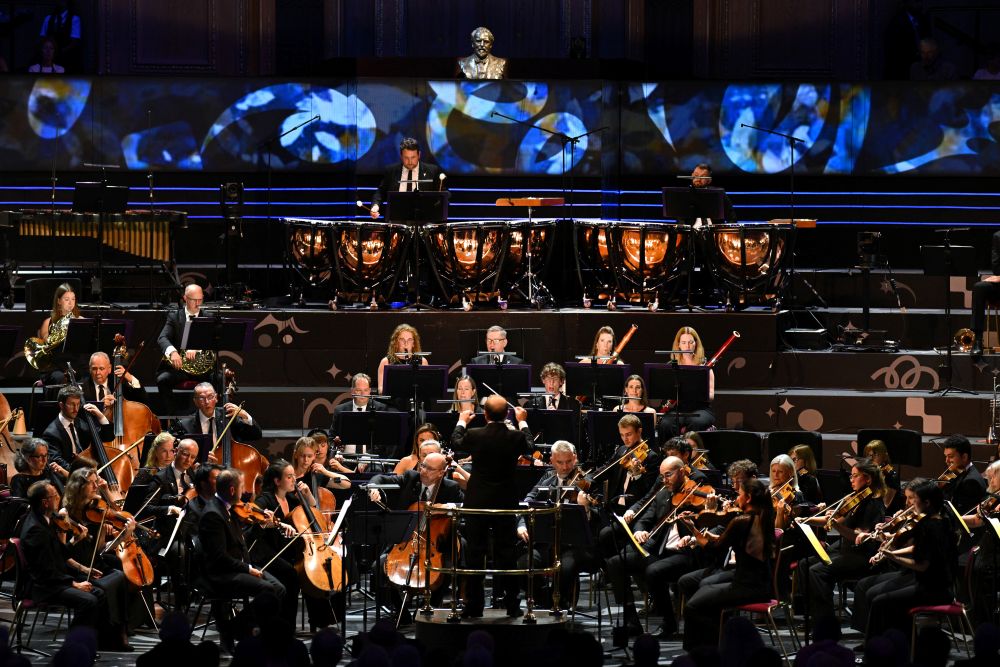 Walton’s First Symphony came a bit too close, for me, on the heels of Pappano’s Barbican performance with the London Symphony Orchestra; it’s been a case of diminishing returns over the years. Even so, the thicker-scored passages, of which there are many, worked better in the Albert Hall space, while the aching wind solos of the slow movement, led by exquisite playing from principal flautist Anna Pyne, proved unusually luminous.
Wigglesworth kept overload at bay with spring-heeled, texturally revelatory clarity in the outer movements and a fast, whiplash scherzo. Curiously it’s the finale, added later, which I love the most these days; its deliberately raucous tattoos and febrile fugues, throwing all the more into relief the one poignant moment, a last post from trumpeter Paul Bosworth, could not have been more precise or exuberant.











