

This was an evening of Iberian highways re-travelled, but with a difference. At the beginning of 2016, the centenary of Spanish master Enrique Granados's untimely death, two young pianists at the National Gallery shared the two piano suites that make up the original Goyescas; finally last night at the Barbican we got the opera partly modelled on their deepest movements. And back in 2008 Josep Pons and the BBC Symphony Orchestra brandished the revised, full-orchestral 1925 ballet score of Manuel de Falla's El amor brujo rather than the intriguing chamber orchestra original, making a virtue out of the necessity of its spare instrumentation, which they also presented yesterday (albeit with more strings than in the 15-strong ensemble of 1915).
Tres hurras go to Falla for bringing a cantaora or flamenco singer into the classical world, and not in a diluted, crossover-y kind of way. Last time it was the compelling Ginesa Ortega as the gypsy Candelas, using witchery to win back her lover, but she didn’t get as much to declaim as Maria Toledo in the original version (pictured below with Josep Pons and members of the BBCSO), a lesson in concert-hall deportment and involvement, and not only when she stood to perform. Which she did with those beautiful and compelling hand gestures and melismas which cut deep, even if the nature of the beast – the delivery usually tends to go inwards in cante jondo, "deep song" – needed to be miked. 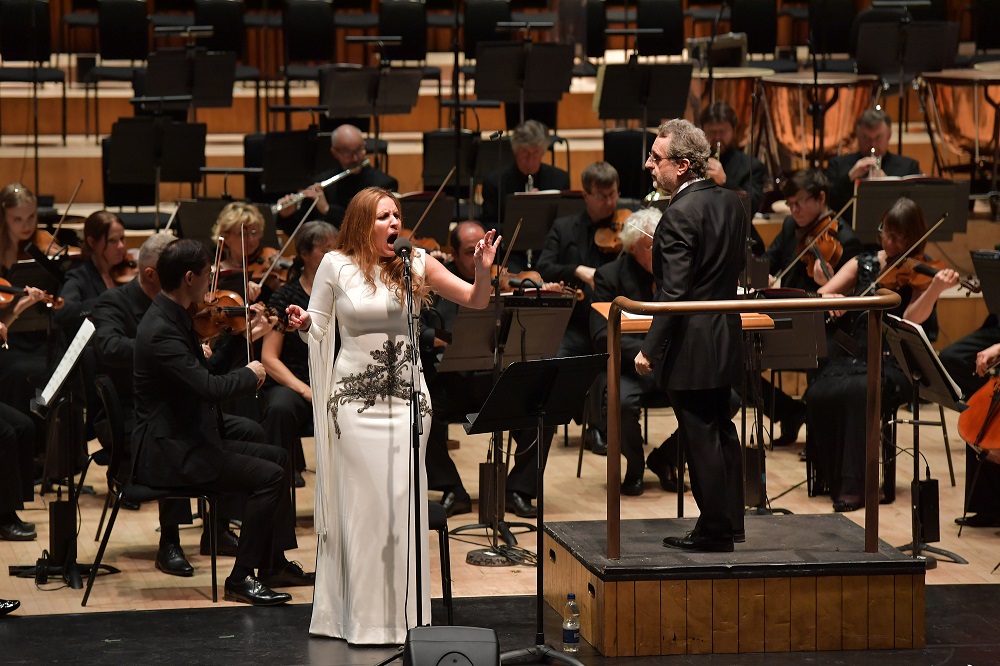 Every inch Toledo's equal for Spanish bite in the very selective orchestration were oboist Richard Simpson and trumpeter Gareth Bimson, while a haunting beauty was evoked by Nicholas Korth’s horn solo and the other-worldly cello song of ineffable Susan Monks in the Cuban guajira of the Introduction to the second scene (think a gentle predecessor of Caetano Veloso’s “Cucurrucucú paloma”).
If Pons sometimes seemed delberate in his tempos here, he got all the definition he needed, and let rip with the colour in the opening tableau of Goyescas after the interval, complete with a flaming if score-bound chorus in the expert BBC Singers. There was uncredited assistance here from Kenneth Richardson’s minimal but telling concert staging and some bold lighting which plunged the stage into purple and blue, with crescent moon, for the night scenes. Three of the four Latin soloists owned the stage: fine baritone José Antonio López as swaggering toreador Paquiro, Lidia Vinyes-Curtes as his maja (Madrilenian girl), and above all Nancy Fabiola Herrera as the classy but troubled Rosario (pictured below second from left, with Gustavo Peña at her side). 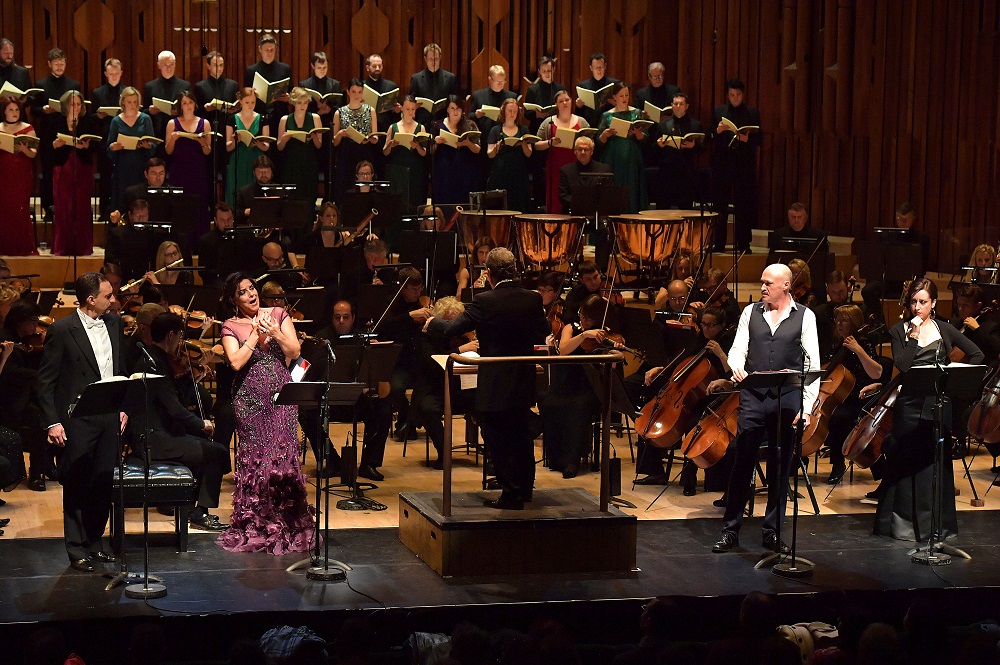 Granados’s odd attempt to turn his piano pieces and other extant material into a series of operatic tableaux is unbalanced, a bit like starting Eugene Onegin at the party scene and ending with the duel, or in this case its aftermath. There’s no chance for the singers to build up their characterisations: Fernando (Gustavo Peña, a ringing tenor with a bit of a problem with support and a disconcerting habit of putting his hand to his ear in several entries, no actor he) is needlessly jealous of his Rosario, and doesn’t need much provocation from Paquiro to challenge him to a duel at a lantern-lit ball. The denouement is inevitable, but teased out with the deepest and most sensuous music of the opera, taken from the two most memorable movements of the two piano suites, “The Maiden and the Nightingale” and “Love and Death”.
The composer's response to Goya – the pictures unseen here, maybe right as the images might detract from the sound, though some could have been reproduced in the programme – is watered down by the stock words of a weak libretto. The scoring can be thick, too; the total masterpiece is the biggest of the piano pieces rather than the operatic love-death we get here. But Fabiola Herrera, as sympathetic a presence throughout as Toledo had been in the first half, gave us the full diva works, blazing in the four big cries of “Amor” and reminding us how much the southern musical temperament can bring to music like this. Hers will surely go down as one of the great operatic performances of the year. Salud to the BBC Symphony Orchestra, too, for bringing this musically inspired work to London; CD release would be very welcome.
- Recorded by BBC Radio 3 for broadcast next month
- Read more opera reviews on theartsdesk











