

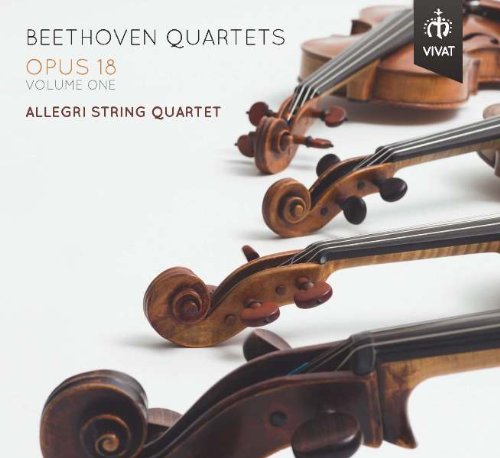
The Allegri Quartet’s earliest incarnation began playing in 1953. Orchestral personnel change constantly and no one bats an eyelid. String quartet members are similarly replaced and retired, leading the curious to ponder the authenticity of any new line-up. Think of it as a musical variant of the "Ship of Theseus" paradox. The playing on this new Beethoven disc is flawless – punchy, energetic and full of humour. The Opus 18 set are Beethoven’s earliest quartets. While owing much to Haydn and Mozart, they're full of passages where Beethoven is already pushing the boundaries. Irregular phrase lengths stand out, and the lower voices begin to assert their individuality. These works are much more than display pieces for the Allegri’s first violin Ofer Falk.
I like this group’s unsentimental, vibrato-free approach to Beethoven’s slow movements – the Andante Cantabile of no 5 is immaculately sustained at a flowing tempo. They play the opening of no 3 as if you’re sneakily eavesdropping on a private conversation. The C minor fourth quartet is the best thing on the disc, its discombobulating, violent close especially potent. Fantastic music, winningly performed and warmly recorded.

You’ve never encountered the music of Jean-Marie Leclair? An internet search will most likely throw up a few fruity factoids concerning this baroque composer’s unfortunate, dramatic demise. He was, literally, stabbed in the back. Let us, instead, concentrate on the music. One selling point of this nicely-produced CD is Charles Brink’s transverse flute playing, melding flexible agility with a gorgeous range of colours. It’s not easy making a flute sound this expressive. Leclair’s output is dominated by dance music, in harpsichordist Andrew Appel’s words “bringing to life the court minuet and gavotte, as well as the barn dance performed by wooden-shoed peasants.”
These performances brim with terpsichorean bounce. The players understand exactly how to use ornamentation, the solo lines frequently elaborated almost to breaking point without ever becoming wearisome. Two four-movement flute sonatas are appropriately played as suites of dance movements, and Brink’s agility in the last movement of the G major sonata is exhilarating. Slightly more substantial is Leclair’s Deuxieme Récréation de Musique, the ensemble now including violin and cello. Violinist Krista Bennion Feeney’s witty flourishes in the closing Tambourin are superb.

There’s been a surge of interest in the accordion recently. Decca have recently signed the accordion-playing winner of Lithuania’s Got Talent and my favourite disc of the year so far has been a two-accordion transcription of Stravinsky’s Petrushka. Is the squeezebox the new ukulele? I suspect not – it’s too difficult to play well, for one thing. Latvian accordionist Ksenija Sidorova’s second album contains some brilliant, fizzy transcriptions. An arrangement of Moszkowski’s Caprice Espagnol sounds more idiomatic than the piano original. Jon Faukstad’s transcription of Grieg’s Holberg Suite is also hugely entertaining, the lower string lines of the opening Rigaudon more prominent than usual. Sidorova’s control of dynamics is extraordinary, the sound of her Pigini instrument occasionally reduced to a whisper.
The gossamer textures of Mendelssohn’s Midsummer Night’s Dream scherzo transfer well, and we get two short works composed specifically for the accordion. Londonov’s punchy Scherzo-Toccata is fun, and the black humour of Artem Vassiliev’s recent Who’s the Puppet? can’t help recalling Stravinsky’s Petrushka. The disc takes its title from Fairy Tales, a 1959 accordion concerto by the Czech composer Václav Trojan. You can sense Sidorova’s delight at finally being able to interact with a full orchestra. Trojan’s cheery, colourful score is more soundtrack than concerto, but contains some glorious things, such as a Prokofiev-like waltz in its sixth movement and a hyperactive close. We even get a smoochy Piazzolla tango as a bonus track. Highly recommended.











