

This luminously persuasive, radically inventive performance of Shostakovich’s music begins – quite literally – at the end. Beneath a slowly revolving monochrome moon, a lone musician delivers a plangent rendition of the Moderato and Allegretto from the final viola sonata the composer wrote before dying of cancer in 1975. From the shadows an accordionist emerges as the accompanist, eking out the understated melancholy from the shifting harmonies. It’s a deceptively simple, elegiac introduction to the wonderfully daring ninety minutes that ensues.
The electrically compelling Finnish violinist Pekka Kuusisto has collaborated with Danish director Mikkel Harder Munck-Hansen to produce a very different take on the composer who wrote many of his greatest works under the shadow of Stalin. Rather than taking the obvious route of politicising this staging of his works, they have built a haunting dreamscape in which Kuusisto along with members of the Norwegian Chamber Orchestra appear as otherworldly figures, completely possessed by the music they play.
Sometimes the mood’s subversive, almost comedic, at others it’s more philosophical. What’s most striking is that the entire ensemble has memorised almost twenty works so that their communication with each other is uninhibited. The choreography demands that they dart in and out of each other, on occasions wearing masks, always changing formation between pieces and sometimes even between phrases. The result is a technically impressive, viscerally thrilling survey of Shostakovich’s work. Pale makeup which exaggerates the musicians’ eyes and cheekbones along with rag tag tartan costumes means that sometimes the players look like clowns, at others like fugitives, at others like ghosts. 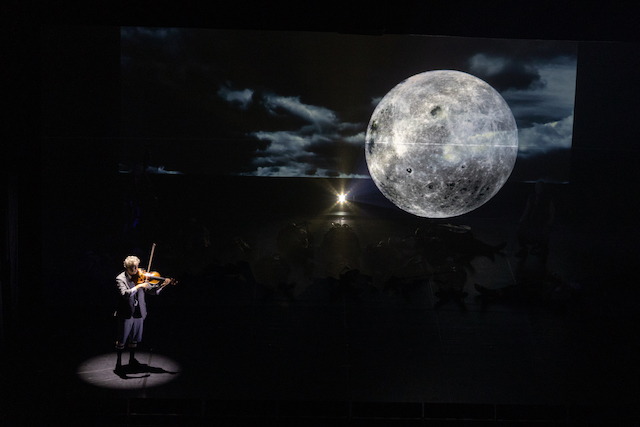 The programme as a whole is built around the musical motif DSCH (D, E flat, C, B natural) that Shostakovich often used in his works as a leitmotif from the German spelling of his name. From the viola sonata, we’re swept into a performance of the Romance from the composer’s score for the 1955 film The Gadfly – in which the entire ensemble, lit in red, rises up in front of a backdrop that looks like a manic spider’s web. Then a more measured atmosphere prevails as a grid is projected onto the stage, and a shadow dancer – echoed by a filmed image at the back – loops across the grid to the accompaniment of the Polka from Shostakovich’s Three Fantastic Dances.
Certain numbers, inevitably, stand out. Not least the Allegretto from the Seventh String Quartet, in which the musicians appear to be passengers on a train speeding through silver birch woods, continuously swapping seats to change musical conversations. Following this the aesthetic shifts dramatically, as Katrine Sonstad – who co-conceptualised the concert’s staging – appears centre stage with her double bass, dressed in red like a fiery angel.
In the performance of the Allegretto from the Second Cello Concerto that ensues, there are many occasions when the bass is drawn into an intense, lyrical dialogue with accordionist Bjarke Mogensen. Among many other of its aspects, this concert really emphasises the full expressive potential of the accordion – frequently it appears as a substitute for the piano, and Mogensen compellingly demonstrates how it has both the gravitas and poetic range to do so.
The longest piece, by some measure, is the 20-minute performance of the Chamber Symphony arranged by Rudolf Barshai from the Eighth String Quartet in front of projections of rolling clouds in a bruise-coloured sky, the orchestra excavates all the symphony’s despair and quiet rage. Øystein Sonstad’s expressive cello playing in particular takes centre stage as the notes resonate like a desolate prayer to a fate that he cannot control.
The programme announces proudly that this is a “concert unlike any other”, and that’s undeniable. The considerable demands that it imposes on the musicians, not just musically but also physically, means that it is unlikely to have imitators any time soon. All the more reason to rush to see it whenever you have the opportunity, to experience it in all its beguiling, fiercely intelligent originality. A searing triumph.
- Read more reviews on the arts desk
- Pekka Kuusisto will next be performing Mahler at the Tonnhalle in Zürich











