

Six weeks ago, the Ernst von Siemens Music Foundation announced that it the winner of its prestigious and extremely valuable main annual prize for 2020 "to a composer, performer, or scholar who has made outstanding contributions to the world of music" will be the viola player Tabea Zimmermann. She commented to an interviewer that what mattered to her most was neither well-paid concert appearances nor playing in large halls, but rather to be involved in things that are interesting for what she called their "Inhalt". The German language is blessed with words that have a whole field of resonances rather than just a single meaning, and "Inhalt" is one of them. It can signify just the contents of something, but it also means the thing which gives an endeavour - or indeed a whole life as lived - its purpose and meaning.
This Beethoven year is producing some remarkable things, and this opportunity to engage with the whole of Beethoven’s oeuvre for string trio on one evening and to hear it played at such an astonishing level was a very great pleasure indeed. Zimmermann's trio with German violinist Daniel Sepec, (pictured below courtesy of Deutsche Kammerphilharmonie Bremen, where he is concertmaster/soloist) and French cellist Jean-Guihen Queyras is a remarkable unit. All are soloists in their own right, but clearly bring a particular passion and purpose to this group.
 It was a long concert. The whole programme lasted three hours and 40 minutes including two intervals, but the time passed unbelievably quickly. Misha Donat’s thoughtful programme note added to the experience too. He points out that as Beethoven assimilated the great Mozart Divertimento in E-flat major, K563, and transported it into his own musical world, he was already working in the with structures longer than the classical four-movement structure, and thereby sowing the seeds for his later experiments in form in the late quartets. He also draws attention to what an astonishing work the C minor trio from Op. 9 is, and makes the case well that it is a more successful work than the C minor quartet from the Op. 18. set.
The facts remain that the Beethoven quartets are better known than these trios, that the quartets tell a longer story of development through Beethoven’s life than these trios from the 1790s, so we will inevitably tend to listen to the trios through the prism of the quartets. And yet these are anything but ‘student’ works. They inhabit a world that is clearly Beethoven’s. And what is constantly remarkable is how light and airy the textures in a trio can become. As Donat has said elsewhere, “the transparency of the texture in a trio forces the composer to think contrapuntally, in horizontal rather than vertical terms.” Towards the end of the evening, Sepec had really found his stride as a soloist telling long and convincing and characterful stories. And throughout the evening Sepec, Zimmermann and Queyras were performing astonishing feats of airiness of texture, making us complicit in their adventures on the boundaries of silence.
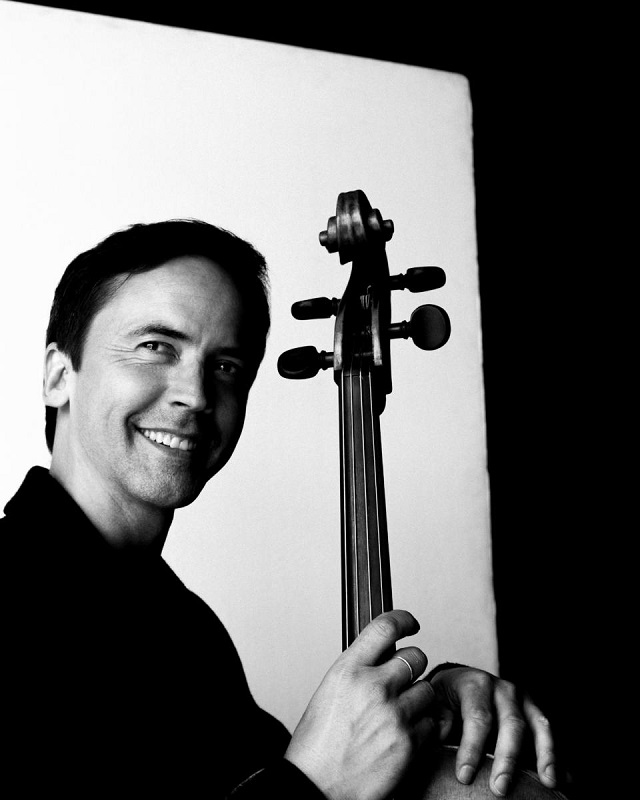 One of the main tasks of the violinist and the cellist here is to make the viola audible, and Sepec and Queyras (pictured left) achieved that admirably. Zimmermann is such an astonishing player, one is drawn into what she is doing anyway. String players around me in the audience were talking during the intervals in a complete sense of awe about her: her effortlessly even bowing arm, the quality of her ‘short bowing’, the way she manages to give just the right weight and emphasis to Beethoven’s rebellious offbeats. She also has an astonishing capacity to give flow and a shape to what might seem the simplest or blandest of, say, an accompanying arpeggio. One young player told me she was completely captivated by the sense of pacing, the astonishing freedom and collective improvisatory feel that all three members of the trio were bringing to the music.
I found myself fascinated by less technical, simpler things. There are musicians who can convey the whole emotional world that a piece of music inhabits through their facial expressions - the late great cellist Valentin (Volya) Berlinsky comes to mind – and Tabea Zimmermann does that too. As the trio is about to enter the distinctive and different emotional world of each and every Beethoven movement, Zimmermann wordlessly signals the mood that the music will capture. Before leading us into the poise and concentration of the adagio con espressione of the great C minor trio Op. 9, she placed the viola on her knee and waited for a moment in stilled concentration. And before the festive dance of the allegretto alla polacca from the Serenade Op. 8 there was a infectiously winning smile. Each time the tone is set. Magisterially.
People are understandably staying away from concerts at the moment. By the end of the evening, when we sang Jean-Guihen Queyras a "Happy Birthday" at 10.40pm, the hall felt very depleted. Better times will return, as will concerts that are not just as completely fulfilling as this one, but also completely full.
- The concert was live-streamed and is available on YouTube
- More classical music reviews on theartsdesk











