

Antonio Pappano fervently believes that talking about music is a vital part of his communicative art, and nobody does it better. Given that the London Symphony Orchestra's enterprising Half Six Fix format is scheduled for an hour each time, and that Ravel’s complete Daphnis et Chloé lasts almost that long, there wasn’t going to be much room for pre-performance demonstration yesterday evenng, but what we got still hit the mark.
Pappano asked his LSO players to float away with the opening of “Daybreak”, start of the more often heard Second Suite but occurring some 40 minutes into the full ballet score, then the water-rivulets of flutes and clarinets with just the bass line, then the two harps alone, before showing how the whole picture shifts as if cinematically we were heading towards a close-up. That also gave us a glimpse of the main love-motif which Ravel varies so gorgeously throughout the drama of shepherd and shepherdess parted by pirates, brought together again by statues coming to life and invoking the god Pan.
A crucial part of the hour-long presentation was the reproduction of all the plot details which are less easy to follow in the score (mine has French only). There’s not a lazy bar in the whole of Daphnis, but it really does help to know what’s happening, for example, in that most mysterious of passages where ten-part muted strings set up an “unreal light” leading to Pan's appearance. The Philharmonia used to provide supertitles for full ballet scores like this, Stravinsky’s The Firebird and Bartók’s The Miraculous Mandarin; it would be a help in the full concerts, too. Here you also get close-ups on the screens either side of the orchestra, a bit erratic at times, but also welcome. 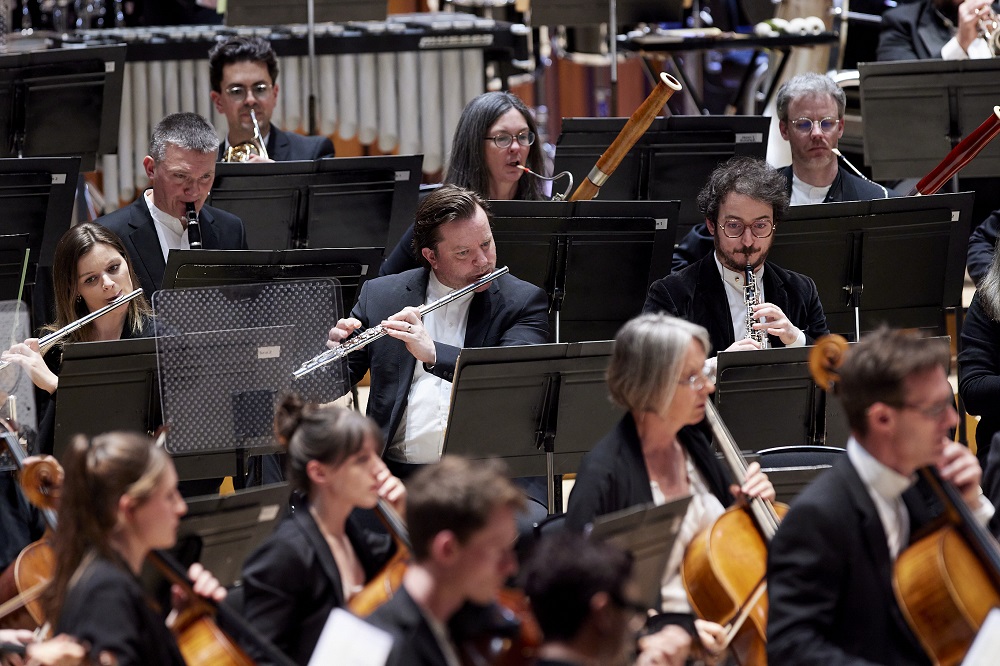 But the playing’s the thing, and Pappano managed the miracle of pointillist details coming through even in the most elaborate of impressionistic textures. As in François-Xavier Roth’s magnificent Sunday marshalling of Bartók’s Concerto for Orchestra, the peerless wind section were in the limelight; one even wonders if Bartok noted how Ravel, surely the greatest orchestrator of all time, introduces a mysterious flute bars into his introduction, and did likewise. Gareth Davies (pictured above by Kevin Leighton in Sunday's LSO Futures concert wth fellow LSO woodwind including oboist Olivier Stankewiecz, right, and bassoonist Rachel Gough behind him) excelled himself yesterday evening; I’ll even stick my neck out and say that surely the most ravishing extended flute solo in the orchestral repertoire, as Daphns and Chloe act out the legend of Pan and Syrinx in the “Pantomime”, can never have had more refined or exquisite treatment. An out-of-body experience.
Pappano could trust his players in moments like this, but his flexibility made dazzling work of the constant tempo and occasional metre changes of the pirates’ orgy. The more gracious dances lilted; the final Bacchanalia was as virtuosicaly thrilling as it can be.
If there were to be the slightest reservation over anything, it might be that the excellent Tenebrae voices were too English-choral- traditional in what should be the more nature-sensuous of their wordless exclamations, but they certainly contributed subtly to the whole effect, relished by a packed audience of all ages. I’d go again tonight if another master conductor and another London orchestra more unexpectedy in top form, Vasily Petrenko and the Royal Philharmonic, didn’t beckon over at the Royal Festival Hall. It's just one of those remarkable weeks on the London concert scene.
- Repeat performance tonight with Alison Balsom giving the UK premiere of Wynton Marsalis' Trumpet Concerto (returns only); Pappano conducts the LSO in Vaughan Williams' Fifth Symphony next week (Half Six Fix next Wednesday)
- More classical reviews on theartsdesk











