

With the wealth of online performances during the pandemic, it is easy to forget the regular offerings from the Wigmore Hall. The Hall found itself in a better position than most, as it was able to present its autumn schedule largely unchanged, the only programming issues arising from international travel limitations for the performers. And the finances somehow permitted them to give concerts even without audiences when restrictions dictated, but broadcast everything live on webstreams. An appeal for donations on every broadcast suggests some hardship, but the fact that these broadcasts have happened at all is little short of a miracle. This lunchtime recital, by Wigmore regulars the Doric Quartet, was the first with a live audience since the end of the November lockdown. But you wouldn’t know it from the conspicuously unbroken silence from the stalls.
The Doric Quartet performed two works by Mozart and Britten connected by clear but subtle connections. Both were among the respective composer’s final works. That is little more than an accident of history in the case of Mozart’s first “Prussian” String Quartet, K 575, but Britten’s Third Quartet is much more retrospective and elegiac. Also, K 575 has a nickname, “The Violet”, coined by the musicologist Hans Keller, to whom Britten’s quartet is dedicated. So the programme tied together quite nicely.
The quartet has a distinctive sound, which suits the two works, but in different ways. The tone isn’t round or warm, more sinewy and focussed. In louder passages, this grows in body to an impressively dramatic sound, but always with that focus of line and clarity of texture. First violin Alex Redington defines the ensemble with his precise and often steely tone production. Cellist John Myerscough also plays an important role. His sound is muscular, anchoring the quartet’s tone, but also often standing out from the other players. He can blend with ensemble too, but usually though violist Hélène Clément increasing the weight of her sound to match him. 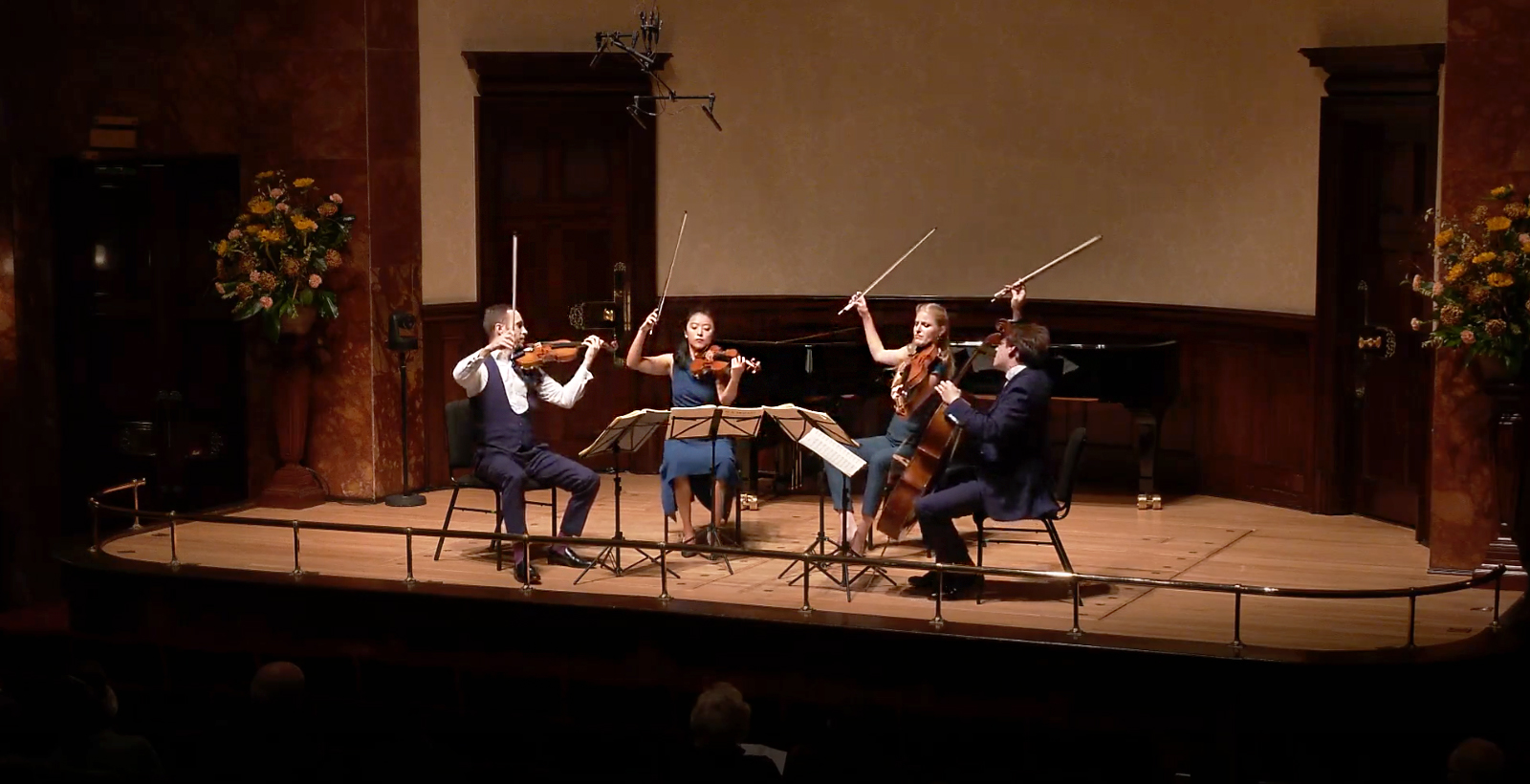 The Mozart was played with Classical-era bows, but these looked very similar to the modern standard and any difference in tone was too subtle for my ear. If the aim was a lighter texture, it didn’t really succeed, but that didn’t matter, as the Doric’s muscular intonation proved a good match for Mozart’s often emphatic textures. The players also bring lightness and bounce through their brisk and often capricious tempos. In the first movement, they often sped into statements of the themes, only restoring the main tempo and the last possible moment. A similar nervous energy characterised the second movement Andante, with thematic statements teasingly hesitant, and delicate interplay between the instruments. The third movement Minuetto was given a weighty reading, with brutal accents and emphatic phrasing. The finale was again weighty, but balanced by the playful interludes.
Britten’s Third Quartet is a darker and more sombre work. It was written during the composer’s final illness, most of it in Aldeburgh, but the last movement in Venice, the music here quoting his opera Death in Venice written a few years before. The Doric Quartet are closely associated with the work and have recorded it for Chandos. Their focussed tone is ideal for this music, and they often take the timbre to extremes. The first movement is called “Duets” and sets the players in pairs. In each, the woody tone of the two players was well matched. A sullen, muted lyricism hangs over this music, and the movement eventually evaporates into a series of highly ambiguous harmonics.
The slow middle movement was an exercise in sustained intensity. The players here applied little or no vibrato, instead carrying the long lines in simple pure tone. The Venice-inspired finale is another broad but subdued canvas. The themes are simple, but Britten never lets us get comfortable, and, despite the moderate dynamics, there is a muted intensity that continues into the ambiguous conclusion. The Doric Quartet judged the mood here perfectly, applying their angular tone to Britten’s increasingly sparse textures, and signing off the coda with a gentle intensity perfectly matched to the sense of resignation in Britten’s score.











