

Vibrant rustic dancing to conclude the first half, a heavenly barcarolle to cast a spell of silence at the end of the second: Bernard Haitink's 90th birthday celebrations of middle-European mastery wrought yet more magic in Dvořák and Mahler after his first concert of Mozart and Bruckner. He seemed perhaps a little more frail, less spiritually concentrated this time; but that wasn't going to get in the way of the phenomenal stick technique nor of the London Symphony Orchestra sounding, once again, more like its counterparts in Amsterdam, Berlin and Vienna than ever before.
It's possible that the vivacious Isabelle Faust could even have directed the performance of Dvořák's Violin Concerto herself, though only Haitink could hit the grandeur of the big ensemble before a turbulent first movement subsides naturally into the central Adagio. Faust's deeply feeling special collaborators were the radiant LSO woodwind, one unique first oboe sound (that of Olivier Stankiewicz) taking over from another, Juliana Koch's, on the Sunday; the ever-amazing tone of first horn Katy Woolley, new Concertgebouw leader; and guest leader Goerge Tudorache, who so visibly rose to the rapport invited by Faust.
She's the most engaging of players to watch, but that wouldn't be enough by itself if the intonation weren't perfect, the sound always clear, every phrase brought to life so that the to-ings and fro-ings of that Adagio actually made sense. And I've never heard the dance-finale turn more dangerous, a premonition of the wild wood nymphs' cavortings in Rusalka: a real work-out for both musicians and audience. 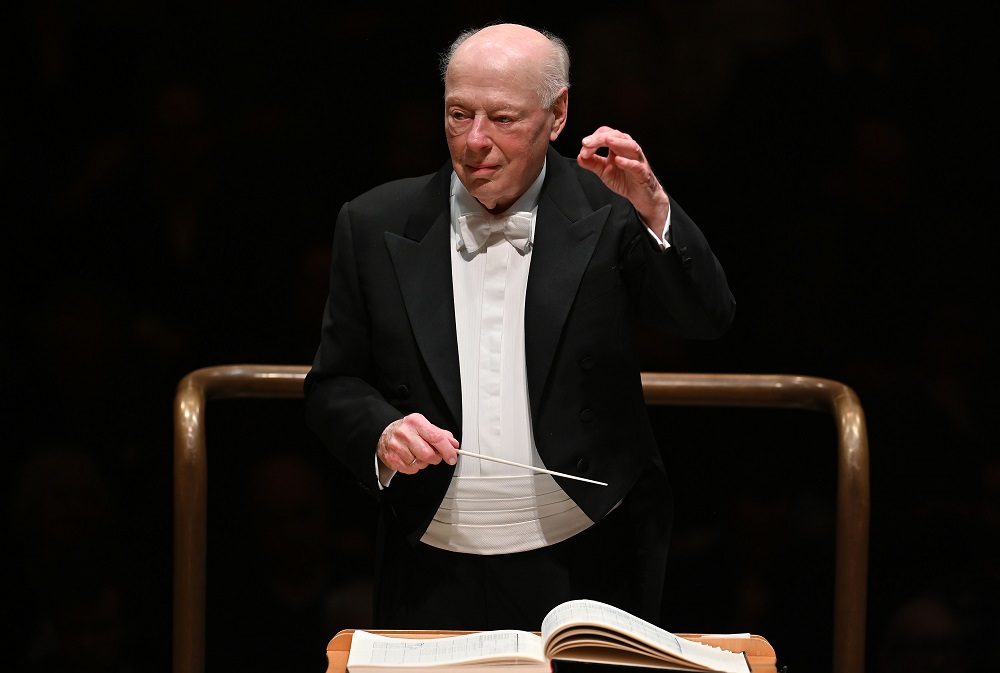 After which the woodland scene at the start of Mahler Four couldn't have been more different. Haitink (pictured above by Mark Allan at the Sunday concert) now takes it not as a spring jaunt but a leisurely walk in autumn. It might drag if the rhythms and extraordinary, often chamber-musical palette weren't so well defined. The lesson was that the slower you proceed, the more in nature you observe, magnifying-glass at the ready. Thrumming double basses, weird forest sounds from the clarinets, second violin lines all emerged with exceptional vividness; and the pace allowed the violent explosion at the development's climax to truly haunt as a vision of destruction, the foreshadowing of the Fifth's funeral-march fanfare on low trumpets casting the shadow of death.
All the more welcome, then, the restoration of good humour. A colleague once said that the real magic of a Haitink-conducted Don Giovanni was the way he got the strings to phrase the 12-note transition to the Trio in the Act 1 finale. I thought of that as time stood still with the violins' three-note lead back into the closing revels of the movement.
Tudorache cut through the grotesqueries of the scherzo as a pied piper of mortality on his second, tuned down fiddle, while the trios floating seraphically. The initial tempo here was more familiar, and Haitink just let the gently moving song of the great slow movement unfold naturally. If the arrival at heaven's gate didn't quite reach the transcendence anticipated, that came in the last stanza of the song-finale, Sally Matthews' knowing soprano settling to a sublime sliver of tone before the double-basses and harp rocked us to oblivion, and that well-earned silence.
- Programme repeated on 21 March
- More classical music reviews on theartsdesk











