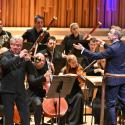
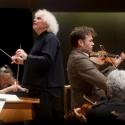
A month ago, I sat in St Martin-in-the Fields listening to London Mozart Players recording my orchestral version of Letters from Burma. I have never been to Burma but I was inspired to compose this work after reading a collection of 54 letters by Aung San Suu Kyi. The first excitement that morning was to be in the presence of an orchestra. In these times of the pandemic, with borders closed, this novelty can’t to be underestimated – I am devastated not be able to travel to attend the birth of another compositional “baby” at Amsterdam’s Concertgebouw next month.
The second excitement was that all the orchestral musicians, oboe soloist Olivier Stankiewicz (pictured below in the fim), TV crew, and production team had all assembled for a common goal, to film and record my piece for Refugee Week this week. Despite the struggles of the past year with concert halls closed, all the musicians offered their time for free. There was a tremendous sense of unity and goodwill.
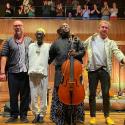
In 2008, London Mozart Players’ co-leader Ruth Rogers travelled out to Burma to visit a refugee camp holding 50,000 people. Her brother, Ben Rogers, is the Senior Analyst for East Asia at the human rights organization CSW. When the situation in Burma disintegrated again last year and their democratically elected leader Aung San Suu Kyi was returned to house arrest, Ruth Rogers approached her fellow players in the orchestra to see whether they would record my piece to highlight the crisis in Myanmar and raise money for refugee charity Advance Myanmar, which provides emergency aid to thousands forced to flee their homes in the recent struggles for democracy.  On the day of the filming, Ben Rogers provided the context for this project and introduced the musicians to some refugees to hear their stories first hand.
I originally wrote Letters from Burma for the Vellinger String Quartet and Douglas Boyd. Noting that they would be presenting Janacek’s Intimate Letters Quartet, my first port of call was to typing “letters” into the Amazon search bar, first book to pop up was Letters from Burma, written for a Japanese newspaper between November 1995 and December 1996.
In 2004 at the time of this commission, Aung San Suu Kyi was a beacon of hope for democracy and an icon of determination and grace. Her letters describe every aspect of Burma – its culture, scenery, religion, politics and more – copious inspiration for a new composition! With two infants at home at the time, I was devastated to read Aung San Suu Kyi’s letter, Young Birds outside of Cages:
Political prisoners have to speak to their families through a double barrier of iron grating and wire netting so that no physical contact is possible. The children of one political prisoner would make small holes in the netting and push their fingers through to touch their father. When the holes got visibly large, the jail authorities had them patched up with thin sheets of tin. The children would start all over again trying to bore a hole through to their father: this is not the kind of activity one would wish for any child.  As a new mother, I felt this keenly, especially knowing about Aung San Suu Kyi’s phenomenal personal sacrifice. This letter became the inspiration for the second movement: the oboe became the child with a bird-like melody, while the quartet (now, string orchestra) played strong cold chords, like the bars of the cage.
With the help of Burmese music expert John O’Kell, I discovered the stunning traditional Burmese folk song “Aung-ze pain-ze”, a laudatory song of benediction about the power and valour of the King. The first movement (of the same title) is a straight transcription of part of the song in the oboe, with a new accompaniment in the strings. The whole piece is influenced not only by this melody but by its appoggiaturas (“grace notes”), portamentos (subtle “glissandos”) and quarter-tones (pitches between the 12-tone scale used in Western music traditions). It reflected Aung San Suu Kyi’s valour, standing by her principles.
The other movements are “Thazin”, named after a Burmese orchid – an exceedingly romantic national symbol – and “Kintha Dance”, which is a composite of all of Aung San Suu Kyi’s descriptions of dance throughout the book. A kintha is a type of bird, to which she likens the “precise and graceful” gestures of a “Mon” dancer. She also describes sword dances with flashing “well-honed blades” and dancers that “thrust and parried and swirled in action”. I’ve represented that swirling with another common trait in Burmese music – lightening runs of demi-semi-quavers. At various points small and clumsy chordal interruptions occur in the string quartet – this is my analogy for the oppressive regime with its heavy clumsy chords trying and failing to quench the vivid and irrepressible Burmese spirit.  Returning to this composition again in spring 2021, it was clear that Letters from Burma has taken on a new resonance. We have come full circle. Myanmar is now in a major humanitarian crisis, with tens of thousands of people displaced by military attacks, almost 900 people killed and 5,000 remaining in jail. Aung San Suu Kyi, who in recent years was fiercely criticized internationally for allegedly turning a blind eye to Myanmar military’s persecution of Rohingya Muslims, is again being held in an undisclosed location, cut off from everything and everyone, with her citizens calling for her return.
My father fled a totalitarian regime 70 years ago, and the courage and kindness of those who helped him stays with my family to this day. My piece describes every facet of the beauty and also the severe hardship of the county but ends in triumph. I hope and pray Burma’s suppressed will do so, one day too. Please help support those brave enough to endeavour to make this happen and the innocent victims of totalitarian oppression.
Watch 'Letters from Burma' on YouTube