

Ernst Krenek is probably best remembered nowadays as the composer of Jonny Spielt Auf – the quintessential Zeitoper of Weimar Germany and later the archetype of all that was designated “degenerate” in art by the Nazi regime. And perhaps also as – briefly – the husband of Anna Mahler, daughter of Gustav. But Krenek was far more than that. He was a magpie collector of styles and influences whose large corpus of work reflects almost every major 20th-century trend. From Romanticism to jazz, serialism, neo-Renaissance modality and even electronic works, Krenek’s history is the history of music itself.
Among a body of extraordinary music – extraordinary in every sense – the song-cycle Reisebuch aus den österreichischen Alpen is surely among the most striking. Over the course of 20 songs (words and music both by Krenek himself) he manages to sustain both a homage to and a satire on the great German cycles of Schubert, Schumann, even Mahler, with their mountains charged with Romantic urgency of emotion.
A journey through the Alps here becomes a rather more banal affair, plagued with tourists and technology – electric trains, automobiles, and all the paraphernalia of modern life, psychological as well as social. Krenek muses, like the good Austrian he is, on man’s relationship with nature, but unlike his predecessors comes to the frank conclusion of a pragmatist: they can never be one, so he must “love the world as it is”.
Apart from Wolfgang Holzmair, this awkward, brilliant work has had few champions. Which makes last night’s performance by Austrian baritone Florian Boesch and pianist Roger Vignoles all the more interesting. A pre-performance discussion focused our listening; for Boesch the emphasis is on humour, exasperation and sly, wry social critique, underplaying the work’s darkest questions in true Weimar style – this is Schubert by way of Brecht and Weill.
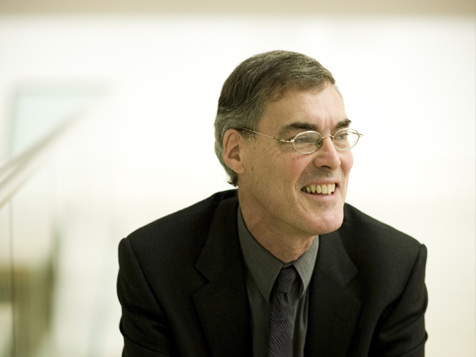 No discussion could have prepared us, however, for Boesch’s conversational delivery. Crooning, speak-singing and generally breaking every rule of Good Technique, he found the textural answer to Krenek’s determinedly un-beautiful texts. To release the full loveliness and power of which this voice is capable would be to misunderstand this work, to succumb to the very urges its narrator urges us to reject. The voice also plays an unusual role, called on to play the straight-man to the joker of a piano part – smoothly and wittily dispatched by Vignoles (pictured left) – that pretends to conform to tonality only so it can consistently and ear-twistingly thwart all anticipated rules and patterns. By the final Epilogue the assault has exhausted itself, attacking on a whole new flank with its naked melody and harking piano interjections.
A musical manifesto against atonalism, offering proof that tonality was not played out, the Reisebuch more than makes its case. So why is it not programmed and performed more? Perhaps, as this concert demonstrated, it’s as much to do with context as anything inherent to the cycle itself. Its preoccupations and textures are not those of the lieder recital – the very nose-thumbing contrary, in some respects, making it an awkward sell for audiences and an even harder partner for other repertoire. Holzmair gets round this by pairing Schubert songs with Krenek’s own, and it was hard to let Boesch leave the stage after a mere 45 minutes of music without hoping for an interval followed by a little Dichterliebe or similar.
But perhaps it’s right and proper to let this prickly, confronting work have the last word. Having reset your ears and expectations it ends with a chuckle, leading you to – what? Existential despair? Alcoholic oblivion? Shoulder-shrugging contentment? All of the above, and more.











