

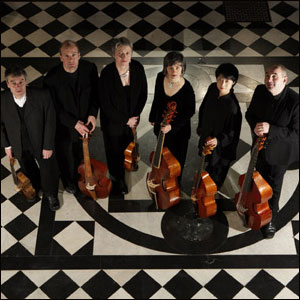
“For if their musicke please in earthly things/How would it sound if strung with heavenly strings?” Listening to viol consort Fretwork last night, the audience at the Wigmore Hall didn’t have to imagine the answer to Gibbons’ question. Listening to the vitality and variety of tone colour this group so reliably produce, it’s hard to remember that this is ear(th)ly music – hardly the wan and consumptive sound so many people still stubbornly associate with viols.
Joined by the Hilliard Ensemble to form a sort of Renaissance supergroup, Fretwork gave us a programme of Orlando Gibbons, passing his verse anthems and madrigals freely among both solo and consort voices and strings, sometime omitting texted parts altogether as the composer (ever the pragmatist) himself permitted. At the centre of the programme was My Days – a world premiere Wigmore commission from Nico Muhly, and surely the reason for a much-anticipated live Radio 3 broadcast.
Muhly's string writing delights in the rougher timbre these instruments can produce
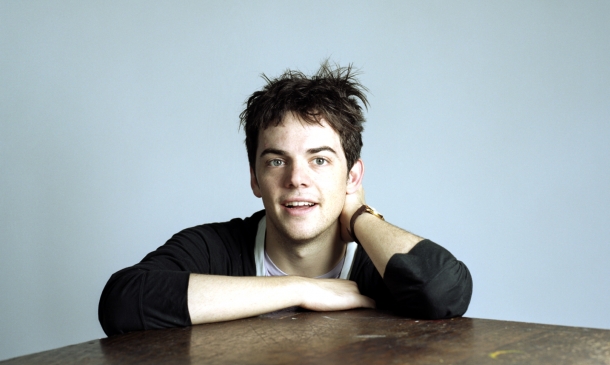
It’s a gorgeous work of homage – a “ritualised memory piece” – to a composer Muhly (pictured below) clearly reveres, finding correlations and correspondences between Gibbons’ writing and Muhly’s own while avoiding the too-obvious gaucheries of pastiche. Setting the verses from Psalm 39 perhaps most familiar from Parry’s Songs of Farewell (“Behold, thou hast made my days as it were a span long…”) but also set by Gibbons, Muhly ingeniously divides these meditations on mortality with a central section whose text is the 17th-century autopsy report on Gibbons himself.
 It’s a juxtaposition not overworked by the composer, content to let the structural drama do its work. The music initially passes between viols and voices, the viols rejecting and raging against the calm, fauxbordon-style acceptance of death expressed in the Hilliard’s trademark blended directness. The string writing delights in the rougher timbre these instruments can produce, generating a matted texture among which the warp and weft of the five instruments is still clearly audible. The central section finds a new mood of rapt contemplation, sustaining more horizontal harmonic direction that leads us eventually to Gibbons’ death – touchingly gentle, as viols veil and cradle him into silence.
 It’s odd that the balance between consort and voices should work so much better in this contemporary piece than elsewhere during the evening, where balance favoured strings, with doublings between parts often obliterating the lower voices. The Hilliard men here were joined by sopranos Julie Cooper and Julia Doyle, who dominated the texture – most pleasingly in Daintie Fine Bird where they fluttered and wove their vocal plaints. Solo contributions from both singers wore Gibbons’ moralising texts lightly, but the highlight was a full ensemble performance of the composer’s Nay let mee weepe. Composed possibly as a tribute on the death of Prince Henry, it has a dramatic scope missing elsewhere in Gibbons’ repertoire, which lacks both the emotional ambition or achievement of a Monteverdi or Gesualdo.
It was paradoxically in the instrumental treatments of Gibbons’ works that some of his texts achieved their most poignant rendering. Fretwork’s viols do not so much imitate voices as become them, finding sighs in their down-bows and struggling gasps in the tensions of their up-bows. The resistance offered by bow-on-string becomes especially vivid when evoking Gibbons’ thwarted lovers or anxious moralisers.
Typically thoughtful Wigmore programming in an intimate space should have made for a perfect evening, and would have but for the rather aggressive and unsympathetic lighting. Why illuminate the audience so emphatically throughout? If the artists’ diction is as it should be then we shouldn’t have any cause to be reading English texts during the performance. It certainly would have made for a much more peaceful and focused listening experience if we had been allowed to direct our full attention to the stage rather than the rustling and twitching going-on among the rows in front. Next time Wigmore welcomes period instruments can we please have some dim period lighting to set the tone instead?











