

It's fitting that for its 50th anniversary the Edinburgh Festival Chorus should perform Berlioz’s gigantic Grande Messe des Morts. There is nothing in the large-scale orchestral repertoire in which the chorus plays so huge and significant a role – it sings throughout and the only soloist that Berlioz admits is a solitary tenor whose appearance in the "Sanctus" is almost apologetic.
You don’t have to be a very acute observer of the Festival Chorus to realise that a 50th birthday, for a choir as much as for a person, is a mixed celebration. Some members of the chorus have sung in it since its inception, not long after the Edinburgh Festival was born. There is no polite way of saying this, but it's beginning to sound old. Chorus Master Christopher Bell also directs the National Youth Choir of Scotland, and having heard both choirs in recent years it is clear that the wisdom, knowledge, and performance skills of the older choir do not equate to the radiant and bell-like sound of the younger. Bell makes the most of any choir he directs, and the Festival Chorus comes over as precise and observant – a bit like an older driver whose experience renders the journey swift but unexciting.
 That said, this was not a dull concert; far from it. We can thank Berlioz’s stupendous orchestration for that: four sets of timpani, countless drums, gongs and cymbals, and the mesmerising sound of four brass choirs placed at corners of the auditorium. One of the brass ensembles was high up on a podium in the choir stalls, where prior to each appearance they assembled in a line and stood smartly to attention, a theatrical touch that lent more to their performance than the notes alone.
If Verdi’s Requiem is often described as operatic, Berlioz’s Grande Messe is pure theatre. Where Verdi is emotional, Berlioz is austere, the drama derived from large, almost monolithic building blocks, sudden diminuendi and momentary walls of sound. Apart from some intriguing interplay between offstage trombone and flute, this is not the crazy, delirious Berlioz of the Symphonie fantastique, but a vision of altogether more restrained splendour. In this, the Philharmonia Orchestra under Esa-Pekka Salonen was superb. It was truly a vast orchestra, immaculately controlled.
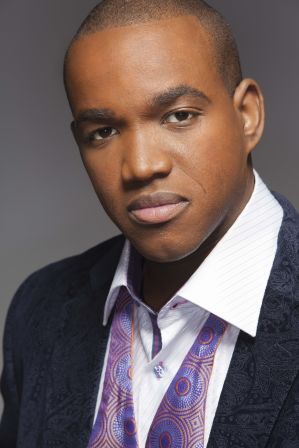
For the "Sanctus", the American tenor Lawrence Brownlee (pictured above right by Derek Blanks) was an inspired choice. Standing way up backstage in the shadow of the basses, his big easy sound filled the hall. Was it my imagination, or did his interplay with the chorus in this movement create a slightly more nuanced choral sound, as though for once the chorus had to listen carefully? The a cappella semi-chorus "Quaerens me" was good too; being quieter and less of a fortissimo belt, it showed off the finer side of this venerable chorus.
A week earlier I sat in the gods in the same concert hall and heard violinist Nicola Benedetti play an exquisite Bach encore. It is salutary to observe that while a huge orchestra and choir fill the Usher Hall quite magnificently, one performer can do the same job just as well. Last night, the "Offertoire" was interrupted by the noise of fireworks from the Edinburgh Tattoo – to the huge audience on the castle esplanade, the two and a half thousand people in the Usher Hall would be but a drop in the ocean.











