Jörg Widmann writes fast. He is also one of the few young German composers who can write distinctive and idiomatic music without feeling the weight of his country’s musical heritage on his shoulders at every turn. Surprisingly, then, his Clarinet Quintet, which here received its UK premiere at Wigmore Hall, was eight years in the making, and was initially abandoned because "music history ... suddenly appeared as a great burden". Typically, though, his return to the project at the start of 2017 marked a period of intense creativity: "I felt that the music was simply pouring out of me."
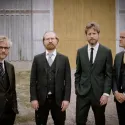
Widmann (pictured below by Marco Borggreve) credits that change of heart to the Hagen Quartet, with whom he played this evening, and they are certainly a good match. His music is often quiet, relying on muted harmonies and soft but richly shaded sonorities – the very qualities that make the Hagen sound special. There is plenty more here, too, from extended bowing techniques to clarinet multiphonics, but the Hagens took it all in their stride.
The work is a 40-minute Lento, and there is a feeling throughout of suppressed Romantic expression, as if the music continually wants to shift up a gear or launch into a searing climax. The climaxes, when they do come, are either frustrated by the slow tempo or interrupted before they begin. And the rest of the music hovers around silence, relying on the clarinet’s ability to play at the edge of audibility. At one point, the pitches disappear altogether, and Widmann simply blows air through his clarinet while the strings bow the bodies of their instruments. From there, the music gradually returns, but always seems on the verge of disappearing again at any minute.
On top of all this, Widmann adds a big, Romantic melody. The disjunction between avant-garde and romantic would jar in lesser hands, but Widmann gets the balance just right. The melody always appears over ambiguous harmonies, or even unpitched sounds, and is only ever present for an instant before melting back into the textures. There’s no apparent irony here, nor any knowing reference back to the Romantic era – he plays it straight, and somehow gets away with it, even if he’s right on the edge of good taste. As if to emphasise that Widmann does indeed speak from within the Austro-German tradition, the Hagen Quartet prefaced his work with the Webern String Quartet of 1905. Like the Widmann, this plays out as a single slow span (though it is actually three movements run together), melodically rich, but always supported by dark, nebulous harmonies. This, too, is perfect music for the Hagen Quartet, who infuse every minute gesture with meaning and expression through the elegance of their dark, burnished tone.
Mozart, however, calls for a brighter sound, and for his Clarinet Quintet in the second half, Widmann and the Hagens moved towards a more straightforward, classical tone. Even so, the playing was still reserved, with generally steady tempos and quiet dynamics, which served to highlight the intimacy and playfulness of this music. Widmann performed very much as part of the ensemble, with little ostentation, no vibrato, and modest, if sometimes quirky ornaments. Mozart’s writing for the string ensemble here is unusually democratic, with many exposed moments for the viola and cello, with whom Widmann would closely interact – lots of eye contact from him, and rarely a glance at the music. There were a few surprising moments, like the last slow episode of the finale, before the coda, which was brought to almost to a standstill while the players luxuriated in the open, airy textures. But on the whole, this was a measured and disciplined reading. Some may have found it overly mannered or lacking in expression, but to me it was the very model of classical proportion and elegance.