

The baton passed, metaphorically, to the Hallé last night in the Vaughan Williams symphony cycle shared between them and the BBC Philharmonic to mark the composer’s 150th anniversary. Literally, that baton was in the same hand as on the last date, for it was John Wilson who conducted the Ninth Symphony, as he had the second and seventh 12 days ago. This time VW was paired with Holst, as the second part of the concert consisted of The Planets.
It made an interesting comparison, as the two composers were friends as young men, and though Holst died 24 years before Vaughan Williams and The Planets was written (mainly) during the Great War, while the Ninth Symphony came well after the Second World War, it’s the earlier work that still sounds the more radical. By 1958, the tide of musical fashion was turning away from tradition, and since VW’s final symphony was written by a man in his eighties, it was easy to consider it the dying fall of a great career.
From our perspective we can perhaps see that it was in his nature to develop and modify a style that had worked for him all his life. There was no need to turn elsewhere – though the instrumentation of the symphony added the tones of saxophones and a solo flugelhorn to the orchestral palette. But it’s a concise, four-movement work with the classical elements of slow movement and scherzo in the middle, and substantial (though hardly conventional) outer movements to make its argument.
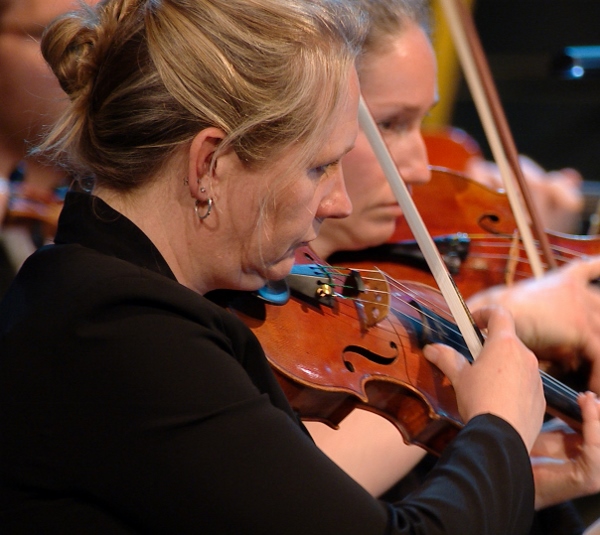 John Wilson’s reading delighted in the sweetly nostalgic episodes that are the glory of the Ninth, though he also built a superb head of tension in the finale, bringing its climax to a real high point before the last, fading moments. That balanced the grim heaviness of the opening, but VW undoubtedly knew how to maintain interest through contrast, and the textures and harmonic language he’d used with such appeal from his early years to evoke an “English” lyrical feeling kept popping up to entice and charm. The Hallé strings, at full 60-odd strength, are masters of this sweet gentility, and were led by Hannah Perowne (pictured). They excelled in the second movement, while the wind and brass were effective in the clumping rhythms and swirling figuration of the scherzo (aspects of the writing that are themselves strangely reminiscent of Holst’s in The Planets). The last movement, with its high sustained strings, soaring melodies and emphatic counterpoint, brought one evocative paragraph after another, with all the solo resources of this orchestra in play.
The Planets may have been the principal reason for a reassuringly good turnout of Hallé attenders on a Thursday night, and Wilson gave a disciplined and thrilling account of it. It helps to have a big body of strings, of course, and also to add a fourth trombone to the line-up, producing a fruity roar in the brass chorus that was telling in effect again and again.
“Mars” was skilfully controlled in dynamic rise and fall, proving both impressionistic and scarily loud, and with careful control of the forward flow in “Jupiter” we enjoyed the best of each of its themes, while “Saturn” was built to each of its high points and an effect that was (as Holst wanted) quite devastating at the climax. There was clarity and precision, too, in gentler sounds and delicate effects, which were as much the mark of this reading as the big ones. Familiar fare it may be to orchestral players, but this performance was never a routine one.
- Broadcast live on Radio 3
- More classical reviews on theartsdesk











