

Kahchun Wong’s third Bridgewater Hall concert with the Hallé in his inaugural season as principal conductor consisted of just one work: Bruckner’s Symphony no. 9 – but not in the incomplete three-movement version that until quite recently has been the norm in Manchester (and elsewhere).
The story that only three of four planned movements were completed, with mere sketches for the last one being found at the composer’s death, was widely accepted, and when Cristian Mandeal performed and recorded it with the Hallé in 2007, and Ryan Wigglesworth played it with them in 2017, that was the version we heard.
But this time it was with a complete fourth movement, as conceived and most recently re-edited by the Australian musicologist Dr John A Phillips – this has been performed by Robin Ticciati, and he and Riccardo Chailly (who is to give it in Amsterdam and Milan), and Kahchun Wong, we are told, all believe this will be the form the work takes in future. The material that Bruckner left for the finale has been found to be much more extensive than just sketches, so much so that a convincing case for a complete restoration can be made.
It adds up to an epic journey in music that takes 90 minutes to play and which Wong, in a brief pre-concert chat to his audience, likened to The Lord of the Rings. He’s keen to take listeners on musical adventures – his previous concert, including Tan Dun’s Violin Concerto: Fire Ritual, with Eldbjørg Hemsing as soloist, was a UK premiere of a radically novel piece given by him and her in 2019 with the New York Philharmonic – and this showed the same desire to enter new territory even in staple 19th century repertoire.
The symphony – undoubtedly Bruckner’s valedictory opus and arguably his greatest – thus forms a concert on its own. That alone made this evening an event to remember, but its interpretation, conducted entirely from memory, also provided an intensely illuminating experience of Wong’s approach and skills as a musician. He and the orchestra had spent the previous week recording it for the Hallé’s own label, and in the Bridgewater Hall performance there was filming going on as well.
Some conductors seem to make Bruckner’s symphonic writing sound difficult: Kahchun Wong makes it, in the best sense of the word, sound easy. It’s not just that the playing is marked by clarity, precision and beauty of tone, but also that the long paragraphs are measured and shaped to be mentally comprehensible, with each part of them melodically led and in proportion to its neighbours, and each bar – often containing superficially repetitive motifs – treated as a step on a journey. Tempo, for him, is a subtle and at times remarkably flexible thing. Mahler may have written myriad instructions about gradations and variations of speed in his scores: Bruckner’s are relatively few, but the interpretative skill of modifying it to expound a structure is something that great conductors of earlier generations found second-nature, and it certainly works in the case of this symphony.
The symphony opened with warm, transparent and balanced textures, the French horn chorus (later to include players on “Wagner tubas”) shining brightly, and the first big tutti of the work was rich and powerful. Then came that flexibility of tempo to introduce the second subject music, itself lovingly handled and ebbing and flowing to form its climax, with solo wind players making singing tone and a splendour in the full brass sound.
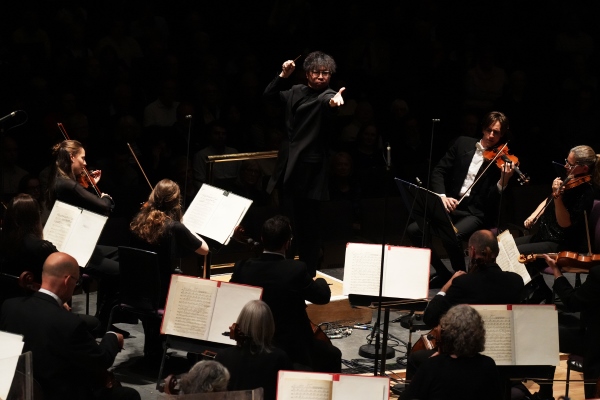
The Scherzo second movement is the only one in the work to be in any sense fast, and yet its one-in-bar triple time seemed unhurried, with precision in the pizzicato string playing and tension built to match the harmonic progressions. If Bruckner meant it to represent hell on earth (as Dr Phillips believes) he also managed to make it sound quite attractive – and after the temporary furiosity of the Trio section Kahchun Wong (pictured above) used the reprise to play to the gallery a little: I hope it looks good in the film.
The Adagio, long seen as a kind of death-bed farewell, seems different when you know there is in fact a finale to come, and this time it had momentum, even drama, the counterpoint of Bruckner’s writing (particularly the combination of two violin lines and horn melody) exquisitely blended. The closing part, where the high, divided strings are ethereal and the music seems to feature a nervous heartbeat while the Wagner tubas’ low register sounds just a little wavery, had intimations of mortality in plenty.
Then there was the finale movement. It has to contain a fugue and a big “chorale” tune, because Bruckner said as much, and in the reconstruction is a complex and many-faceted structure, with drama from the start. There was energy and excitement, and unusual instrumental timbres (the clarinets in chalumeau register near the beginning, for instance), but the highlight comes with what Dr Phillips calls “one of the greatest passages in all Bruckner” as the key centre turns from D minor to D major. That’s not the end, though, and in the reconstruction of its coda there are hugely successful examples of Brucknerian combinations of themes. That was something he said he was doing in this movement, but an earlier attempt at realising it perhaps attempted to combine too many of them: in the new Phillips version it’s the first and fourth movements’ ones that come together first, then others from the Adagio and indeed from Bruckner’s other creations, making a summation of his whole life’s work.
It certainly convinced me that he could have wanted to end the symphony like that, and there’s a gloriously long pedal D to underline the joy of – as Phillips believes Bruckner saw it – final salvation.











