

Manchester’s oldest chamber orchestra has been gathering a new audience at the Stoller Hall in Chetham’s School of Music since that auditorium opened, and Sunday afternoon’s programme provided an excellent example of where the Northern Chamber Orchestra’s virtues lie.
With Chloë Hanslip, the orchestra’s artist in association, appearing as both soloist and director, it also happened to have been selected by the BBC for recording for a radio focus on Manchester music-making, to come in January. (When you listen to that you may just detect some querulous cries and bumps arising from the presence of very young children in the hall in the first half of the concert …. The NCO does a great job in connecting with audiences of the future, too..
But if the first half of the performance was meant to be a demonstration of the most immediately appealing qualities of this small body of top-class string players, led by Nicholas Ward, it was a success. The strings are the heart of the NCO, and, being small in number, they play as real chamber musicians (usually without any conductor at all). The richness and vibrancy of the tone they can make from such small human resources was there from the first notes of Grieg’s Holberg Suite – perfectly incisive and a real coup de l’archet, followed immediately by the beauty of their dolce tone for the Praeludium’s delicious first tune.
Maybe the second violins weren’t quite so perfect on their own a few moments later, but that hardly mattered: the varied textures in the Gavotte movement were beautifully delivered, and in the Air (the least neo-baroque in flavour of all the movements of the suite) the cellos were heard at their best, and there were flashes of passion amid the elegance that made it seem almost like Elgar. Gerald Finzi’s string writing in his Romance is even more of a vehicle for gorgeous string playing than Grieg’s transcription of his own piano score, and here there was lovely warmth of a kind that seems inimitably English. 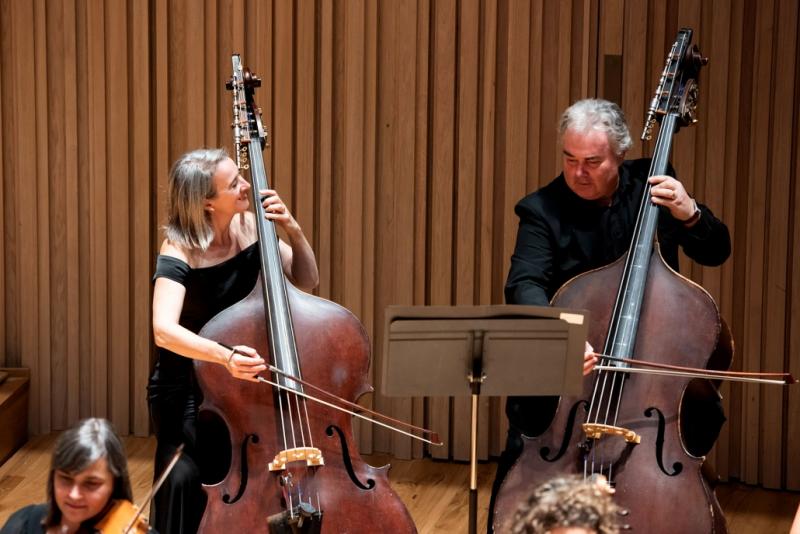 Real Elgar was to follow: the E minor Serenade for strings, played with poise and deep affection under Hanslip’s first-desk direction. The opening was taken quite briskly, but the middle movement grew in depth and beauty – and in it the second violins came into their own alongside the firsts, with noble sounds from violas and celli, also (pictured above by Sara Porter photography, double-bass players Diane Clark and James Manson).
So far, so elegiac, lyrical and even easy on the ear. But the NCO is made of tougher stuff than this, and for the second part of the concert Hanslip was their soloist in Shostakovich’s Sonata for violin, percussion and string orchestra – an odd title for something that’s not far off being a full-blown concerto (written for David Oistrakh). The percussionist, the RNCM and Chetham’s Andrea Vogler on this occasion, is close to being a second star of the piece, as Shostakovich asks her to bring pretty well everything but the kitchen sink to the party: wood block, side drum, bass drum, cymbals, gong … Together the strings and that lot can build quite an amount of noise.
It's challenging, too – not simply to the soloist and other players, but to the listener, starting off with a 12-tone row and rarely indulging in sweetness (though it’s the more effective when it does). Hanslip and the orchestra created an ethereal opening and mysterious close to the Andante, with episodes of burlesque and vehemence in the music in between.
Furious fiddling, horsehair flying by the end, was apparent in the finely accomplished scherzo-style second movement, but the emotional weight of the work lay in its long, quasi-passacaglia-style finale. There were flashes of lyricism and longing, but the first rumbling, and then thunderous, tutti climax was a worthy high-point –followed by a sizzling cadenza, made for the Hanslip Guarneri to shine. It was a serious piece of serious music-making.











