Even by trumpeters’ standards, Håkan Hardenberger is a flamboyant figure. He sports a sharp, tailored suit and a wing-collared shirt, and his stage presence is all swagger and pomp. HK Gruber has captured his spirit perfectly in his jazzy, experimental trumpet concerto Aerial, which has become the trumpeter’s calling card. That proved the highlight of the evening here, though, as it was followed by a lacklustre Mahler Five, a rare disappointment from the usually reliable conductor Andris Nelsons.
The Gruber concerto is in two movements – one slow, one fast – but even in the slow movement there is little sense of poetry or reflection. Instead it begins with a range of semi-pitched sounds, initially achieved through growling, where the player sings a note into the instrument that is unrelated to the note played, and later through removing tuning slides and letting the air escape through the open holes. Some of this is quite radical, from an avant-garde perspective, but its real purpose is to allow Hardenberger to dominate proceedings, which become a vehicle for his showmanship. The second movement is more interesting musically. Gruber jazzes things up, occasionally bringing the music close to actual swing – saxophone riffs, drum kit licks – but without ever going over the edge.
Gruber makes his limited material go a long way, fully justifying the work's half hour duration
Hardenberger now has some proper virtuoso music, runs and ornaments up in the stratosphere, and, as expected, his performance was typically bravura. The programme told us that he has now performed this concerto over 60 times, so he is clearly knows what he’s doing. There is some difficult music here, though, and several splits and unfocused attacks demonstrated that some of the music here tests even his limitations. It’s not a masterpiece but it’s certainly entertaining, and Gruber makes his limited material go a long way, fully justifying the work’s half hour duration.
Quite an act to follow, especially for Alistair Mackie, principal trumpet of the Philharmonia, who had to open the second half with the unaccompanied solo that begins Mahler’s Fifth Symphony. In fact he did an excellent job, projecting a completely different tone and musical personality, here and throughout the work. Sadly, though, the performance that it heralded wasn’t much to the credit of either the orchestra or the conductor. Andris Nelsons always brings youthful energy and zest to the Austro-German symphonic showpieces, but he can usually combine that with an innate understanding of the architecture and of the cultural significance of all the genres and forms within each movement. That’s what he delivered two weeks ago with this orchestra: a Bruckner Third that was inspired in every respect.
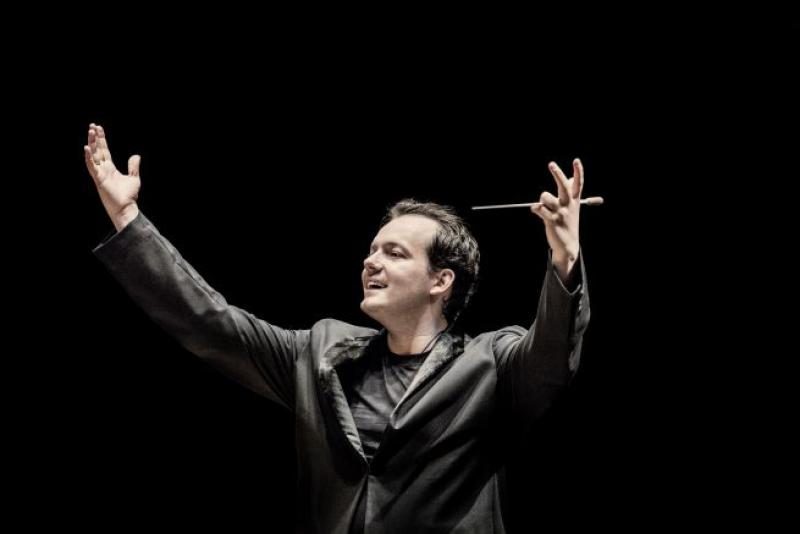 Yet this Mahler didn’t add up, and it was difficult to work out exactly why. Nelsons (pictured right) is never pedantic with his tempos, and he is always prepared to pull back when required. But even in the quiet, slow music he still conducted with a heavy, definite beat, seemingly reluctant to relinquish control and give the woodwind and brass soloists the space they needed. The louder and fast music was pushed hard, but often in the wrong places and in the wrong directions. Section endings, and especially the endings of the first, second and fifth movements, seemed poorly timed and even arbitrary. Even the Adagietto was presented as a regimented arc, everything pointing towards the climax, and with Nelsons taking little interest in the shaping of individual phrases.
On top of which, the orchestra were in poor form. There was little of the clarity they usually bring to Mahler’s complex textures. Entries were often messy (some were poorly cued), and the unity of purpose that this music relies on so heavily was only occasionally apparent. From a lesser orchestra and a lesser conductor, much of this may have been forgivable, but the Philharmonia and Nelsons, both together and apart, have repeatedly demonstrated that they are capable of far more than this – a serviceable Mahler Five, but no better than that.