

It was guaranteed: string masterpieces by Vaughan Williams, Britten and Elgar would be played and conducted at the very highest level by John Wilson and his Sinfonia of London.
Would a rarity by Arthur Bliss and a slow movement from a Delius string quartet arranged by Eric Fenby match them? The otherworldly Delius did; the muscular Bliss, despite special pleading by John Wilson in an affable spoken introduction, sounded magnificent and was worth hearing, but not quite on the genius level.
No matter; this was a vintage Wilson programme, and the mastery of him and his players was immediately apparent in the softest, most magical sounds possible in Vaughan Williams’ infallible Fantasia on a Theme of Thomas Tallis – no easy task in the Barbican, which makes perspectives difficult. But those numinous chord progressions instantly took us into the beyond before the Tallis melody began to sing. Wilson had all the time in the (other) world for the outer hymns; the central rhapsody moved faster, but was graced with improvisatory-feeling solos from viola-player Edgar Francis and leader Charlie Lovell-Jones. 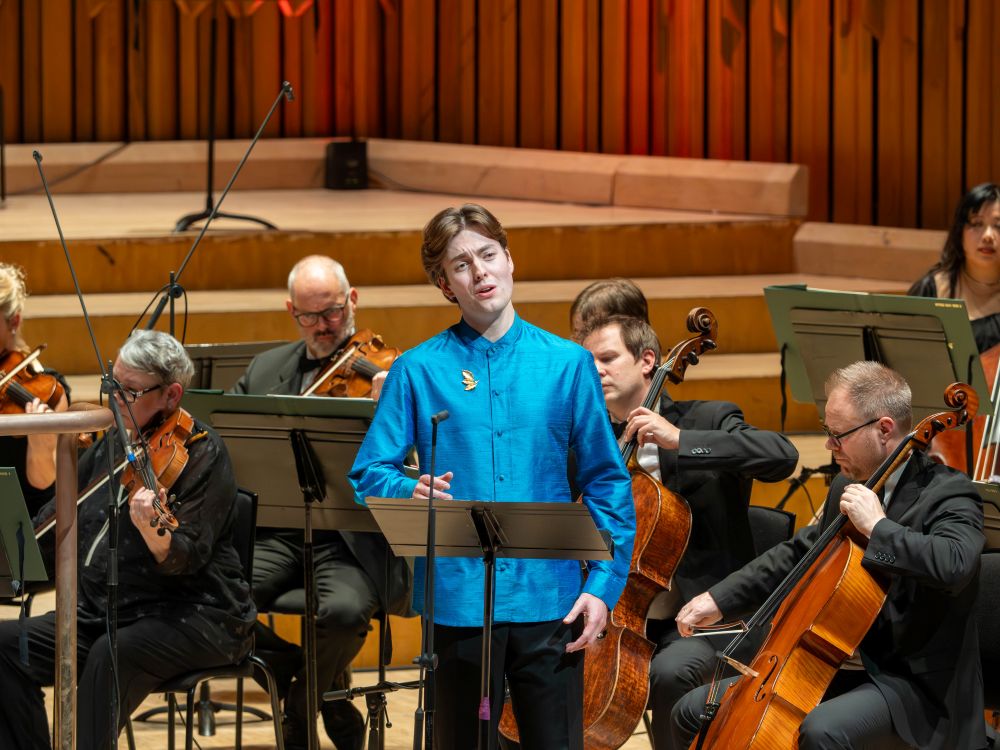 When we reached the exquisite final setting of Britten’s Serenade, of Keats’s Sonnet to Sleep, we felt we’d come home, but with the younger genius’s special stamp: more multi-part magic, with the additional balm and aching expression of young tenor Laurence Kilsby (pictured above). The last time I heard him sing Britten was as a treble, “a voice in a thousand” (forgive the self-quotation from 2011), in Tewkesbury Abbey. The voice is singular, obviously not extending to the power of an Allan Clayton, the most comprehensive interpreter of Britten and especially the Serenade we have at the moment. But the effect is akin to that I witnessed from Irish soprano Ava Dodd in the ENO Carmen – another voice that isn't big, but so alert to every word and its expressive possibilities that everything compels (especially here the baritonal colour in Blake’s “O Rose, thou art sick”).
Kilsby never forces, and the rapid runs in Jonson’s Hymn to Diana, beyond some famous tenors (no names), delighted alongside the Mozartian evocation of Christopher Parkes (pictured below), principal horn of Wilson’s team and also of the Swedish Radio Symphony Orchestra. His tones, too, were fine-tuned to the amazingly detailed work of the strings, the distant echo of the opening at the end perfectly placed. So yes, a Serenade, like treble and tenor Kilsby, in a thousand. 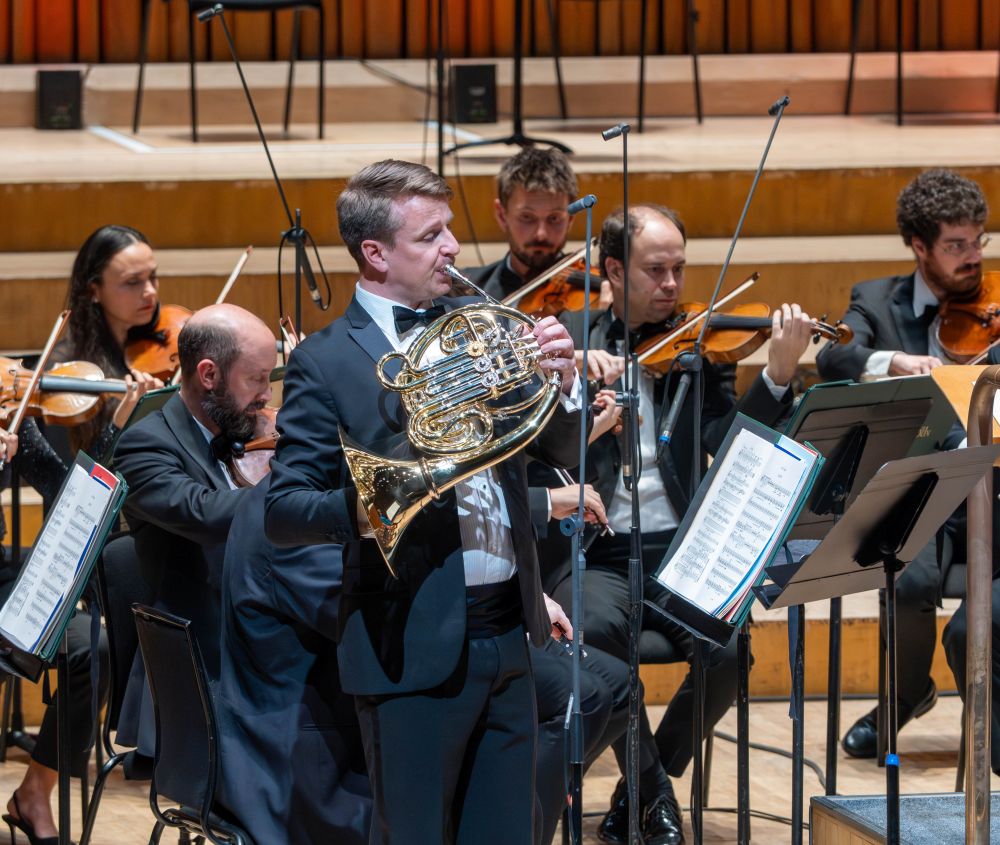 Introducing the second half, Wilson engagingly told us that as a fiddler, Elgar knew everything about string writing for his Introduction and Allegro: “just switch it on and ride on the back of it”. Actually the conductor has some decisions to make, and I found the first theme of the Allegro a bit too rapid-bumpy, not elusive-wistful. But that was a choice in a generally rapid interpretation, and the sound of violins passionate on the G string was unforgettable, with again excellent solo work.
Bliss’s Music for Strings came first: distinctive in its exposed virtuoso flourishes and rhythmic kick, played to the focused limit. Memorable? Possibly it needs another hearing, but only one idea really stood out for me, the central one of the Andante. The mystic fade at the end of the first movement, though, brought more barely-heard enchantment. And the “Late Swallows” circling at the heart of Delius’s slow movement were as haunting as anything in the Vaughan Williams or the Elgar. A perfect balance of head and heart, robust and tranquil – what a shame there weren't more people in the audience to relish it. But the response was still vociferous, and deservedly so.











