

Violinist Patricia Kopatchinskaja has a joyous hunger for communication through music. She sometimes seems to dance through it. This was at its most vivid when she lunged towards BBC Scottish Symphony Orchestra leader Laura Samuel to invite her to start the encore at the end of the first half of Saturday’s Bartók Roots Prom, “Baladă și Joc” (ballad and dance), a duo for two violins by György Ligeti.
This friendly challenge – gleefully accepted – was made in the spirit of bringing the energy and vitality of folk fiddling into the formal arena of classical music. As Kopatchinskaja has said in a recent interview: “Away with the cages of convention!”
That search for the folk inspiration and energy that lie behind Bartók’s music was the theme of the Saturday night Prom. In each half, the performance of the main work was preceded by a 10-minute back-and forth between Hungarian music played by Folktone, a UK-based quartet led by Adam Römer, all of whose members received their musical education in Hungary, and the orchestra and soloist playing short extracts from each of the works which were about to be played in full. The folk group brought us, as might be expected, the alluring timbres of a cimbalom, but also the far less familiar ütőgardon, a cello-shaped instrument which is beaten with a stick.
The main work in the first half of the concert was Bartók’s Second Violin Concerto. Kopatchinskaja made an award-winning recording of the piece nearly a decade ago, and her performance of the work has been evolving since that time. Whereas back then she seemed to relish the occasional instruction in the score to play ruvido (roughly), these days it is the quieter, dream-like, ethereal worlds in this concerto which really capture the imagination and stay in the mind. Instructions in the score to play tranquillo and con calore are heeded spectacularly. The Quasi Lento section in the last movement was an especially beautiful oasis of calm. 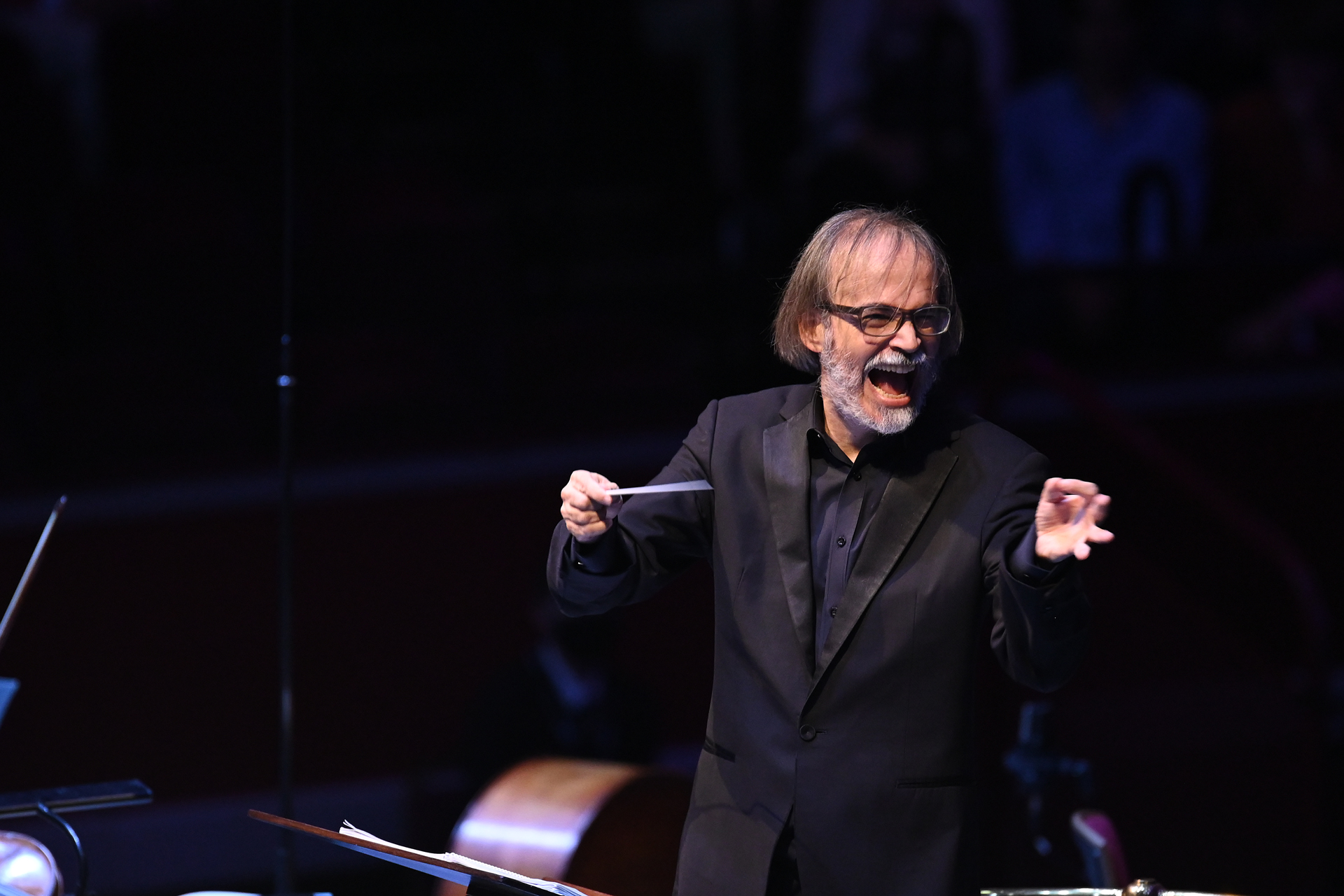 This work has been described as “the most polished of all his concertos”, and the BBCSSO under Ilan Volkov pictured above (pictured above) did that aspect of the work complete justice. For a hall known to present all kinds of acoustic challenges, Saturday’s performance was remarkable for its balance, accuracy and finesse. The entrances from the brass section in the third movement were particularly gratifying, clean and crisp.
Kopatchinskaja’s first deed the moment the concerto had ended was particularly unselfish: she wanted above all to applaud the orchestra and conductor. All in all, this was a very fine performance, and the quality of the orchestral playing to be heard in the hall is confirmed by listening to the concert on BBC Sounds.
The Suite No 2 for Orchestra, performed in the second half, is heard far less often; it is believed never to have been played at the Proms before. It was originally written in 1905-7. Paul Griffiths’s programme note sets the context well for a work which is steeped in the orchestral music which preceded it – he mentions Till Eulenspiegel and Tristan – but which also looks forward so clearly to Bartók’s own later masterpieces. The fugue in the second movement feels like a young and callow cousin of the one in the final movement of the Concerto for Orchestra. The clarity with which Volkov paced the inventive twists and turns of the last movement was awe-inspiring.
The folk background to Bartók is such a fertile path for exploration. It is an area also occupied by the Budapest Festival Orchestra, who have brought some fascinating programmes to London in recent years. The difference was that the message on Saturday was given wordlessly rather than explained through speech; the music itself was allowed to do the talking. Listeners not steeped in Bartók are bound to find the Hungarian music readily approachable. Can it function as an entry-point to appreciate Bartók’s artful subtleties? Maybe. Above all, this concert worked with the premise that barriers to communication don’t – or shouldn’t need to – exist between different genres of music.











