

It might seem odd to start with the encore, but I’ve never seen one like it. At the end of its two-night residency at the Festival Hall, having just romped through the rigours of The Rite of Spring, the players of the Budapest Festival Orchestra put their instruments down, shuffled to their feet and sang for us. Stravinsky’s humble, minute long Ave Maria made the perfect counterpoint to the violent paganism of the Rite, and the sound made by the untrained voices of these highly trained musicians added a vulnerability and sincerity to what had gone before.
The two all-Stravinsky programmes that the orchestra offered – the Friday night audience depleted by storm Eunice – followed the same structure: an orchestral opener followed by a concerto and rounded off with one of the great ballets. The sizzling Rite of Spring was the highlight, but the concertos were both very satisfying performances.
Patricia Kopatchinskaja threw down the opening chords of the Violin Concerto pugnaciously, like she was challenging the audience to a fight. Her punky, combative approach propelled the first movement forward with a pleasing devilishness, but at time risked being pantomimic. But in the middle movements, a pair of arias, Kopatchinskaja found a beautiful cantabile, sensitively accompanied by a deceptively large orchestra.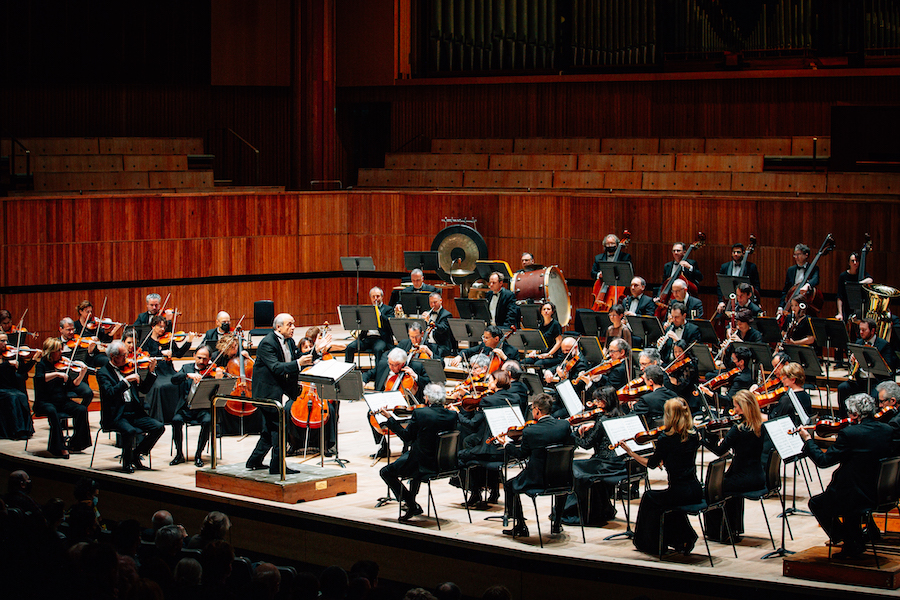 Iván Fischer used some eccentric seating plans on both nights, most notably in the ViolinCconcerto, where the front row of strings was replaced by the low brass. I have never seen a tuba sitting where the principal second violin should be, but it made sense of some of Stravinsky’s oompah textures and the tubist, Jószef Bazsinka, was terrific throughout.
Fischer’s conducting, which is always watchable, at times almost slips into micromanagement. He was more understated in the concertos than elsewhere, and fantastic in the last movement, which threw caution to the winds and was genuinely exciting in its edge of danger.
The concerto on Friday was the Capriccio, a work for piano and orchestra from 1929 that Stravinsky wrote for himself. It is not therefore the most demanding solo part, but requires characterisation and swift changes of tone. I was really taken with the playing of Nicolas Namoradze (pictured below by Nathan Elson), who is a bit of a dude, from his green shoes upward. His playing was precise and cool and very Stravinskian, technically effortless. Stravinsky’s writing is witty, with everything in quotation marks, and Namoradze got that, conjuring the references from Tchaikovsky to Ravel with understated ease.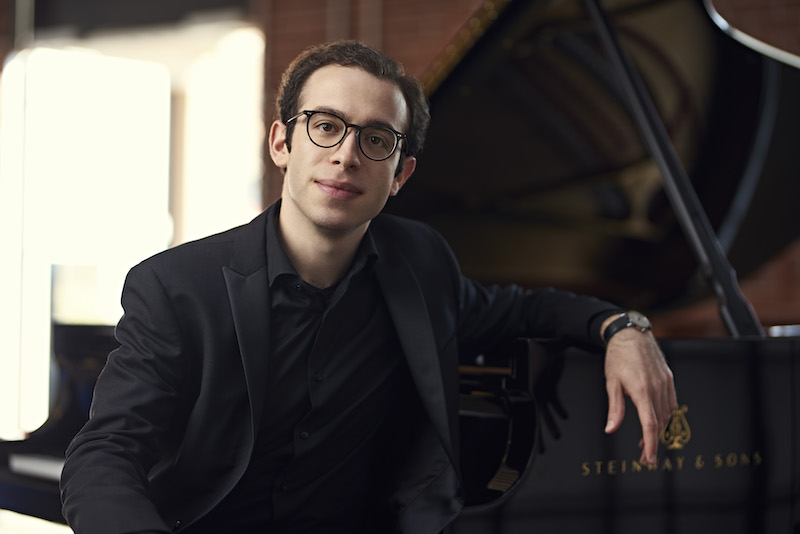 Petrushka, which ended the Thursday concert, was very good, if not electrifying. Fischer here cast himself as the ringmaster – belying his general demeanour of a genial maître d’ – leading the parade of characters at the Shrovetide Fair. The multi-layered orchestration was delightful, with some wonderful wind playing from clarinettist Ákos Ács and buoyant bassoonist Bence Bogányi, who was also fantastic in the famous Rite opening. There were a couple of moments of problematic coordination and a couple of brass fluffs, but in this regard we are spoiled by being used to perfect recordings and these moments are a small price to pay for hearing such an orchestra in full flow.
Jeu de Cartes, the Thursday opener, was surprisingly sluggish at first, and perhaps lacked a sense of fun, until the ending, one of Stravinsky’s best. Likewise the Concerto in D on Friday didn’t quite have the sharpness of attack it really needs – I was surprised the violin and double bass contingent wasn’t reduced for this as it felt just too full-bodied for what is really a concerto grosso.
But there were no such reservations about The Rite of Spring. Since this is an absolute favourite of mine I am predisposed to enjoy it – but also perhaps predisposed to be disappointed. No danger of that here. From the teeming winds of the Introduction to the violent end, everything was as it should be. Fischer, conducting from memory and almost throwing himself off the podium at one point, found some new things in the score – I particularly liked his slightly prolonging the bassoons in the final chord of Part 1. The strings were rich and dark in the “Spring Rounds” and the ensemble throughout as tight as handcuffs. The “Sacrificial Dance” had some eccentric tempo changes but built to a fine frenzy – before the brilliant final gesture of the orchestra as choir, faithfully following their leader to the most unlikely of destinations.











