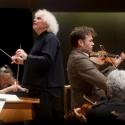
With regional youth orchestras dropping from a thousand short-sighted, wholesale cuts - flagship Leicestershire the latest under threat - it should be enough just to celebrate 60 seasons of the LSSO, safe for now under the City of London's munificent wing. But last night was more than just another fun concert. No one ought to miss any appearance of the, ahem, enormously charismatic Leif Segerstam, composer of 244 symphonies to date and master orchestral trainer, who always goes for depth of sound rather than surface glitter. Nor is it every year you get to hear the Britten Cello Symphony, one of the few thornier masterpieces of the last 50 years to change shape and colour each time I hear it.
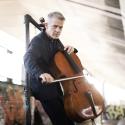
What I wasn't expecting was to find the ghost of Sibelius behind Britten's icy North Sea winds. Not the Sibelius of the cheery/bittersweet Karelia miniatures, where the composer's jovial compatriot even let his London young musicians do their own thing for a few bars in the Alla marcia while he turned to the audience, playing up to the Santa Claus image, and performed his version of a soft-shoe shuffle. No, Britten seems to have at the back of his mind the lean master of the Fourth Symphony and Tapiola, whose wood sprites flicker around the eerie, unquiet scherzo; throughout, there's the same sense of a desperate need to break free of the soul's dark night. The Symphony for Cello and Orchestra, to give it the full name, is a tough, exposed work for youth to handle, with huge gaps in the scoring to let the cellist breathe, however painfully. The centre certainly held here. LSSO's woodwind captured the elusive mood of their wraith-like writing and Segerstam's firm underlying rhythmic sense, apparent from the first bars of Berlioz's Roman Carnival Overture, was matched by that of his quietly remarkable cellist daughter Pia (pictured below by Kira Glusckoff).
 Very well, so it's not a sound that tears at the soul from the first note like that of the dedicatee, Rostropovich - whose is? - honoured by Britten with a starkly uningratiating monument to set alongside Prokofiev's Symphony Concerto and Shostakovich's Second. But Segerstam fille - a slender Mountain King's Daughter, focused inwardly on her playing rather than giving out to her younger colleagues - projects a more tightly focused golden tone that never let go of Britten's tortured rhetoric. There are still textures here that anyone writing a new work today would kill for, above all the return of contrabassoon, tuba and double bass writhing with woodwind unisons above boring a memorable oscillation into the brain while the cellist strums guitar-like pizzicati to its uneasy rest. The work's final, almost cinematic liberation always comes as a surprise: another case, perhaps, of Billy Budd's repressed sea captain catching sight of "a far-shining sail". And it is indeed a true ensemble piece which shares its bold ideas; outstanding contributions came with gun-shot timpanism from Jack McNeill-Adams and a skewed sea-shanty trumpet solo boldly taken by Louis Barclay.
The rest of the programme was more of a holiday, though Segerstam showed a true Finn's austerity in the abrupt pauses between the surprisingly busy string textures of Karelia's Ballade. He wouldn't let Berlioz's carnival coruscate: this was more a case of Kaurismäki's laconic Finns abroad - Leningrad Cowboys do Piazza Navona, perhaps, gaping with beers in hand at the kerfuffle around them - but what it did boast was exemplary tempo control and fabulous crescendi. Which takes us all the way from the single-note swells of horn and clarinet to the slow burn of ghost cohorts on the Appian way in Respighi's Pines of Rome.
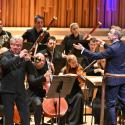
That's always a good showcase for large youth-orchestra forces, and duly unfurled with inscaped splendour as the ancient Roman buccine fanfared from the Barbican Hall's grand circle; but here, too, Segerstam brought his own sound to bear in the unique depths of string tone that turned the auditorium, somehow, into a resonating cathedral for the central rites of catacombs and Janiculum. And he took a typical liberty with the swelling chant of underground Christians - starting loud with unforgettable contrabassoon edge, rising to apocalyptic. Yes, the Segerstam crescendo is unique, as is the man himself, who ambled out to the front stalls at the end to encourage a standing ovation for his fabulous young players.
- Find out more about the Centre for Young Musicians where the LSSO is based
- See what's on at the Barbican Centre
 Find Leif Segerstam on Amazon
Watch Segerstam conduct the Gothenburg Symphony Orchestra in the Alla marcia from Sibelius's Karelia Suite