To find a single completely successful piece in a contemporary music programme is rare enough. The sieve of time has yet to separate the wheat from the chaff. But to find complete satisfaction in all five pieces programmed, and for all five pieces programmed to be by the same composer, is a testament to one thing: that George Benjamin is a total genius. I am not the first to have noticed this. The six-year-old Benjamin was Messiaen's favourite pupil. They are pictured above; a white-haired Messiaen is sat in the middle next to a bashfully bushy-haired Benjamin.
At 20, while still a student, he became the youngest composer to write a new work for the Proms. There were two works from this early stage of his compositional career in last night's 50th birthday celebrations at the Queen Elizabeth Hall: A Mind of Winter (1981), a good, solid work, and At First Light (1982), an astonishing one. The first reveals Benjamin's facility at exploiting orchestral colour and balancing periods of change and aural blocks of repetition. Clare Booth sung the words of Wallace Stevens's downbeat poem The Snow Man with her usual force, while the woodwind of the London Sinfonietta evoked the invading cold of winter within a sandwich of a sustained A-minor frost
At First Light is as hot as A Mind of Winter is cold. A flooring combination of timbres greets us at the peak of the first climax; a blinding triangle, high trumpet and piccolo weave round a woody tap, all emerging from a late Romantic crescendo. Moments later the babbling oboe line of what appears to be the duck from Prokofiev's Peter and the Wolf waddles into the din. A pearl necklace, borrowed from Messiaen's Vingts Regards, is unfurled by a celeste; moments of trilled, tremoloed intensity wash across us; an awakened tamtam is cut short; a ping pong crickets in a glass. What we are hearing is a dawn being recreated in high definition.
At First Light is, however, much more than just clever impressionism. This is a dramatised dawn of the kind that Mahler might have appreciated. A careful, convincing, Romantic ebb and flow is shunting us along, one with a modest not quite Mahlerian epiphany from the bassoon, the sudden sounding of a heart-warming diatonic interval, played over a fleecy vibratoed quintet of strings. At First Light, written when Benjamin was just 22, is up there with the progidious achievements of Mendelssohn and Mozart.
And this early talent hasn't been squandered. On show was a thoroughly impassioned, almost symphonic duet for violas (if that's not a contradiction in terms), called Viola, Viola from 1997. Intense, long-bowed passages alternate excitingly with the jagged stab. The last page of music, full of half-heard plucks, thin up-bows and disintegrating harmonics, was reminiscent again of Mahler, this time his Nachtmusik. The most accessible work, the Piano Figures (2004), written for the amateur pianist, deserves to become a modern classic, a 21st-century Pictures at an Exhibition, such is the economy, lucidity and attractiveness of the writing and the rightness of the aural evocations of the various images tackled.
What also comes through in the last movement of this work is a new-found fierceness that comes to dominate Palimpsests (1999-2002), the dark last offering of the evening. In it, we follow a group of polyphonic fragments migrate around the orchestra as they are assaulted, then crushed, by brass. Few modern works move through such affecting worlds as this. With the re-emergence of the opening phrase on muted violin (cradled by snare drum), and the escape of this aural shadow into the sound world of the lute (recreated by a small string orchestra), we enter a vortex of passionate musical development that intimidates us through to the end.
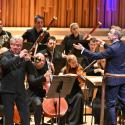
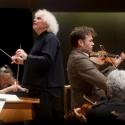
Off stage, Benjamin still has the air of a child prodigy about him: an otherworldly, awkward manner. This all changes when he hits the podium. He conducted the London Sinfonietta with enormous, impassioned arm movements (very unusual for a conductor of contemporary classical music), his mouth blinking like some creature of the deep. Throughout, he was beaming. And the audience, one of the most refreshingly normal audiences I have ever seen at a concert, was beaming with him.
- The London Sinfonietta's next performance at the South Bank, including work by Gerald Barry and Richard Ayres, takes place on 17 March at the Queen Elizabeth Hall. They also take part in the Barbican's Wolfgang Rihm Day on March 13.
- Find more about George Benjamin at Faber Music.