

The Scottish Chamber Orchestra’s final season concert conducted by Robin Ticciati, who leaves his post as chief conductor of the SCO for the Deutsches Symphonie-Orchester Berlin, was bound to be an emotional occasion. Spanning a decade, the relationship between orchestra and conductor has been a very special one indeed, and has seen an abundance of success over the past 10 years. The fervour and intensity shown in the playing at Edinburgh’s Usher Hall on Thursday was almost palpable, a fitting finale to such a fruitful partnership.
Opening with a small band of players, JS Bach’s Orchestral Suite No. 4 in D had a golden, rich timbre perfectly suited to the period, but still shone with a startling level of clarity and finesse. Each minute detail was independently audible, coming together in a deftly woven musical tapestry. Ticciati’s conducting, though at first glance smooth and serene, was highly detailed and nuanced, as he teased out the subtle sway in Bach’s dance music. Placed at the front of the orchestra, the bassoon sounded bright and clear, coupled with the continuo to give a steady underpinning to the music.
Ticciati’s intimate relationship with each orchestral section set the music’s layers aglow
Moving into a different sound world entirely, the SCO’s own principal clarinettist, Maximiliano Martín (pictured below with other SCO players and Ticciati), took centre stage to perform Copland’s clarinet concerto, written for solo clarinet, string orchestra and harp. The swooping, almost cinematic sounding strings epitomised that crisp, American sound with a perfect balance of lucidity and dreamy lyricism. Commissioned and premiered by Benny Goodman – the "King of Swing" – who then had a two-year exclusivity on performing the work, this is a concerto which beautifully blurs the boundaries between jazz and classical. One of the wonderful things about this orchestra is their showcasing of their own players. Martín exuded genuine warmth and had a captivating presence on stage. His playing was immaculately controlled – although maybe too much so in the cadenza ending the first movement, which seemed to lack any real element of chance. 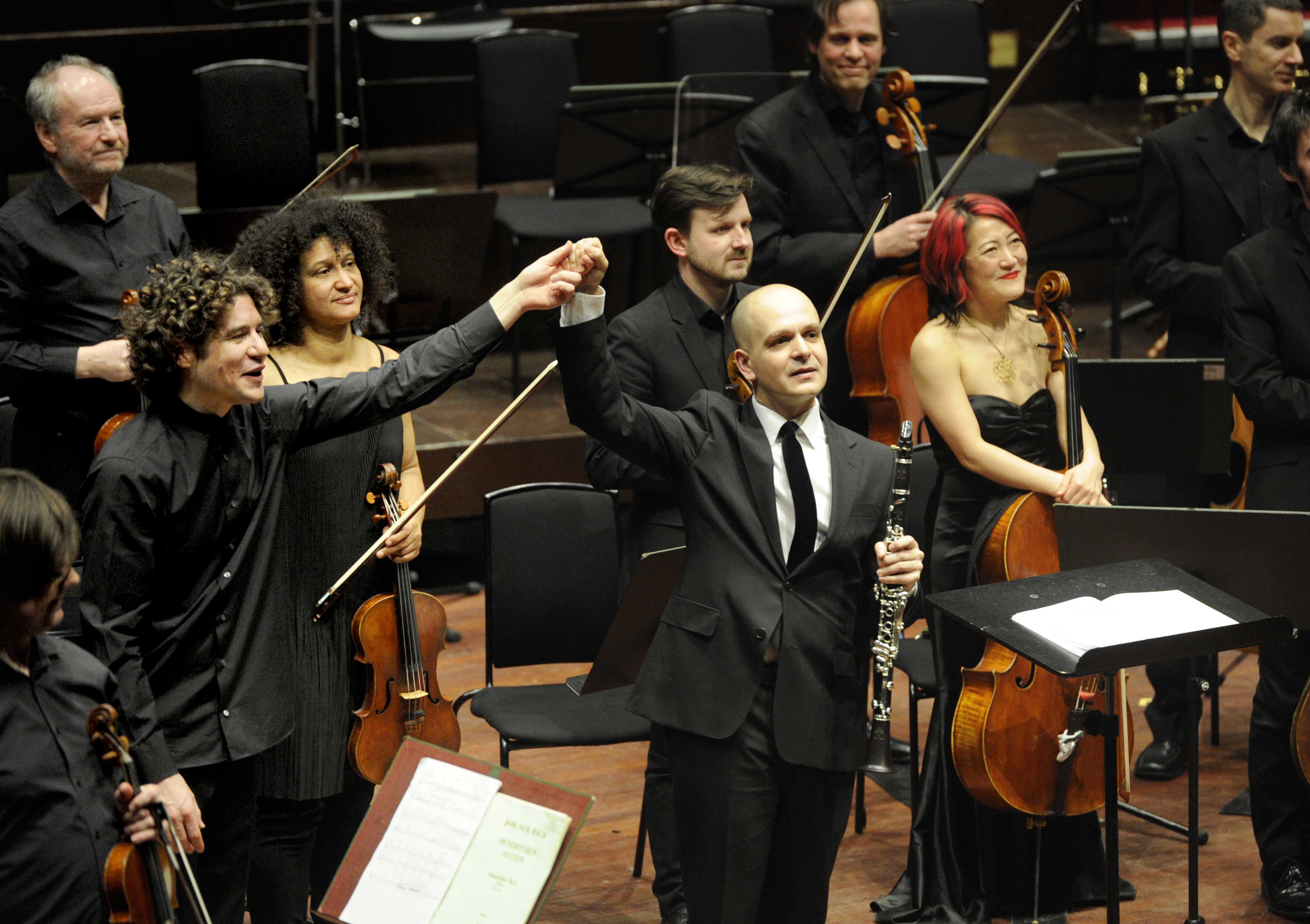 But the true zeal of the programme lay in the second half, with a breathtaking performance of Dvořák’s 9th Symphony "From the New World". I have never heard a performance of this symphony quite like it, either in a concert hall or on recording, and expect I never shall again. This was proper edge-of-your-seat stuff. Ticciati’s intimate relationship with each section set the music’s layers aglow, with excitement and energy in every chord. Beginning with a magnetic intensity, the full forces of the Scottish Chamber Orchestra delivered some really meaty playing, racing into the Allegro Molto section of the first movement with a ferocious velocity.
The second movement, the Largo, opened with deep, ponderous chords, as a velvety backdrop to Robin Williams’s soothing, soaring oboe solo. The most moving music of this movement, however, was in the silences, each full rest pregnant with possibility. The third Scherzo movement was both galvanising and galvanised, brimming with an infectious, driven energy before the orchestra moved into a fierce and fiery finale. Ticciati took it at quite a lick – a hair’s breadth faster would have been too much – but the tempo he maintained was just enough to pack a punch without losing any detail.
This was a performance to be cherished, and a triumphant culmination of Ticciati’s sterling work with the orchestra – and indeed, theirs with him.
- Ticciati will return to conduct the SCO in the four Brahms symphonies at the Edinburgh Festival
- Read more classical reviews on theartsdesk











