

Praise be, or slava if you prefer, to Valery Gergiev for honouring new Russian music alongside his hallmark interpretations - ever evolving or dangerously volatile according to taste – of Prokofiev, Shostakovich and Stravinsky. Last LSO season featured some of the less than inspired recent works Rodion Shchedrin has been dredging by the yard. Yet few would begrudge the palm of deep and original musical thought to this past week’s heroine, Sofia Gubaidulina. Gergiev riveted a quarter-full Albert Hall with her stunning St John Passion and Resurrection at the 2001 Proms, and last night he had a great performer Gubaidulina understandably respects, Anne-Sophie Mutter, as style icon in the profoundest sense to act out what the conflict in her latest work for violin and orchestra is all about.
In tempus praesens bends the "present time" it purports to be all about with unstable interchanges between soloist and kaleidoscopic, unpredictable orchestral groups. The courage of Mutter's ardent solo violin at the start with its intense, human vibrato sometimes takes a battering from the heavier scoring - though the singular colour of the three Wagner tubas fleetingly present couldn't really be detected - and several times is silenced by the oracular "enough" of a giant tam-tam, struck by a player with his back to the massive instrument.
 An intensely beautiful, chorale-like weave between soloist and woodwind is brushed aside by manic flights and monster-toybox rattles taking up where Shostakovich, another great innovator with the percussion battery, left off; a relentless three-note string tattoo urged by Gergiev with his usual insistence on fullness of sound finally ushers in a big cadenza before a final metaphysical soaring.
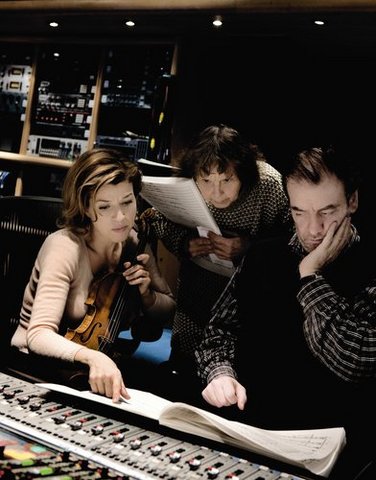
One Russian cellist told me he saw the end of Prokofiev's Symphony-Concerto as the Russian image of the soul squeezing in to heaven through the eye of a needle, as it were, and that's how Gubaidulina's strange adventure (the composer pictured above with Mutter and Gergiev) seemed to end. And adventure it was, moving forward through space - or certainly seeming to do so through Mutter's urgent interaction with Gergiev's ever-vivid LSO - in a way that few contemporary pieces genuinely achieve, and stocked with enough ideas for half a dozen works by a lesser composer. This is a concerto that's here to stay.
Collectively, the woodwind plumb unison depth of tone that few achieve in Shostakovich's whirlwind Scherzo
Nearly 60 years on, there's no doubt about the status of Shostakovich's 10th Symphony, one of the most monumentally entrenched in the repertoire out of the 15. Gergiev's latest way with a work he knows inside out no longer favours much brooding atmosphere - slow introduction to the finale excepted - nor colossal tragedy, only a mastery that understands how every corner must be turned, and how to communicate that turning with the finest nuance to the players.
Collectively, the woodwind plumb unison depth of tone that few achieve in the whirlwind Scherzo - which may, or may not, be an evocation of Stalin's terror years looking back from the temporary release of 1953 - but they’re equally impressive as individuals. If you had to slice into the interpretation for the truest evidence of Gergiev’s moulding, it would probably be for the combination of ravishing tone colours from flute and softest pizzicato in the limping waltz that ever so cautiously lifts the laments of the first movement.
Yet every solo brought its fine-etched personality, culminating in the personal pleas of Nora Cismondi's oboe and Rachel Gough's bassoon, both superlative, before the clouds lift for what in this case was an unequivocally springy final romp. As the years pass, we come to hear Shostakovich's symphonies as flawless constructions not necessarily freighted with the horrors of his times, and in that respect Gergiev seems to have loosened up as much as many of his younger fellow conductors. But then next time his Shostakovich 10 will probably sound different again.











