

Though billed as a “concert performance”, this was really much more than that. With the resources of their own theatre, Opera North’s team present a staging that employs a big, built-up and raked floor, with a simple platform in the centre and a starry-night black back-cloth, and their principals and chorus move and act in simple but effective style.
There are costumes, there is theatre lighting, and there are sound effects – thunder and rushing wind noises tell us we’re visiting the land of the dead and abode of the Furies (as well as Gluck’s music, of course). I’ve seen poorer production values in other places that claimed a director, a designer and production staff. In this case the only published credit, apart from those to the musicians, language coach and stage management, is to Sophie Gilpin for “concert placing”. But someone’s been working hard.
There was a distinct reason for taking notice of this first night in the Grand Theatre, Leeds, rather than the first performance in Huddersfield Town Hall the previous week (which was, I think, accurately termed a concert version). This was the one-night-only debut in the leading role of Orfeo by Polly Leech (main picture), a young British mezzo-soprano who has already made some impact. (Alice Coote sings in all other performances).
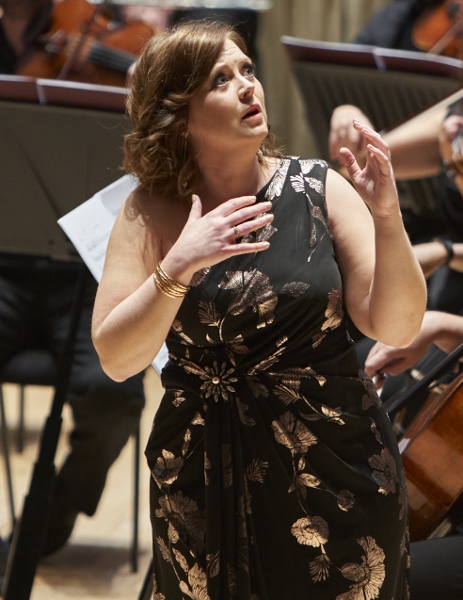 Polly Leech is an accomplished actress-singer with the ability to convey meaning by using her face and body language as well as her voice. She may not yet have developed a deal of power in the lowest register of this part (it was originally designed for a castrato), but she floated her sound smoothly and beautifully over a pretty punchy orchestral sound, and saved well judged extra impact for the key moments in the drama. The audience was waiting for her “Che farò”, of course, and duly applauded (as audiences often do when they hear a number they know), stopping the show, but it had not been just a matter of pure tone and smooth line, Kathleen Ferrier-style, but also an expression of anguish and despair, in keeping with the story.
Drama was dominant in Antony Hermus’ reading of the entire score. Opera North’s principal guest conductor had something to say about this music: it’s not a slightly insipid precursor to Mozart but something that was striking and moving when first heard – a bit like Handel on steroids. Orchestral articulation was impactful, delicate when required, and the instrumental colours clear. (The echo effects in “Chiamo il mio ben così” were really subtle and almost realistic).
Fflur Wyn (pictured above right) sang Eurydice as effectively as did Polly Leech her role: pre-toned, alert and full of character. The duet-argument between her and Orfeo became the highspot of the evening and earned its own applause.
And Daisy Brown’s interpretation of Amore, the goddess of love who has to appear to move the story on at its two critical points (this is the Orpheus legend with a happy ending, as Amore, feeling sorry for him, brings Orpheus's loved one back to life after all), was imaginatively created, pulling every nuance of knowing experience and seductiveness from the text.
Following their “re-imagination” of Monteverdi’s L’Orfeo, this was Opera North doing the later and better-known operatic version of the Orpheus and Eurydice story pretty well straight. It makes an interesting contrast, as Gluck’s Enlightenment approach, focusing on classical balance, proto-Romantic expressiveness and would-be realism, produced a piece that buffs up well even now. There are limitations here – the chorus re-appearing as a “joyful band” (according to the surtitle translation) when changed from Furies to Blessed Spirits, but still in the same black garb, brought a few titters from audience members who sensed a touch of sarcasm, and their attempts at beatific grins to counter that impression – but it made a good night in the theatre nonetheless.
- Further performances at Leeds Grand Theatre, and touring to Newcastle, Nottingham and Salford











