There it gleamed, the pearl in the massive oyster of Albert's colosseum: the gilded, decorated piano supplied to his Queen by Érard in 1856. Pearly in sound it was not, though often harp-like; the programme was of mostly silver works, with a gold scherzo and some wooden songs. It was the task of Proms favourite Stephen Hough, the very glowing sound of the Orchestra of the Age of Enlightenment and a febrile grand master, Ádám Fischer, to bring them all to life in this lavish concert marking 200 years since Victoria's birth.
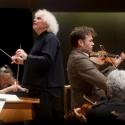
Which they did with bags of character, though not much could be done about three of the songs, settings of coventional lyrics by Ernest I of Saxe-Coburg and Gotha by his musical son: interesting for royal history but not for music. Hough just had to keep the arpeggios flowing; Alessandro Fisher's light, bright, fast-vibratoed tenor was probably right for them, though you wouldn't want to listen to the unvaried timbre for a whole programme (the two pictured below). Grateful for small mercies, one could admire the way the song of the vagrant Harper from Goethe's Wilhelm Meister's Apprenticeship slunk from the major to end in the minor, and there were some interesting modulations at last in Albert's response to Uhland's "Farewell".  The major virtue of Hough's playing here was to showcase the harplike qualities of the royal instrument - unsurprising from the major French manufacturers of the harp. Best in his playing of the very virtuoso role in Mendelssohn's First Piano Concerto were the most delicate moments like the threshold-of-audibility climb to the plateau of the sweet central Andante. Otherwise it took time to adjust to a dry, slightly cowled forte which sounded like a piano recording of the 78rpm era surrounded by the palpable liveness of the OAE's playing, keenly driven by Fischer (pictured below). Let's also remember that such an instrument was never destined to be heard in such a vast venue (just as Steinways are not ideal in places like the WIgmore Hall).
Best of all was the spacious Chopin E flat major Nocturne as encore. Hearing Roman Rabinovich play one of the composer's Pleyels at the Cobbe Collection in Hatchlands, Surrey, had been a revelation of how intimate the sound of a 19th century French period instrument could be in the grander Ballades; here the final upper-register roulades before the end were in themselves enough to justify the journey of the Érard from Buckingham Palace. In the sparkling bookends of the programme, Sullivan hardly paled alongside Mendelssohn, though still to be writing in the master's style in the 1890s must have seemed anachronistic even at the time. The OAE wind and brass gave the ideal smokiness to the introductions of both the Victoria and Merrie England Suite and Mendelssohn's Third ("Scottish") Symphony, inspired by a pre-Queen-Victoria visit to Edinburgh and the West Coast, eventually dedicated to her on a visit to London to present it in 1842.
Sullivan's ballet had a successful run some 55 years later. The surviving suite celebrates "Ancient Britain". and its dances as well as its misty introduction are delectable (why don't the Proms have more all-light-music programmes? These works never get a hearing in any other context). Comes a train of Japanese schoolgirls into the "Mistletoe Dance", while the sailors of HMS Pinafore and the daughters of Major-General Stanley participate in "May Day Festivities". Nothing, it's true, is quite as memorable as Mendelssohn's "Schottische" second movement, vivace indeed, with clarinettist Antony Pay luminously leading the way as he had in Sullivan's opening. Although i found the first-movement exposition repeat I'd so missed in Barenboim's Monday performance of Schubert's "Unfinished" Symphony less than welcome here, Fischer knew how to give space to the passages where Mendelssohn soars on wings of song, and the always surprising arrival of the final peroration gave us a right royal sendoff, natural horns rampant.
- Listen to this concert for the next month on the BBC iPlayer and/or watch the BBC Four broadcast on Sunday
- Read more classical reviews on theartsdesk