

There is no reason why young musicians shouldn't make something special out of mature thoughts on mortality. Nor is the Albert Hall problematic when it comes to haloing intimate Bach as finely as it does massive Bruckner. The Gustav Mahler Youth Orchestra glowed in both the large scale and the small last night. Any shortcomings were in senior hands and hearts - possibly those of a usually great conductor, Philippe Jordan, more likely the infirm purpose of his composer, Bruckner. The most surprising disappointment of all came from that most prized of baritones, Christian Gerhaher.
First, though, the orchestral sound: warm, layered, very middle-European. Odd, that, since although Claudio Abbado took his initial pick in 1986 from under-26-year-olds in Austria, what was then Czechoslovakia and Hungary, the ensemble is now truly pan-European (a shame the nationalities couldn't be listed in the programme, as they usually are with the European Union Youth Orchestra - concurrently playing Bruckner under Haitink, incidentally). Jordan knew how to draw the most intense, humming pianissimos from the differently sized strings in Bach and Bruckner, to build the many long term crescendi in Bruckner's Ninth, to draw the right kind of fire in the conflagrations of the first-movement development and finale.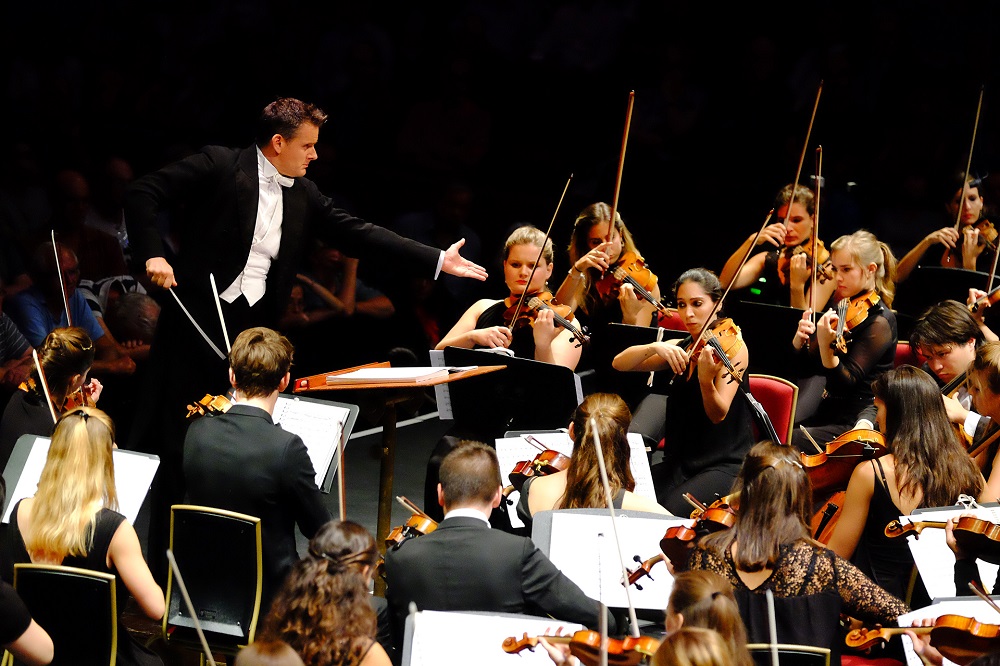 Most impressive of all was the quartet of Wagner tubas - fifth to eighth horns doubling their lower cousins - in projecting a very special sound at the core of Bruckner's last, and most astonishing, Adagio (where the symphony in what survives of the manuscript ends, not inappropriately). Players get paid more to handle the tricky intonation of these noble beasts; here, the pitch didn't falter once, and the tone was huge. And if Jordan didn't manage to justify the becalmed coda, the suspended blaze-ups at heaven's gate which fade so disconcertingly, the brief consolations of the violins' airs on the G string, and the horrifying discord which is really the heart of the movement duly held us in awe.
So did the massive poundings and the weird trio-rush of the Scherzo. All this tells us of Bruckner's faltering faith and his chronic disturbances more compellingly than swathes of the first movement, at least as it stood here. Maybe Jordan's point is that the hidings to nowhere can't really be controlled, but as so often with this composer it just feels wrong, inorganic, except in the most extraordinary of hands (Wand and Colin Davis in the last years of their lives, Blomstedt who, as the previous night's Prom had proved, is still very much alive).
Is Bruckner the right composer to feed to young musicians? Are they wasting some of the best months of their lives on something that may be ungraspable, however compelling and unique? Call these the questions of a writer with a blind spot, but with each year that I hear the Bruckner symphonies, I seem to grasp and like them less. Which is unfortunate, because there are three more to come in the last week of this year's Proms.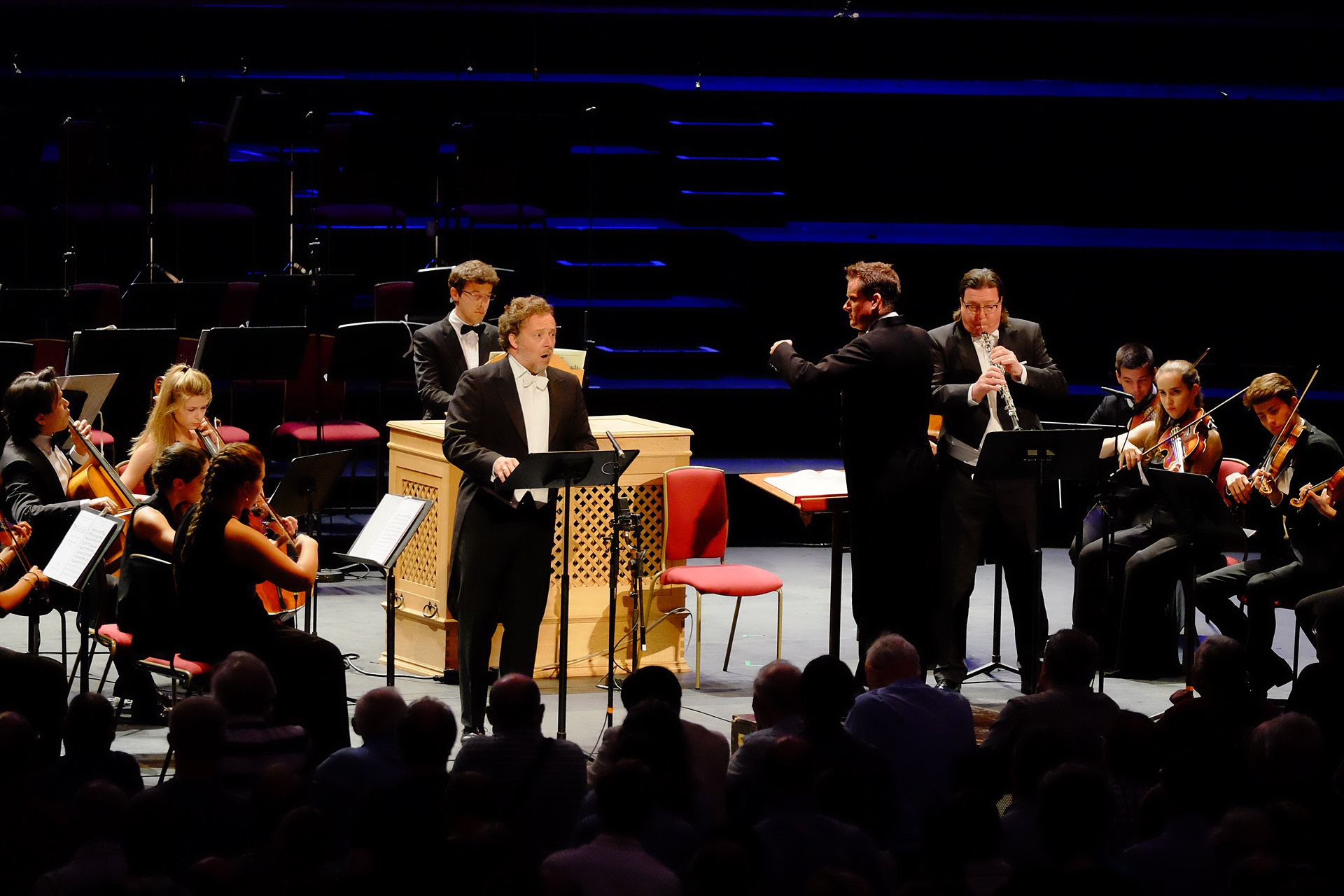 Bach, on the other hand, always has a direct line to the God that Bruckner desperately wants to approach, but so often fails to reach. Many of us remember being torn apart by the late Lorraine Hunt Lieberson's lacerating delivery of the Cantata "Ich habe genug" ("It is enough"), whether on disc or in Peter Sellars's extraordinary hospital-bed "staging". Clearly the more objective Christan Gerhaher (pictured above with Jordan, Bernard Heinrichs and the young players) was going to give a very different interpretation: smooth and almost instrumental to match his oboist (Heinrichs, radiant in the hall) in the arias, every word inflected in the recitatives.
What a disappointment, then, that this great baritone voice, usually dark-hued enough to suggest bass resonances, found Bach's tricky compass so problematic. Time and again the lines petered out in the lower-register notes - and you can't blame that on the venue. Nor is Gerhaher an easy communicator, essential for a soloist working with a youth orchestra. You can see the tension in the shoulders, the lack of ease compared to the flow and grace of the Gustav Mahler strings so expressively urged by Jordan. Proms programmes often defy expectations; a relatively tame-looking 2016 prospectus has been vindicated by many extraordinary performances. It's just a pity that this time, the result was a less than happy one.











