

Light-filled Cadogan Hall is hosting the most fascinatingly programmed concerts in a Proms season not otherwise conspicuous for its adventurousness. There's also an honourable pledge to premiere at least one new work by a female composer in each event, honouring the centenary of votes for women. Guarantee of quality in this rich starter was the experience of several East Neuk Festivals up in Scotland, where the Californian Calidore Quartet blazed a path with the six Mendelssohn quartets and the younger Castalian Quartet, already their equals, introduced many of us to the metamorphic music of Pulitzer prizewinner Caroline Shaw.
What they so vividly showed us of the unpredictable yet always logical path taken by her misleadingly-named Entr'acte was fulfilled by the Calidores (pictured below) giving us the triptych of "Essays" yesterday lunchtime - the first premiered in 2016, the other two Proms co-commissions with four other organisations. First Essay, "Nimrod" begins in diatonic confidence that is anything but placid, but with Shaw nothing stays still for long; disorienting slides and an enigmatic last few minutes pull the rich oriental carpet from under our feet. Shaw tells us in an eloquent note that the change of direction was due to "the turmoil of the US Presidential election in November 2016". The comparison with Shostakovich and the even more turbulent, tyrannical times through which he lived is not inappropriate.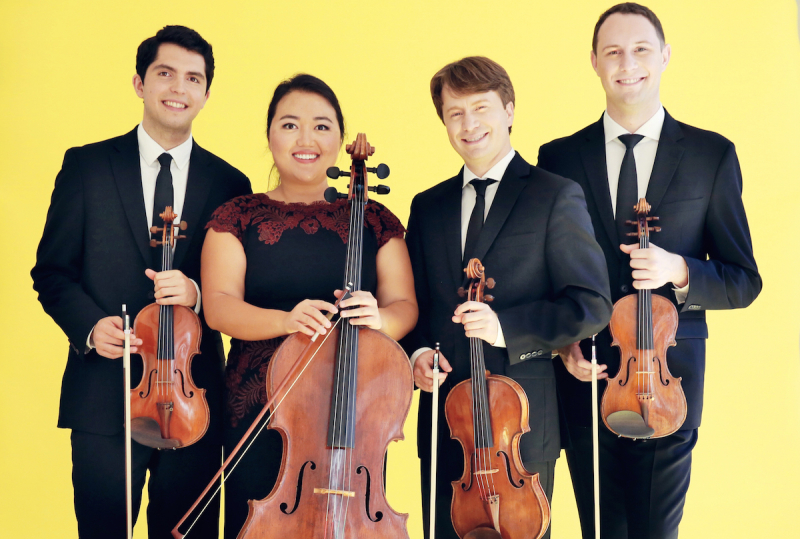 For Second Essay, "Echo", haunting triads emerge out of white noise; Shaw's placement of the final chord shows the instinct of genius. Third Essay "Ruby" pulls the strange adventure of the first into more vigorous focus. It could be the finale of a three-movement quartet, but Shaw seems to prefer the genre of the self-contained single movement, and for their short duration, the ones I've heard are certainly rich in evolution. Like the Castalians in Fife, the Calidores lived every moment of these remarkable and original pieces, making a human conversation out of the first and third, hinting at the metaphysical in "Echo". Above all, as a violinist in a string quartet, Shaw writed idiomatically and challengingly for the medium. Expect more glories in the near future.
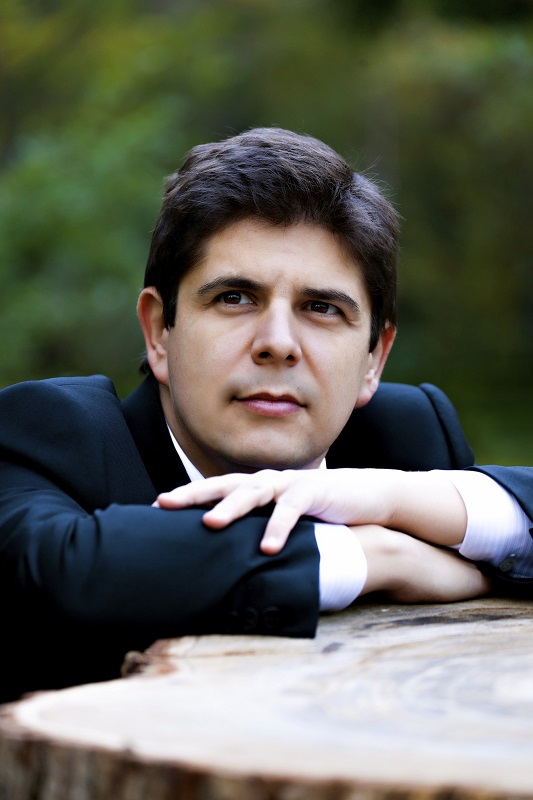 The wonders of the enchanted hour continued with a subtle, often inward interpretation of Schumann's astonishing Piano Quintet with Javier Perianes (pictured right) - buoyant rather than boisterous in the composer's more assertive moods, Perianes only truly pulling out the stops as the finale waxes more ambitious in scale. Without watching or knowing the way Schumann divides the heart-leaping second theme of the opening movement, you'd think the voices of cellist Estelle Choi and viola-player Jeremy Berry were one; later there were striking differences in timbre between violinists Jeffrey Meyers and Ryan Meehan, pointedly more viola-like for the passage in question.
Collectively the Calidores made sure that the lifting of the slow movement's austere solemnity, winging clear of the funeral cortege, stayed ethereal. It was so good to hear it only days after the 100th anniversary of Ingmar Bergman's birth; recalling the movement's use to delineate the poles of severity and warmth experienced by the young protagonist in Fanny and Alexander heightened rather than cheapened the introspective but intense emotion of the moment.











