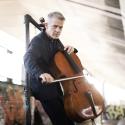
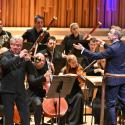
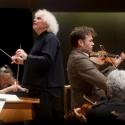
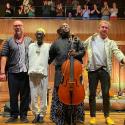
Advice to young musicians, as given at several “how to market your career” seminars: don’t begin a biography with “one of the finest xxxs of his/her/their generation”. From my side, I’m allowed to use it occasionally: surely Timothy Ridout is the finest viola-player of his generation, and last night he struck sparks off four other artists at the top of their game: violinists Maria Włoszczowska and Tim Crawford, fellow viola-player Ting-Ru Lai and cellist Tim Posner
With any other musicians, I might have regretted not checking the programme carefully before I went: the Mozart string quintet wasn’t one of those late masterpieces which the octogenarian Richard Strauss studied, along with the complete works of Goethe, to affirm the Austro-German culture which the Nazi “barbarians” (his term) had nearly destroyed. And the Brahms string quintet in question turned out not to be the bracing Op. 111 but the far more often heard Clarinet Quintet with viola substituting for the wind instrument in Brahms’s own arrangement.
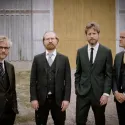
The Mozart was a revelation – in this performance, K174, engaging two violas, came across as another early work which gives the lie to the general notion that Mozart was accomplished in his youth, but that genius came later: there's an ambition here not far off the achievement of another 17-year-old, Mendelssohn, whose Octet dazzled those of us at the Academy of St Martin in the Field's second Marrnier centenary concert last week. This quintet's presentation was part of the magic: bold, free playing rather than galant prettiness, a rustic-sounding Minuet, speedy virtuosity in the finale. But the Haydnesque jokes are surely there already in Mozart's wanting to show how far he can go, and the shadowy unisons suggest a darkness beneath the surface, relating nicely to similar effects in Brahms's finale.  Ridout's ability to change a colour within a phrase and send even the commonplaces of the rococo era soaring gave another kick to this effervescent starter. Also extraordinary is the fact that the team seem to look more often at each other than at the music, suggesting that they know it by heart. Something of a miracle, this, in the Schoenberg Trio featuring "the three Tims" (pictured above) who've played together since their youth.
Although Schoenberg's serialism seems less rigorous in this late (1946) labyrinth - there are even triads in moments of relative relaxation, and a serene conclusion - the real difficulty, quite apart from the enormous technical demands, is the stop-start nature of the argument, supposedly reflecting the experiences of a near fatal heart attack and its aftermath three weeks before he composed the Trio. So well did these marvellous artists seem to have probed each idea, from the frenzied to the calm, that we went wth them, totally in the moment. Surely a landmark performance.  Viola for clarinet gives us a completely different experience in Brahms's Op.115: while several clarinettists in recent performances have taken the Quintet out of the "autumnal" category, the beautifully blended sound of five strings dialoguing intimately with each other restored that (both approaches are valid). Ridout took up what would normally be the first violin's place (pictured above), frequently soaring above Włoszczowska; their teamwork was magical throughout. The one place where the originally intended instrument might be missed is at the heart of the slow movement, where the agitated flurries still work better, I think, on clarinet. But this flowing third movement was peerless, and the dark colours of the finale once again benefitted from such intensive working-together. No wonder so many younger-generation musicians were in the audience, giving it a different atmosphere from the Wigmore usual.