

“My first recital in about a gazillion years in London!” wrote Sarah Chang a week ago for her 140,000 Twitter followers. “I usually work with orchestras whenever I'm in town so what an absolute joy+pleasure to be playing a duo program with piano!”
There were indeed musical aspects of this recital by the duo of Chang and pianist Ashley Wass which did impart "joy+pleasure", and the Chang faithful who attended – Cadogan Hall was not quite half full – cheered and cooed their appreciation, and clearly loved every moment of it. There were even some very young, impeccably quiet children, taken there to witness the erstwhile child prodigy in action.
The main work of the first half, Brahms's Third Violin Sonata, brought to mind a noun which Brahms himself used, “Singenlassen” (letting the violin sing). That sense of wanting the lyrical to be unimpaired came across strongly in Chang’s playing. And in the welling-up of the climaxes, she was intent on giving the work a big scale. In passages of punchy double-stopping, she seemed to be seeking out the kinship of the sonata with the Violin Concerto, which she recorded with Kurt Masur on her last major recording, now a full decade ago.
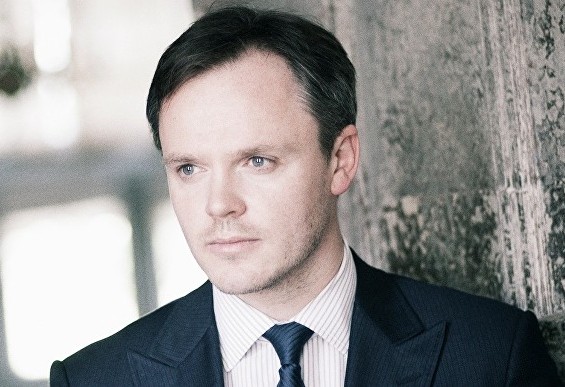
The second half consisted of another large-scale work, the Franck A Major Sonata. It is the pianist who has most of the responsibility for shaping and pacing the drama, and Wass (pictured below by Patrick Allen) absolutely rose to that challenge as the work progressed. I found the opening movement of the Franck more problematic. Chang has built a succession of rather mannered little expressive caesuras into the melodic line, unnaturally tugging and distorting the gentle sway of the 9/8 rhythm.
 Chang’s terms of engagement as a duo partner are unusual. She hardly looks at her pianist at all. In her normal violin posture, her gaze seems fixed downward onto the fingerboard. She has spoken in interviews of the work of the instrumental soloist above all in terms of the personal challenge, and, watching her, one had the sense of an "inner game" to be constantly worked through, such was the intensity of her gaze onto the violin as she played. And during her bars rest her focus would be on tightening the bow perhaps, or inspecting the chin-rest alignment, or wiping her left-hand fingers on her hip, and then getting her violin set-up stable and ready to re-enter. And then there were the moments when she triumphantly threw her head back, or gave the bow a flourish at the end of a phrase as if semaphoring a victory...In the end I found it far more satisfying to just enjoy the musical results – and look away.
The fact that Chang virtually never seeks out eye contact with the pianist shifts just about all responsibility onto him. For the beginning of the first two movements of the Brahms Sonata, where both instruments enter the fray simultaneously, the only way flawless ensemble will be achieved is for the pianist to wait, to watch like a hawk for the moment when bow touches string. Wass needed to be stoical, flawlessly ever-present. He was. His was a remarkable contribution. And the fact that the programme had Chang's name in a typeface four times the size that of Wass's – or indeed those of the three composers – felt very unjust.
This was definitely one for fans of short concerts. The first half, including the Bartók Romanian Dances, was exactly half an hour. The second included two contrasting encores, both Chang staples for many years now, Carlos Gardel’s Por Una Cabeza in the arrangement by Simon Hale, and Bach/Wilhelmj Air on the G String, came in at just under forty minutes. It was enough.











