

Many orchestral concerts leaven two or three established classics with something new or unusual. The LSO reversed that formula at the Barbican last night, with three pieces written since 2000 offset by just one familiar item, Sibelius’s Third Symphony. The result was invigorating, challenging – and very enjoyable.
The presiding artistic mind was that of Thomas Adès, featuring both as conductor and composer. His passion for the music he had chosen shone through, overcoming the rough-and-readiness of his baton technique, and his enthusiasm brought forth a range of sounds from the orchestra, from the whack-you-round-the-face maximalism of Alex Paxton’s World Builder, Creature to the reduced and transparent textures of Poul Ruders’ Paganini Variations for Guitar and Orchestra.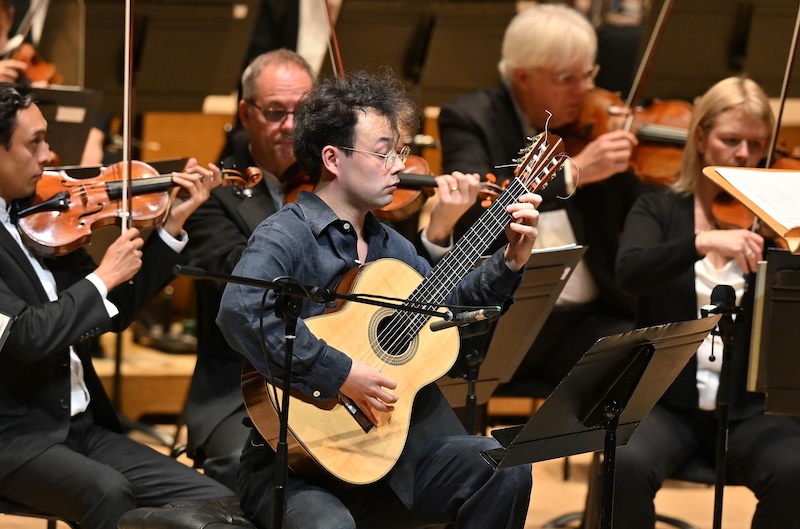 The concerto was played by the peerless Sean Shibe (pictured above by Mark Allan). I used to like Ruders and then had the misfortune to experience his opera The Handmaid’s Tale, which I have struggled to forgive. This concerto, though, is very different, constructed around the theme most famously appropriated by Rachmaninoff – a ballsy move. But it pretty much works, the variations strongly characterised both in the orchestration and in the solo writing. Shibe was equally at home in the athletic passagework as in the dreamy passage of stillness about 10 minutes in. It was my first experience of Shibe in the flesh, and I enjoyed how his professorial demeanour was completely in keeping with the attention to detail in his playing.
To open, we had had the 23-minute Paxton UK premiere (bafflingly billed as 15 minutes in the programme). I have been a fan for a while, reviewing Alex Paxton’s (pictured below) recorded music for theartsdesk, but never having heard it live. World Builder, Creature contained lots of what I have known and loved: a frenetic energy, a hyperactive busyness and Technicolor extravagance of orchestral sound. The structure isn’t subtle – it is, as the saying goes, just one damn thing after another – but the orchestration is infinitely calibrated, even as it piles up into cacophony. Twenty-three minutes was at the outer limit of how much this kind of thing can be sustained, like eating a whole bag of cola sweets, but I loved its unruliness, its sugary sweetness belying a steeliness below, its squirming, fidgeting restlessness. It builds to a joyful mêlée, Adès in full cop-directing-traffic mode, the echoes of Charles Ives, John Adams and Stravinsky subsumed into a very individual musical world.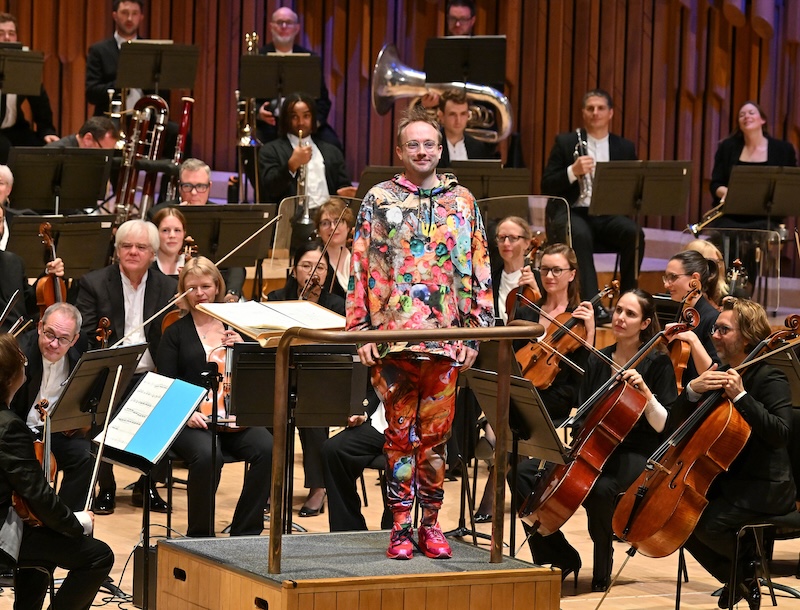 Another very individual musical world – but one a million miles from Paxton’s – was that of Sibelius’s Third Symphony. (I had fun imagining Sibelius’s reaction to the Paxton.) Here Adès’s love of the music was even more apparent, as he lived every gesture, every change of direction, every new colour. The second movement was the highlight, the LSO flutes finding a rustic lilt for the main tune, and the cellos and basses plangent in their chorale.
The finale was Adès’s own Aquifer, premiered only last year. I reviewed it on CD recently and liked it, but it’s an even more impressive achievement heard live. It is strong and confident music, Adès at the height of his powers, progressing with the inexorable force of a large body of water towards its dazzling C-major resolution, the orchestra making a glorious, implacable noise.











