

STIMMUNG is always an event. Stockhausen’s score calls for a ritual as much as a performance, with six singers sitting around a spherical light on a low table, the audience voyeurs at some intimate but unexplained rite. Singcircle has been performing the work for over 40 years, and its director, Gregory Rose, clearly has an innate sense of its pace, structure and aura. This performance commemorated the 10th anniversary of Stockhausen’s death, but also marked the last ever appearance by Singcircle, a fitting end for a group associated above all else with this work.
As with most of Stockhausen’s music, the concept behind STIMMUNG looks crazy on paper but is utterly convincing in performance. Most of the music is performed in overtone singing, similar to the Tibetan monastic tradition. Over this, Stockhausen adds a range of spoken and vocal effects: names of deities from different cultures, private jokes, and erotic poetry (this last perhaps explained by the fact it was written in America in 1967). The singers are all amplified, and the sounds projected around four speakers – the sound projection this evening led by Stockhausen’s amanuensis Kathinka Pasveer, assisted by composer Stephen Montague.
The resulting mix of vocal timbres added valuable richness and complexity
Atmosphere is the most important part of STIMMUNG, and Singcircle got that just right. Black drapes covered the wooden panelling of the Barbican Hall and, apart from the central, spherical light, all else was darkness. The composition of the ensemble seems to have changed a lot over the decades, and the list of previous members includes many luminaries, including Paul Hillier, who now regularly performs STIMMUNG with his own ensembles. The six singers for this performance were a curious mix of young and old, two of the singers seemingly as old as Rose, and two others recent graduates. The resulting mix of vocal timbres added valuable richness and complexity, especially as the textures are almost always based on unsynchronised lines between the voices. The older singers did struggle, however, and the pure sound of the ethereal overtone effects was often hard-won. Sensitive amplification helped, and the spirit of the work was never compromised.
The second half of the concert brought us up to date with COSMIC PULSES, Stockhausen’s final purely electronic work, completed in 2007, the year of his death. This is complex and imposing music, but its lineage from Stockhausen’s pioneering works of the 1950s and 60s is clear. Dull, bell-like sonorities, deep in the bass, introduce the more complex mid-range effects. And when the music begins to explore the upper registers, it is with whistling overtone series, skipping up and down the higher partials. But by this time, digital technology had changed the way Stockhausen worked, allowing him to create ever-more complex textures and spacialisation effects, this work written for an eight-speaker array.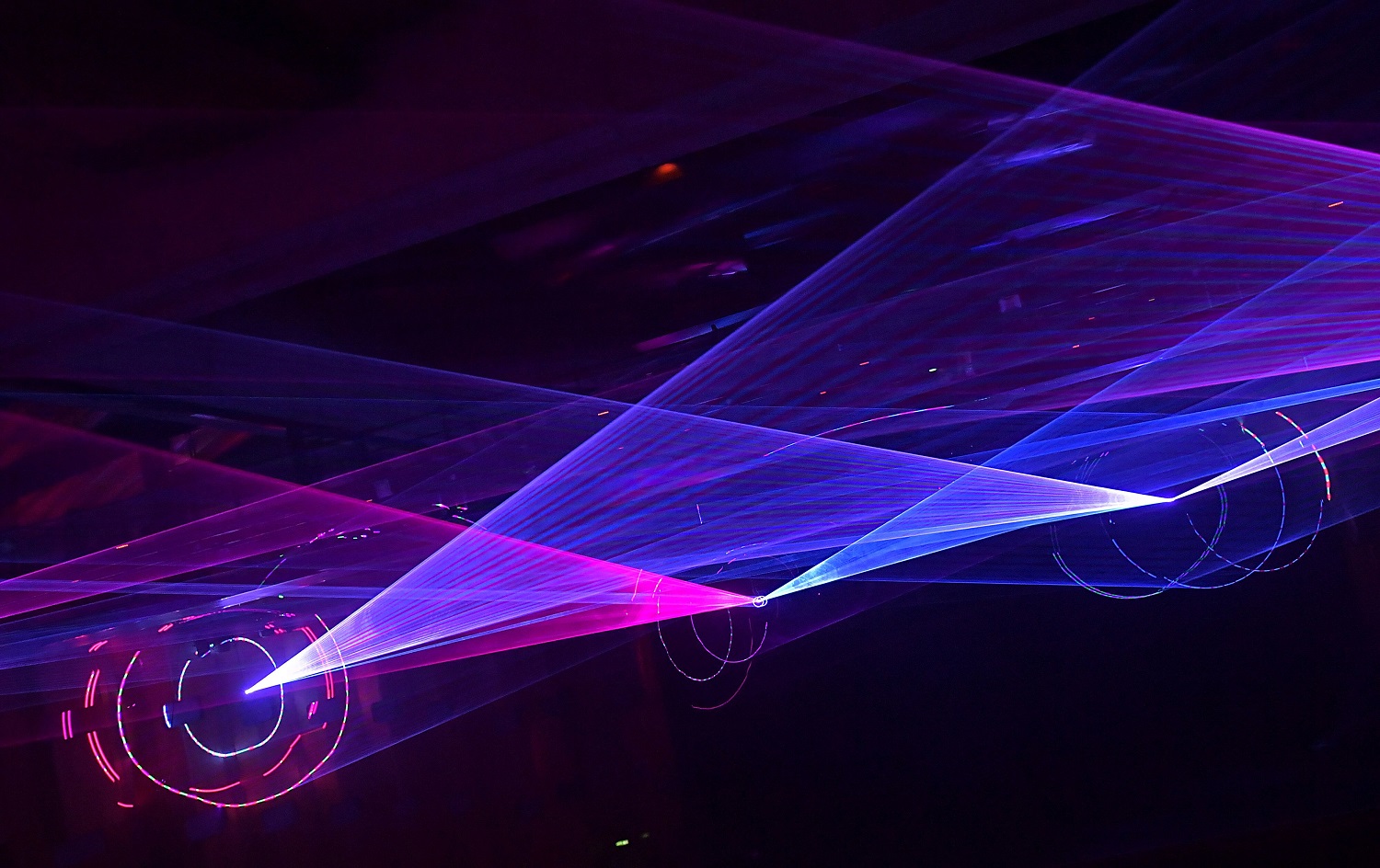 Stockhausen’s technical summary, faithfully reproduced in the programme, told us little about what he was hoping to express. Fortunately, the Barbican engaged a laser artist, Robert Henke, to provide a visual interpretation (pictured above). He set eight lasers around the upper space of the hall, to match the speaker array. Dry ice made all the laser beams visible, and each gradually opened out into a spinning cone of complex patterns as the music grew in intensity. Although as confrontational and complex as the music, Henke’s projections also managed to maintain the sense of abstract ritual that had been so perfectly captured in the performance of STIMMUNG. Even with Henke’s help, this was difficult music to take in, but it spoke of a truly unique composing voice, which still has much to tell us. Ten years after his death, Stockhausen’s music is still waiting for the rest of us to catch up.











