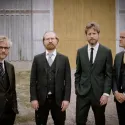
For the second year in a row the Royal Scottish National Orchestra chose to share its platform in Edinburgh’s Usher Hall with the young musicians of St Mary's Music School. As RSNO chief executive Alistair Mackie pointed out in a short opening speech, the links between the two organisations run deep, as many players in the RSNO started their musical careers at St Mary's.
The format of the evening was a repeat of last year, with 40 minutes or so of short solos from the youngsters preceding the main RSNO concert. As before, the orchestral stage set was shoved into the wings to hollow out enough room for a piano and a succession of soloists. What worked last year, in a spirit of experimentation, appeared second time around somewhat haphazard and grudging: the electronics required for the main concert were rather in the way and the roadies changing over music stands were clearly trying to get the St Mary’s pupils out of the way as soon as possible.
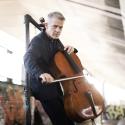
Not that this inhibited some very fine performances. At St Mary's, they teach music, not presentation, so the evening began with Sylvester Maschi marching onto the stage with his button accordion slung over his shoulder like a sack of coal. He then proceeded to sit there while George Brady (pictured below) played a soulful prelude for French horn by Gallay from the audience seats in the grand circle. Maschi’s squeezebox came next, with two virtuoso showpieces by Volpi and Konyaev which demonstrated a phenomenal technique and a staggering degree of contrapuntal dexterity. This was about as far as you could get from an accordionist crooning on the banks of the Seine, yet it was achieved with apparent ease and a considerable degree of wit for so young a performer.  Connie Huang played The Lark, a mellifluous piano piece by Balakirev, and Brady returned with his horn to perform one of Tre Poemi by Kirchner, a piece that used the reverberation of the open piano lid to achieve an astonishing variety of textures. Olivia Massimo sang “The Last Rose of Summer” with a grace and simplicity of expression somewhat undermined by Benjamin Britten’s rather arch and unnecessarily complicated piano accompaniment. William Guo chose one of those entertaining but slightly pointless violin showpieces by Wieniawski and the St Mary’s portion of the evening ended with the gentle meanderings of the so-called “Trad Band” featuring two fiddles, clarsach and the re-appearance of Maschi and his accordion. If this collaboration is to become a permanent fixture of the RSNO spring season, it needs some sort of presentation, or sense of ownership, to prevent the perception that St Mary’s are guests at risk of outstaying their welcome.
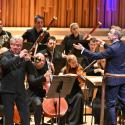
That said, clearly somebody had put a lot of effort into creating this evening as a celebration of youth. The main orchestral concert included a rare outing for the RSNO Youth Chorus, a large choir of some 400 members aged 7 to 18, of whom over a hundred were performing on this occasion. After an orchestral overture by Fanny Mendelssohn, credited in the programme under her married name of Hensel, the main event was the Scottish Premiere of The Lost Words by James Burton, a series of whimsical songs based around common words omitted from a junior dictionary and rescued in poetic form by the renowned language archaeologist Robert Macfarlane.  Burton set 12 of the poems to music, of which the RSNO performed seven, under the baton of chief conductor Thomas Søndergård (pictured above with members of the RSNO). Despite a large orchestra, the settings are short, simple, and declamatory in style, with a largely unison texture breaking out into close and often gorgeous harmony. “Acorn” was very short, driven by a firm pulse, “Newt,” a cheeky two-step rhyming newt with cute, suit, coot, and minute. “Conker” manifested as a jocular waltz, “Bluebell” was gently elegiac, “Willow” liltingly nostalgic, and finally “Wren,” in a setting as spiky as her song. The quality of diction and intonation from these young voices was superb, and the whole choir presented immaculately, dressed in black tee shirts and singing comfortably off copy, a credit to their director Patrick Barrett.
The same chorus, reduced in size, as was the orchestra, re-appeared in the second half of the concert, which presented Felix Mendelssohn’s entire incidental music for A Midsummer Night’s Dream, complete with a chorus of fairies, fleeting appearances from soprano Carine Tinney and mezzo Rosamond Thomas, and a more substantial role for Christine Steel as an amplified and somewhat over-accelerated narrator. At about an hour’s duration, it’s one of those musical-dramatic orchestral adventures that looks so good on paper but which feels limp in execution. Yes, Mendelssohn’s orchestration is delightful, effortlessly conjuring up this uniquely poignant magical-romantic atmosphere, but an hour of such music without grit or grist tends to the bland, if not soporific. Pace my earlier remarks about Britten, he did it better.