The London Philharmonic’s year-long Stravinsky festival, Changing Faces, concluded here in spectacular style, with a tribute to “The Swingling Sixties”. Vladimir Jurowski, the soon to be leaving – and soon to be much-missed, Principal Conductor of the LPO, devised an adventurous and innovative programme, pairing Stravinsky’s late masterpiece Threni with the contemporaneous Sinfonia of Berio. Aesthetically, these pieces were from different worlds, yet each in its way is suffused with the Sixties zeitgeist. Add to this superlative performances, and the result was a satisfying conclusion to one of Jurowski’s most ambitious projects to date.
As a conductor, Jurowski is an all-rounder, and he brings as much personality and interpretive insight to the avant-garde as he does to the classics. For these 1960s works, the result was to reassign them: They are no longer cutting edge, but their power remains – they have joined the classics. So, in the opening work, Stravinsky’s brief and terse Variations (Aldous Huxley in Memoriam), the structure of the music was clearly laid out, with marked divisions between each of the variations, and the distinctive orchestral colouration of each well defined. Jurowski and the orchestra treated the work like a Baroque variations set, formal and well-proportioned, and never sterile. It is customary to perform the work twice, but after this clear and lucid reading, there was no need for an encore.
Stravinsky’s Threni is a real rarity. The work was written for St. Mark’s Basilica in Venice (the dry Festival Hall acoustic is a poor substitute) and applies antiphonal effects to the two choir groups. But connections with the Renaissance polyphony of Monteverdi and Gabrieli are slight: This is austere and uncompromising music, setting the Lamentations of Jeremiah. Listening to the demands it makes on the choir, it is easy to understand why the work is so little performed. The singers are often required to make dissonant entrances, and at hushed dynamics. The orchestra offers little support or assistance, the strings hardly playing at all, and the winds provide only skeletal accompaniment. Kudos, then, to the London Philharmonic Chorus for taking on a work that most professional choirs would balk at, and for making a spectacular success of it. Tuning was never a problem, nor stamina in this 35-minute span. Excellent soloists too, and if I pick out tenor Sam Furness and bass Joshua Bloom for special praise, that is only for the quantity of their solo work in a uniformly fine line-up. (Both were late substitutes, Bloom for Maxim Mikhailov, who died in a road rage incident in Moscow in November: The concert was dedicated to his memory.)
 The Swingles (that’s a recently rebranded Swingle Singers) were the stars of the second half. The Sixties spirit follows them around as well, and they fully embraced it here. To connect with the Stravinsky theme, they began with his Tango, performed in their trademark scat, complete with beatbox drumkit. It was good to get an opportunity to hear what they do for a day job – I’ve heard the group several times live, but only ever in Berio’s Sinfonia.
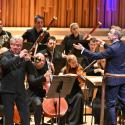
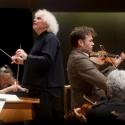
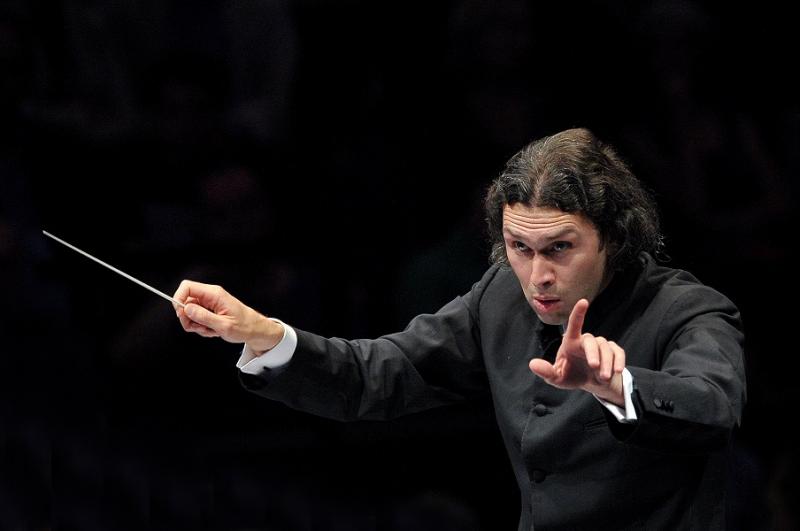
Sure enough, up it comes. Sinfonia can work in mediocre performance; all the orchestral fireworks and clever quotations in the third movement can speak for themselves. But Jurowski (pictured above by Chris Christodoulou) took the work to a higher plane. The Swingles sing almost continuously throughout, and here brought their trademark bravado and sass. But Jurowski matched them, with sleek, dynamic strings, and efficient, incisive brass. The famous third movement – a vast collage based on the Scherzo of Mahler’s Second Symphony, overlaid with hundreds of musical quotations and lines from Beckett – is usually played straight, the conductor too preoccupied with holding the music together to offer an interpretation. Not Jurowski. He shaped the music in line with Mahler’s tempo indications, all the while giving cues to all corners of the huge ensemble and carefully grading balances. The Swingles were integrated into the orchestra. The singers usually sit in a semicircle around the conductor, but this time they moved a row back, behind the first desks of the strings. This had the effect of integrating them into the ensemble, creating an even tighter cohesion between music and words.
For an encore, more Swingles, and back to their core repertoire with Piazzolla’s Libertango – delicious! Jurowski then gave a short speech to wrap up the Stravinsky festival, rightly acknowledging the extraordinary contribution of the LPO Chorus to this evening. He then conceded that the dour lamentations of late Stravinsky were a poor way to conclude, especially at Christmas. So for a final encore, Stravinsky’s Circus Polka, yet another sparkling and vibrant reading: A perfect conclusion to an inspiring concert.
- This performance was recorded for BBC Radio 3 and will be broadcast on 12 December