

Collaboration and collegiality are becoming ever more important across the Scottish arts scene, it seems. Glasgow theatre company Vanishing Point teamed up with Scottish Opera earlier this year for a double-bill based around Bartók’s Bluebeard’s Castle. String group the Scottish Ensemble has focused heavily on collaborative projects in recent years, joining visual artist Toby Paterson, composer Anna Meredith and (okay, admittedly not Caledonian) Swedish ensemble Andersson Dance in a string of projects.
It was probably inevitable that Vanishing Point and the Scottish Ensemble would end up working together – and indeed, with the two groups’ quietly pioneering sensibilities, it feels like a natural match. Their joint show – Tabula Rasa, inspired by the music of Arvo Pärt and its acknowledged significance for patients in palliative care – provides a fascinating if not always convincing template for the ways in which two groups might come together.
It refuses to offer glib answers to the questions it raises
Mainly because for much of Tabula Rasa, they don’t. The two ensembles might share the stage, but they hardly enter each other’s territory. Actor and co-writer Pauline Goldsmith delivers wry but compassionate monologues puncturing illusions about the spiritual gracefulness of death: a dying friend whose ebbing personality reveals some unsavoury views; a botched funeral; a moment of unthinking callousness in an A&E department. Director Matthew Lenton provides striking tableaux, sumptuously lit by Kai Fischer, to illustrate Goldsmith’s memories, the most poetic of which conjures a beatifically glowing head, slowly turning from side to side atop a hospital bed. And in between, Scottish Ensemble players deliver fine accounts of Pärt’s Fratres, Spiegel im Spiegel and Tabula Rasa itself.
It’s as if Lenton is providing us with the raw materials and leaving us to draw our own connections between them – frustratingly so at times, gratifyingly so at others. Nevertheless, and probably because of its refusal to offer pat connections, Tabula Rasa is a potent 90 minutes, and Lenton’s elegant stage images are reflected exquisitely in the Scottish Ensemble’s carefully considered playing.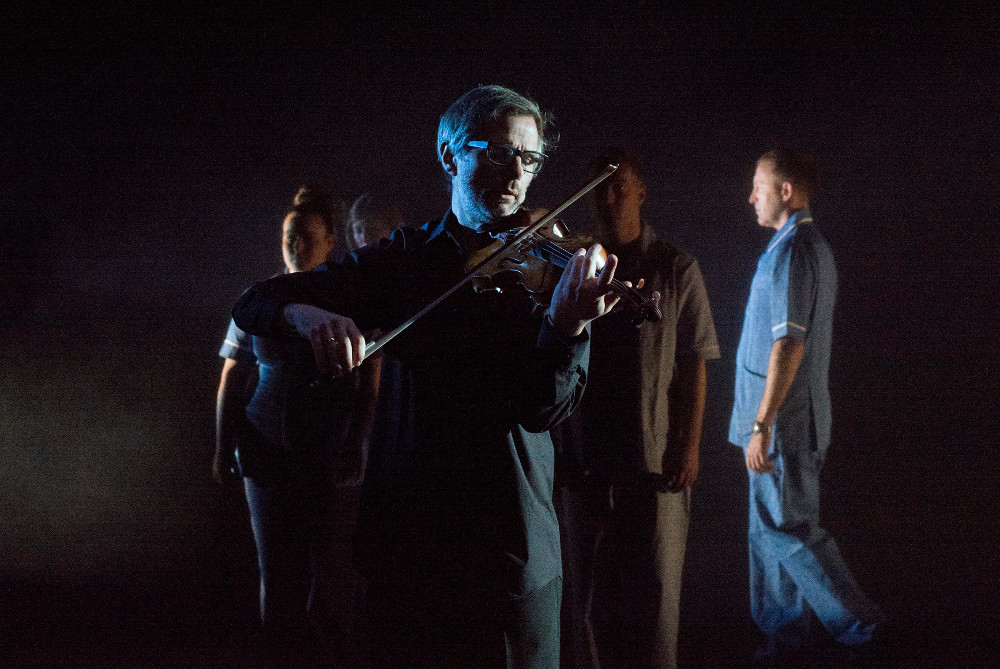 Daniel Pioro delivers a dramatic, assured account of Fratres, each of its variations vividly characterised. Scottish Ensemble artistic director Jonathan Morton (pictured above) is restrained and controlled in a subtle Spiegel im Spiegel, and he’s joined by Clio Gould – plus the rest of the Ensemble players – for a forthright Tabula Rasa. Pianist Sophia Rahman stands out for her beautifully balanced, thoughtful playing – not least in the inexorable tumbling chimes of Tabula Rasa’s prepared piano.
There are some unavoidable issues. The theatre acousic, for a start, robs Pärt’s music of a bloom of resonance that would otherwise serve it well, and Rahman’s non-prepared piano is a somewhat clunky upright with an inconsistent tone. Dividing the two contrasting movements of Tabula Rasa with a monologue from Goldsmith unavoidably turns it into two separate pieces, robbing the piece of some of its cumulative power. But nevertheless this an ambitious, thought-provoking show, one that refuses to offer glib answers to the questions it raises, and that addresses the inevitable messiness of dying – and the resilience of those left behind – with honesty and compassion.
- Tabula Rasa continues at Edinburgh's Traverse Theatre until 11 November, then tours to Eden Court, Inverness (16 Nov) and Tramway, Glasgow (22-24 Nov)











