

It’s not often one comes out of a concert of mainly new works with a spring in one’s step. A sigh of relief is rather more usual. But this concert on Thursday by the Welsh new music ensemble Uproar was an exception, partly but by no means exclusively because of the brilliant performance of John Adams’s invigorating, even appropriately uproarious Son of Chamber Symphony with which it ended.
Michael Rafferty, Uproar’s founder and conductor, had keyed the programme backwards from the 17-year-old Adams piece, naming the concert after it and commissioning three new works for roughly the same 17-instrument ensemble. Since Son of Chamber Symphony might just as well have been called grandson of Schoenberg’s Chamber Symphony – the inspiration for Adams’s original work of that name – there was a discreet historical thread running from work to work here.
Historical: but also visual and associative in other ways as well. Richard Baker’s Motet IV - Accidental Activists is a remarkably convincing pitch transcription, inspired by a documentary film by Scott Calonico, of spoken material and laughter from press briefings from the early days of the AIDS epidemic, a time when (it seems) questions on the subject were greeted with (embarrassed?) hilarity.
Nathan James Dearden’s the day following accompanies, or is accompanied by, images of the last days and destruction of the North Welsh village of Capel Celyn, which was flooded in 1955 to create the Llyn Celyn reservoir. Lynne Plowman’s The Wind Sweepers is a mind’s eye evocation of the wind turbines that increasingly dot the Welsh landscape (you can trust an artist to like such tiresome things, and make them beautiful).
To these new works was added the Austrian composer Olga Neuwirth’s Symphonie diagonale for seven players, written to accompany, and in a sense re-explain, a 1920s abstract film by Viking Eggeling consisting entirely of mobile geometrics. Like the aural associations in Motet IV, Neuwirth’s visual-musical commentary, rich in trumpet and trombone ejaculations, made a fascinating, if fairly elemental, marriage of the senses, though I’m not sure it would amount to much without the film. So what? It was rather as if Neuwirth were at a console in a silent cinema, reacting to the images as they flew past, a skill well worth reviving as a check on any listeners’ tendency to impose on the screen their own sentimental musical rubbish.
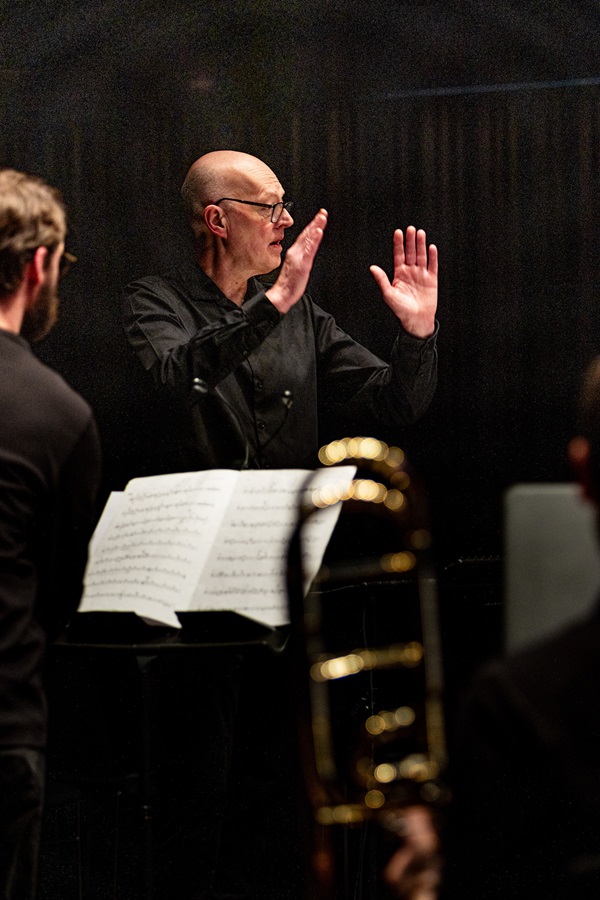 I enjoyed everything in this concert, Rafferty’s crisp, unself-advertising control of the performances, the top-class playing, and not least the highly professional organisation, so comparatively unusual in contemporary music, which tends to regard such bourgeois concerns as far beneath its lofty rebellious aspirations (Rafferty, pictured left).
Above all, I liked the way the new works created musical value out of non-musical material. Baker, for instance, conjured up a modern equivalent of the medieval techniques of hocketing and cantus firmus out of the idea of musicalised speech, which is in a sense where Gregorian chant came from as well, not to mention the hwyl of Welsh preachers. There was no pastiche involved, more a feeling that, given a particular task, musicians of any age will come up with comparable solutions.
In a similar way, Plowden’s windmills generated electricity in the form of largely static harmonies, underpinned by pedal notes and ostinato patterns but with skittering interior counterpoints, like musical electrons under a microscope. Dearden’s music is more restrained, slower moving, more sorrowful. Like Neuwirth’s it might not survive the absence of the images; but does it have to?
As for Adams, the sheer crazy exuberance of what I hesitate to call his part-writing, so arbitrary is its sound, is nevertheless hard to resist. To some extent it reminds me of the Charles Ives of the Fourth Symphony and Three Places in New England. Except that close inward listening finds a network of criss-cross rhythmic patterns that I’ve never found in Ives but is a feature of Reich and Terry Riley and other minimalists, who I suppose still at a stretch include Adams, though minimalism is left far behind by this rich and intricate polyphony.











