

David Hill, long-term driving force of the Bach Choir which Vaughan Williams sang in for 18 years before becoming its music director in 1921, claims VW as “a quintessentially English composer”.
That was rather less the case in Thursday night's choice of works gilded by the Philharmonia at the Royal Festival Hall. The Overture to The Wasps is influenced by French and Russian examples, the early Swinburne setting The Garden of Proserpine offers a kind of late-romantic lingua franca, and, sea shanties apart, A Sea Symphony unfurls what its chosen genius Walt Whitman calls “a pennant universal”.
Fortunately this was a performance which engaged with the poetic meanings at the work’s different levels: Whitman’s bracing sea pictures, remembrance of lives lost, man and nature, the metaphysical sea-journey of the soul. It connected the masterpiece to the two more modest offerings of the first half, too: the second robust melody thrown up by the buzzing in the famous overture, part of a less familiar set of incidental music, to a 1909 Cambridge University production of Aristophanes’ The Wasps, is heard, transfigured in reverie as “O vast Rondure, swimming in space” at the start of A Sea Symphony’s finale, “The Explorers”.
 As for The Garden of Proserpine, composed between 1897 and 1899 while Vaughan Williams was working on a doctoral thesis, the very end justifies the means. Which up to that point are a striking theme prettily clad and a fairly conventional interchange of fury and stasis. Swinburne’s view of Proserpine-Persephone keeps her firmly in the underworld, tending poppies for the forgetfulness of dead men, and doesn’t return her to mother Demeter’s realm on earth. The decadent obsession with “sleep eternal in an eternal night” is the final note of the poem, but VW rejects morbidity. The soprano’s two penultimate stanzas could be detached as a song – they embrace Swinburne’s best lines – while the last has the chorus mostly on a unison monotone, prophetic of things to come in A Sea Symphony, a harmonic resolution and then a slow fade of the kind the composer wrought so magically in many of his finest works to come. Though the creator never tried to get the work performed, all this justifies its resuscitation.
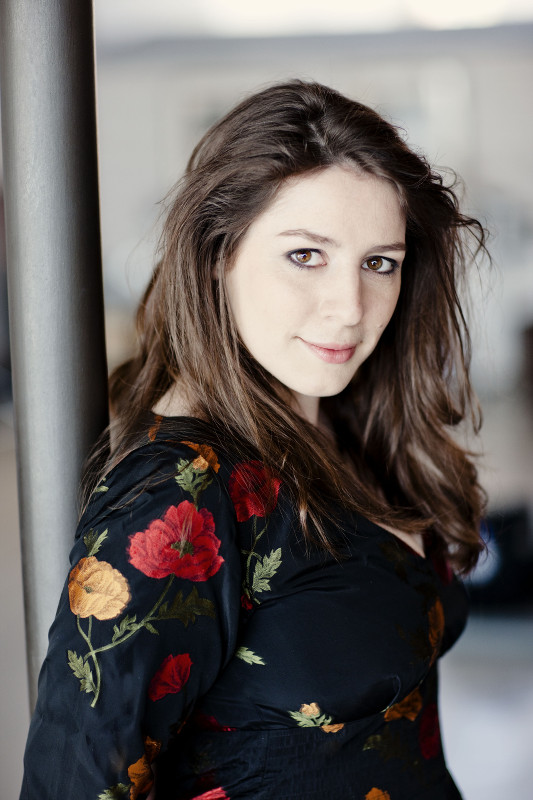
Elizabeth Watts (pictured above by Marco Borggreve) had much to project here, and like her fellow soloist in A Sea Symphony, Roderick Williams, she is always, as they say, “in the zone”. With Whitman’s poetry, such a breath of fresh air still blowing in from the 19th century to the early years of the 20th, both hit the heights and sounded the depths. The “clef of the universes and of the future” is evoked by the onlooker “On the Beach at Night Alone” in the mystical second movement; Williams set the tone poignantly and in the closing stages, where the voice gives up and the orchestra carries the metaphysics onward to the end, Hill got the exquisite Philharmonia to play as softly as possible; even the coughers in the surprisingly full house were stilled. Our baritone again took us inward in the later stages of the finale, after a soaring operatic duet, and the infinite reaches were once again struck.
The big extrovert moments need a big chorus – nearly 200 voices, on this occasion, and so the tingle quotient was high from the very first “Behold, the sea itself” via ther "one flag" manifesto of world unity - more needed now than ever - to the last waves of sound before the final subsiding. In the tricky Scherzo, “The Waves”, we needed more consonants, more open vowels; but no doubt about it, this was a special occasion, as all participants made abundantly clear.











