Zimmermann, Belcea Quartet, Wigmore Hall review - perfection in two very different string quintets

Mozart with other-worldly refinement, focused passion in Brahms

share this article

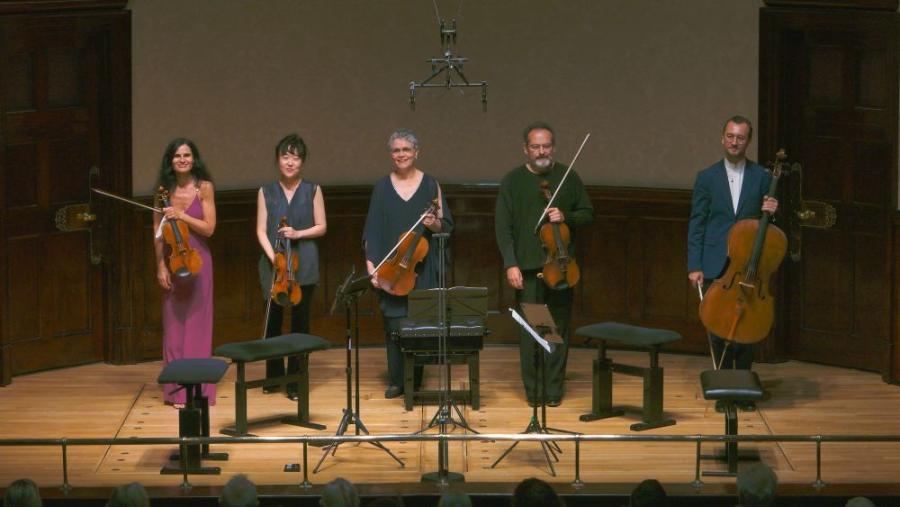
Corina Belcea, Suyeon Kang, Tabea Zimmermann, Krzysztof Chorzelski and Léonard Frey-Maibach
Both images by Darius Weinberg/Wigmore Hall

If the Wigmore Hall sought perfection in its 125th Anniversary Festival, it found it in the two concerts I've attended this week - in the greater part of Lise Davidsen's and James Baillieu's Schubert cornucopia, and last night in the sublime Belcea Quartet's teaming up with similarly legendary viola player Tabea Zimmermann in two awe-inspiring string quintet masterpieces. 

Zimmermann held centre place in Mozart's G minor Quintet, telling from the start because Mozart has the first viola as the lower of the top three voices at the start, only to take the upper line with second viola and cello in plangent symmetries. Time and again Corina Belcea gave us a voice from another planet, though there was marshalled passion in the Menuetto. It's merely a personal thing, but I'd give all the slow movements of Beethoven's late quartets for the humanity of this Adagio ma non troppo. It sounds as if, proto-Beethoven-style, Mozart is going to surprise us with another Adagio movement - there is material enough for one in the finale's introduction - before leaping into the light for an Allegro which may be simple compared to what's gone before, but overwhelms with its G major joy. 
Image
Belcea Quartet and Tabea Zimmermann (centre)

Silk gloves were off, though there was no less sophistication, in the first of Brahms's string quintets, the F major Op. 88. The first-movement development was just subsiding when Corina broke a string. She went off, the other players showed how relaxed they were about it in genial conversation, she returned quickly and we got the movement from the beginning, but without the exposition repeat: a chance, among other wonders, to hear Krzysztof Chorzelski, swapping first-viola role with Zimmermann, play the lovely second theme that startles by starting with brief waltz-mode a fourth time (it returns, of course, in the recap).

The slow movement's switches between sarabande seriousness and light scherzo mood seemed stranger, in a good sense, than ever. Nothing could sum up the other-worldly magic in the concert than the five sustained chords at the end. And then, more joy unleashed with robust exuberance, a fugal charge hopping over to a jig and the most exhilarating of codas. As serious encore, the five magnificent players went deep into the Adagio of Brahms's other String Quintet, Op. 111. I'd have been happy with a second interval followed by the whole of that - its first movement is surely Brahms's most joyous among his chamber works - but best not to be greedy when you've already had perfection.

Silk gloves were off, though there was no less sophistication, in the first of Brahms's string quintets

rating

5

share this article

Support the future of arts journalism

Subscribe to theartsdesk.com

Thanks so much for choosing genuinely independent arts journalism theartsdesk’s mission has never been more important – in an age of relentless algorithmic recommendation, sponsored content and unreliable AI, the expertise and discernment of individual critics deeply embedded in their specialist areas is absolutely vital.

If you want more of that in your life, why not subscribe now?

If you do this before the 31st August, you’ll be able to keep at this “founders rate” for life: your subs will never increase! You can choose to subscribe annually for just £40 simply click here
or monthly for £5 per month simply click here.

Not ready to subscribe?

If you want to support with a little extra or aren’t ready to subscribe just yet, there’s also the option to give direct to our crowdfunder to support our imminent redesign and exciting expansion with new features and collaborations Simply contribute here: https://gofund.me/c3f6033d.

However you choose to be involved, you can proudly say that you are picking the right side in the battle for truth and humanity in the modern information landscape. And we will be very glad to have you on board!

more classical music

Eloquent thoughts on the wonder of 'Dichterliebe' and a new work inspired by it
Latest in a line of great Irish mezzos shows her versatility, and the strings swoon
A pair of much-loved cello concertos, plus percussion transcriptions and a great German song cycle
Two recitals in a thousand, other events good to excellent
Distinction and emotional impact from young musicians and an exuberant maestro
A brass hero blows through favourite pieces - and a bluesy newcomer
Baroque concertos, opera arias on solo horn and new music for contrabass flute
Subtle, introspective 'Harold in Italy' followed by over-punchy 'Symphonie fantastique'
Semi-staged version brings a heightened appreciation of the symphony's jostle of voices
Cellist/singer with friends and top quartet make welcome returns to the DICMF
Striking performances by a quartet with a strong sense of identity
Life-enhancing Danish piano music and a trio of epic symphonies





