The 23 years since 28 Days Later and especially those since Danny Boyle’s soulful encapsulation of Britain’s best spirit at the 2012 Olympics have offered rich material for a franchise about deserted cities, rampaging viruses, hard quarantines and an insular, afraid country hacked adrift from Europe.
28 Years Later takes this chance with punk chutzpah, right from a pumped-up prologue in which children watch Teletubbies to mask the sound of the adult world being eaten by Rage virus-infected zombies, only to be devoured too in a frenzy of close-up Anthony Dod Mantle camerawork, vintage digital video and Young Fathers’ disorienting indie-dance score. Young Jimmy’s vicar dad offers no sanctuary as the Infected smash through stained glass, the priest welcomes his personal end of days and Jimmy runs for his life.
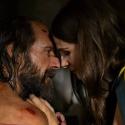
 Twenty-eight years later, Jimmy (Aaron Taylor-Johnson) is a rugged frontiersman on Holy Island, barricaded and sealed at high tide from a shunned mainland itself under hard quarantine from continental Europe. Jimmy is teaching 12-year-old son Spike (Alfie Williams) to be a man while mum Isla (Jodie Comer, pictured above) moulders bedbound and barely coherent. Theirs is a microcosmic, amnesiac England, revering a flag of St. George and Fifties portrait of the Queen like a lost Empire outpost. It’s a perhaps utopian regression to a hearty, homogenous world of homebrew beer and organic grub. Agincourt-style archery is intercut with Olivier’s Henry V, and an escape from Infected toasted with “Blaydon Races” like Newcastle winning the Cup. Mainland Northumberland is meanwhile a lush sylvan hunting ground, with evolving Infected its beasts of the forest.
The zombies are always us, at least since a child ate her parent in the schismed '68 of George A. Romero's Night of the Living Dead. Richard Matheson’s much adapted novel I Am Legend (1954), which made the last, vampire-hunting human vampire society’s monster, acknowledged apocalyptic change requires adaptation, and returning 28 Days Later screenwriter Alex Garland has known since his novel The Beach that sealed paradises rot from within. Garland and Boyle’s giddily allegorical saga encompasses all this as Spike sees the lies his elders cling to, rejecting dad’s macho lessons for an alternate odyssey with mum to seek her cure.
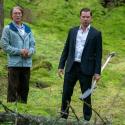
 Spike’s uncharted Northumberland riffs on Planet of the Apes’ Statue of Liberty with a pyramid-eternal Angel of the North, busted Shell sign lacking its “s”, cannibal-roamed Happy Eater and permanently delayed, rat-ridden train. He is seeking Dr. Kelson (Ralph Fiennes, pictured above with Williams), nicknamed Kes (Ken Loach’s film inspired Garland’s unsentimental education of this Northern boy) - and why not Kurtz, as he sets fires amid skull mountains, daubed in “prophylactic” gore. Fiennes’ patrician tones are still solicitously attentive in the best NHS manner, and Boyle’s nurse-valorising Olympics survives in this blasted Britain's pre-Thatcher kindness and albeit suspect working-class solidarity.
Boyle’s propulsive direction revels in low angles and chaotic low-res melees in this wild North. His idea-laden thrill-ride provides bloody catharsis, and perhaps in its promised sequels a corrective, to a present Britain primed to retreat into a wearily cannibalised fictive past. As Trainspotting’s Renton might say with less irony now, Spike chooses life, despite the undead.