A curtain rises at the start of Joe Wright’s thrilling film version of Anna Karenina only for the finish several hours later to be accompanied in time-honoured fashion by the words “the end”. But for all the deliberate theatrical artifice of a movie about a society that knows a thing or two about putting itself on display, the delicious paradox of the occasion is this: in framing his Tolstoy adaptation as if it were a piece of theatre, Wright has made the least stagey film imaginable.
Staginess, in any case, has less to do with sets than a state of mind, and there’s no doubt from the off that Wright, his screenwriter Tom Stoppard, and a (mostly) first-rate cast are on the same page when it comes to capturing anew the dynamism and sweep of their source material. In some ways, one is reminded here of what Stephen Daldry achieved in his groundbreaking stage revival of An Inspector Calls: a potentially fusty piece reclaimed for keeps by an approach whose gutsy, visceral feel coexisted with a belligerent theatricality.
For all the ingenuity of a visual landscape there’s nothing pretty or falsified about the human ache on view
And like Daldry, Wright and Stoppard are fully at home across the two art forms, Wright having grown up within the milieu of the Little Angel puppet theatre in Islington before the cinema came to call. (The filmmaker, incidentally, has just announced his London stage directing debut, to take place next year at the Donmar.) If anything, the heightened emotions on view in this re-telling of Anna’s doomladen tale are amplified by our awareness of the constructed world around her: you gasp at the impossibly beautiful visuals not just as aesthetic glories in themselves but at the degree to which they seem cruelly to mock the enduring mess that these characters make of love.
 At one point, the fluttering of Anna’s fan gives way to the sound of thundering hooves, just as a torn letter is seen morphing into snow: such aural and visual elisions are rife. But for all the ingenuity of a visual landscape befitting a populace used to comparably high-definition lives, there’s nothing pretty or falsified about the human ache on view.
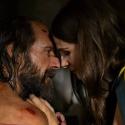
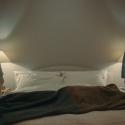
At times, the conceit tilts toward the merely glossy: a post-coital shot of Keira Knightley’s Anna intertwined with Aaron Taylor-Johnson’s Vronsky (both pictured above) suggests an ad for Toast bedlinen. And Taylor-Johnson throughout plays a callow character callowly, which mutes the shifting emotions of the piece. But for the most part Seamus McGarvey’s camera work and Sarah Greenwood’s production design – both Oscar contenders, for sure – bring ravishingly to life a world of self-styled opulence and the meltdown that occurs when one tumbles from the pedestal that money and status can buy: this freefall is brilliantly realised in a scene at the opera in which Anna’s gathering shame trumps anything that the Russian haut-monde might actually be watching on stage.
 Nor, as is sometimes true of such ventures, do the actors come second to the concept. Knightley may not possess the burnished splendour that Helen McCrory brought to the title heroine some while back on TV, but she cuts a compelling figure of fatalism, a woman alive to the imminence of her own death.
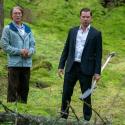
Amid a cast that includes a movingly indrawn Domhnall Gleeson, plumped-up Matthew Macfadyen, and magnificently snappish Olivia Williams, Jude Law (pictured above) gives the standout performance as Karenin, knuckles cracking as this cuckolded public figure tries not to give way to hate. Eyes hardening against a wife whom he watches in every sense slip from view, Law is the coolly commanding centre of a white-hot film. Is this were happening in a playhouse, the night’s largest ovation would be his.
Karenin's warning: watch a clip from Anna Karenina