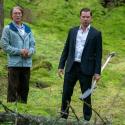
Chris Petit's Radio On, his 1979 debut as writer-director, should be regarded as the first British psychogeography film. Though its protagonist, Robert B (David Beames), a DJ for the United Biscuits Network, drives from London to Bristol in his two-tone Rover to investigate why his brother has killed himself, his journey extends beyond his half-hearted sleuthing and carries him into as many liminal spaces in his psyche as the real ones in which he lingers during his journey.
Unfolding over a few wintry days centred on Saturday, 10 March 1979, Radio On is often painted as bleak, which is not quite accurate. B may end up as lonely and alienated at the end as he is at the beginning, when his live-in girlfriend (sullenly played by Sue-Jones Davies, a future mayor of Aberstywyth) leaves him, but there are grains of hope in some of the human connections he makes in transit. His offhand chat with a Wiltshire petrol pump attendant (pre-fame Sting) and singer who's obsessed with Eddie Cochran – killed in a car crash nearby in 1960 – is conducted in the language of rockabilly lovers and isn't, therefore, meaningless, even though the wannabe star pointedly remarks they won't meet again.
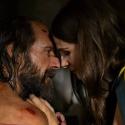
B's temporary friendship with a German woman (Lisa Kreuzer), whom he helps on her quest to recover her young daughter from her estranged husband, isn't pointless either because meeting her, a fellow traveller in loss and sorrow, elicits his compassion. Her apparent disappointment that they didn't sleep together the evening they met is mitigated by the smiles she gives B as she drives him back to his brother's flat after a visit to see her antagonistic émigré aunt in Weston-super-Mare. The brother's girlfriend (Sandy Ratcliff), whose angry, can't-be-bothered tone suggests she's in denial, is kinder to B at the end of their acquaintance than she had been when he arrived. People being unreliable, B can, in any case, succour himself with the pocketful of Kraftwerk cassettes his brother sent him before dying.
 Included on this BFI release are fresh interviews with Petit and producer Keith Griffiths and a lively, informative spiel on the film by critic-author Jason Wood, a road movie specialist and Radio On fanatic. Wood explains how Petit's discovery of Kraftwerk engendered the film as a music-driven piece that prioritised driving, architecture (Ballardian high-rises, the Westway flyover), weather, and late '70s English dystopianism – relayed through radio news bulletins about Northern Ireland and a police sweep of a West Country porn ring Robert's brother may have belonged to – over character and story. Nonetheless, the performances of Beames, Ratcliff and Kreuzer are charged with suppressed emotion, the long-held shots of B cogitating his brother's demise and his own existential void being especially effective.
In contrast, Andrew Byatt played the Glaswegian Army deserter given a ride by B as a lit fuse. His bitter tale of ejection from school at 15, unemployment, soliciting, theft, and PTSD-inducing experiences on his tours in Belfast is a paradigm of the government's betrayal of young men.
A former Army brat in Germany and Time Out's film editor when he wrote the screenplay, Petit was influenced by Antonioni, Two-Lane Blacktop, Get Carter, Perfomance, and the desire to make a film that would be nothing like Mike Leigh's Abigail's Party – or anything traditionally British. He adopted the style of New German Cinema, specifically Alice in the Cities and Kings of the Road, the black-and-white entries in Wim Wenders's masterful Road Trilogy.
Wenders boarded Radio On as an associate producer and co-financier, asked Petit to write a part for Kreuzer (then Wenders's wife, who channelled her Alice in the Cities character), and loaned him his sound man Martin Müller and cameraman Martin Schäfer, assistant to Wenders's cinematographer Robby Müller. Radio On's beauty and Wenders-like ennui, illustrative of sociopolitical and spiritual malaise, owes greatly to the two Martins, who also insisted Petit film Sting performing Cochran's "Three Steps to Heaven"; intending to omit the scene, an affecting homage, Petit mercifully retained it. As well as Kraftwerk (whose "Uranium" fizzes demonically at ominous moments), the searing diegetic soundtrack's contributors include David Bowie (the Anglo-German version of "Heroes"/"Helden" used as a harbinger of tragedy), Robert Fripp, and the Stiff label's Wreckless Eric, Lene Lovich, Ian Dury, and the Rumour.
Radio On set a course for radical, advanced British road movies no one bothered to follow (or knew how to). Only Andrew Kötting's Gallivant – less concerned with the road than destinations and beloved family members – is a comparable English travel film. (Richard Eyre's The Ploughman's Lunch, written by Ian McEwen, is an excellent if stylistically conventional anti-Thatcher road movie.) The miracle of Radio On is its timelessness. No less now than in 1979, it makes you "feel in touch with the modern world," to cite the Jonathan Richman song "Roadrunner", from which Petit plucked his title. Trouble is, modern life is rubbish.