In Concerning Violence Göran Hugo Olsson has created an almanac documentary drawing on material from Swedish television archives, filmed by a number of directors in Africa, largely in the 1970s. It’s fascinating footage, covering a number of perspectives on what was happening in the continent over that decade, from the frontline guerilla wars with the MPLA in Angola and FRELIMO in Mozambique, to industrial unrest in Liberia, and apparently matter-of-fact interviews with white settlers in Rhodesia and elsewhere.
But Olsson’s masterstroke, which gives this diverse material a uniting context, is to use it as illustration to texts drawn from Frantz Fanon’s The Wretched of the Earth, the Martinique-born revolutionary philosopher’s final work (it was published in 1961, the year of Fanon’s early death at the age of 36, and was immediately banned in France). Fanon’s subject throughout his writing was the impact of colonisation, and the process of decolonisation, in which he was actively involved himself, principally in Algeria.
 A crucial part of Fanon’s discourse was the role of violence, and the right of the colonised people to use it against the colonisers. As one phrase in the film has it: “Colonialism is violence in its natural state, and it will only yield when confronted with greater violence.” It’s variations on that theme that recur throughout in the voice-over narration by Lauryn Hill (sometime of the Fugees). Hill’s tone seems right, catching the elements of angry poetry in Fanon’s otherwise restrained style; whether or not the director’s decision to also put certain text extracts up on screen in large phrases is justified or not looks a moot point – it risks drumming the point home to excess, as well as detracting from the visual impact of the footage itself.
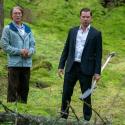
Olsson’s previous film was The Black Power Mixtape 1967-1975, another compilation of found footage from Swedish television about the Black Power movement, and he’s said how that film ended in the mid-Seventies because Swedish attention shifted towards Africa and the liberation struggles taking place there. Sweden may have been nominally neutral, but its tacit support for the ANC in South Africa surely gave the country’s television journalists whose work we see here access to the revolutionary movements. The first of Olsson’s “Nine Scenes from the Anti-Imperialistic Self-Defense” is an embedded journey through the jungle (main picture) with the MPLA in Angola in 1974 to attack and capture a Portuguese fort, filmed in best handheld reportage style.
 But there’s considerable variety in what we see, and the range of material runs far beyond such actual conflict and its background structures (behind the liines with FRELIMO in Mozambique, 1971, pictured above left). Another episode from earlier, 1966, catches a moment of industrial unrest at a mine in Liberia, a facility that was itself Swedish-run and where a television crew happened to be when the strikes started. The result is a full short film, which conveys the situation as it unfolded, complete with interviews with the seemingly mild Swedish management (and even with the president of the country). It culminates with the eviction of a group of strike-leaders and their families from the territory: they’re driven an hour away from the mine, then just left at the roadside, complete with furniture, to fend for themselves.
It's matter-of-factly cruel to watch, and it makes you wonder just what perspective exactly the filmmakers were expressing at the time, and how much we are attributing a modern perspective to material that was shot decades ago. That’s an issue with interviews with the colonists themselves (a Swedish missionary couple in Tanzania, pictured above right), particularly in the then Rhodesia, where we see the full rituals of late colonial life, playing bowls on trim lawns and the like, and feel a sheer smugness in the air – is the irony conscious? It’s hard to watch an interview with an outright apologist for the colonial order, who speaks of “gooks”, “terrs” and “Affies”, and wonder whether the interviewer was setting him up. It’s all a matter of where you pass your judgment. Olsson’s film repays attention for exactly the fact that it raises such questions, rather than answers them.
- Concerning Violence is on limited national release from Friday November 28. Goran Olsson will be present for a Q&A for an advance screening at Curzon Soho tonight Monday November 24.
Overleaf: watch the trailer for Concerning Violence